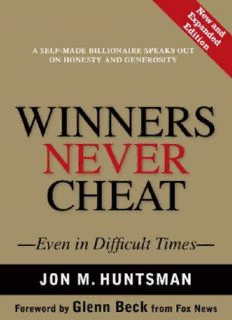
Table Of ContentWinners Never Cheat
Even In Difficult Times
Jon M. Huntsman
Vice President, Publisher: Tim Moore
Associate Publisher and Director of Marketing: Amy Neidlinger
Editorial Assistant: Pamela Boland
Operations Manager: Gina Kanouse
Digital Marketing Manager: Julie Phifer
Publicity Manager: Laura Czaja
Assistant Marketing Manager: Megan Colvin
Cover Designer: Chuti Prasertsith
Managing Editor: Kristy Hart
Senior Project Editor: Lori Lyons
Copy Editor: Water Crest Publishing
Proofreader: San Dee Phillips
Interior Designer and Compositor: Gloria Schurick
Manufacturing Buyer: Dan Uhrig © 2009 by Pearson Education, Inc.
Publishing as Prentice Hall
Upper Saddle River, New Jersey 07458
Prentice Hall offers excellent discounts on this book when
ordered in quantity for bulk purchases or special sales. For more information,
please contact U.S. Corporate and Government Sales, 1-800-382-3419,
[email protected]. For sales outside the U.S., please contact
International Sales at [email protected].
Company and product names mentioned herein are the trademarks or
registered trademarks of their respective owners.
All rights reserved. No part of this book may be reproduced, in any form or by
any means, without permission in writing from the publisher.
Printed in the United States of America
Fourth Printing November 2010
Fourth Printing November 2010
ISBN 10: 0-13-700903-8
ISBN 13: 978-0-13-700903-9
Pearson Education LTD.
Pearson Education Australia PTY, Limited.
Pearson Education Singapore, Pte. Ltd.
Pearson Education North Asia, Ltd.
Pearson Education Canada, Ltd.
Pearson Educación de Mexico, S.A. de C.V.
Pearson Education—Japan
Pearson Education Malaysia, Pte. Ltd.
Library of Congress Cataloging-in-Publication Data
Huntsman, Jon M.
Winners never cheat : even in difficult times / Jon M. Huntsman.
p. cm.
Rev. ed. of: Winners never cheat : everyday values that we learned as children
(but may have forgotten). 2005.
ISBN 0-13-700903-8 (hbk. : alk. paper) 1. Business ethics. 2. Success in
business—Moral and ethical aspects. 3. Executives—Conduct of life. 4.
Huntsman, Jon M. 5. Businessmen—United States—Biography. I. Title.
HF5387.H863 2009
174’.4—dc22
2008041502
TO KAREN,
MY PARTNER AND
BEST FRIEND.
Contents
Foreword by Glenn Beck
Introduction Good Times, Bad Times
Circumstances may change but your values shouldn’t.
Chapter One Lessons from the Sandbox
Everything we need for today’s marketplace we learned as kids.
Chapter Two Check Your Moral Compass
We know darn well what is right and wrong.
Chapter Three Play by the Rules
Compete fiercely and fairly—but no cutting in line.
Chapter Four Setting the Example
Risk, responsibility, reliability—the three Rs of leadership.
Chapter Five Keep Your Word
It’s high time to corral the corporate lawyers.
Chapter Six Why We Cross the Line
There are many temptations, but reminders help.
Chapter Seven Pick Advisors Wisely
Surround yourself with associates who have the courage to say no.
Chapter Eight Get Mad, Not Even
Revenge is unhealthy and unproductive. Learn to move on.
Chapter Nine Graciousness Is Next to Godliness
Treat competitors, colleagues, employees, and customers with respect.
Chapter Ten Your Name Is on the Door
Operate businesses and organizations as if they’re family owned.
Chapter Eleven The Obligation to Give Back
Nobody is completely self-made; return the favors and good fortune.
Chapter Twelve The Bottom Line
Acceptable values are child’s play, not rocket science.
Perspective from Larry King
Perspective from Neil Cavuto
Perspective from Wayne Reaud
Acknowledgments
I wish to convey my great appreciation to Jay Shelledy, a professional writer and
editor, who challenged and organized my thoughts and helped convert them to
the written word, and to Pam Bailey, my dedicated and loyal administrative
assistant who eased the hassle with those astounding and generally unknown
complexities of writing a book.
I also desire to thank deeply the professionals at Prentice Hall: Vice President
and Publisher Tim Moore, and Associate Publisher and Director of Marketing
Amy Neidlinger, for their initial faith and encouragement that I publish an
updated version; and Operations Manager Gina Kanouse for her valuable
suggestions on this edition. Thanks also goes to Pearson Education Senior Vice
President of Sales and Marketing Logan Campbell, and Marketing Director John
Pierce, for their unwavering commitment to and patience with a first-time
author; Development Editor Russ Hall, for clear and candid critiques; Managing
Editor Kristy Hart, and Copy Editors, Keith Cline and Sarah Kearns, for their
swift, quality-enhancing suggestions to and the preparation of my manuscript;
and Wharton School administrators, faculty, and students for their longstanding
support in this and other endeavors.
I would be especially remiss if I did not acknowledge the contributions of Larry
King, whose gracious Introduction set the tone for what follows; of Neil Cavuto,
for his kind Afterword and whose own book, More Than Money, provided
inspiration; Glenn Beck, for his kind and humbling Foreword; and of trial lawyer
extraordinaire, Wayne Reaud, for his humbling Preface. They are more than just
successful professionals, highly respected by their peers; they are friends of
mine.
I am indebted to my mother and other family members—living and deceased—
for providing models of kindness and decency, and to my late father-in-law,
David Haight, who always believed in me.
My greatest debt, however, is reserved for my spouse, Karen, our 9 children, and
58 grandchildren for providing me with 68 convincing reasons why a person
ought to stay the proper course.
—J.M.H.
About the Author
Jon M. Huntsman is chairman and founder of Huntsman Corporation. He
started the firm with his brother, Blaine, in 1970. By 2000, it had become the
world’s largest privately held chemical company and America’s biggest family-
owned and operated business, with more than $12 billion in annual revenues. He
took the business public in early 2005. He was a special assistant to the president
in the Nixon White House, was the first American to own controlling interest of
a business in the former Soviet Union, and is the chairman of the Board of
Overseers for Wharton School at the University of Pennsylvania, his alma mater.
Mr. Huntsman also has served on the boards of numerous major public
corporations and philanthropic organizations, including the U.S. Chamber of
Commerce and the American Red Cross. The Business School at Utah State
University is named after him, as is the basketball arena at the University of
Utah. The Huntsman businesses fund the foundation that is the primary
underwriter for the prestigious Huntsman Cancer Institute in Salt Lake City,
which he founded. The hospital/research facility has become a leader in the
prevention, early diagnosis, genetic legacies, and humane treatment of cancer.
He resides with his wife, Karen, in Salt Lake City. His oldest son, Jon Jr., is
governor of Utah.
Foreword
There is a good chance that you’ve never heard of Jon Huntsman. He shuns the
spotlight, doesn’t like to talk about himself, and likes it even less when others
talk about his good works. If you’ve ever used a plastic plate, bowl, dish, or
Styrofoam take-out food container, you have Jon Huntsman to thank. His
company was the first to develop these products, along with the first plastic egg
carton, the original Big Mac container, and plastic fork and spoon. The small
business he started with his brother in 1970 became the largest privately held
chemical company in the world.
Jon Huntsman’s true legacy, however, isn’t the multi-billion dollar company he
built or how he revolutionized how we live with what he created, but his
unwavering honor, integrity, and generosity in every aspect of his professional
and personal life. In an era of high-priced lawyers and accountants always
looking for the latest legal loophole or tactical advantage, Jon Huntsman has
done business on a handshake. Deals valued in the hundreds-of-millions of
dollars were negotiated and concluded, literally, with nothing more than both
parties looking each other in the eye and shaking hands. That is Jon Huntsman’s
reputation and legacy.
To many people, this will be nothing more than a quaint anecdote or a nostalgic
reminder of how life used to be. They argue that Jon Huntsman is a man made
for a different and simpler time. I would argue that we are a people out of place.
Jon is currently living the life that all of us want to live, but somehow too many
people have convinced themselves that business and relationships just aren’t
conducted this way anymore.
They couldn’t be more wrong!
I first met Jon Huntsman on a visit to Utah when a mutual friend arranged for us
to have lunch together. I really didn’t know a lot about Jon Huntsman, but I
knew he was a self-made man and a multi-billionaire. How could I turn down
lunch with a multi-billionaire? When I was told we would be having lunch at a
hospital cafeteria, I thought it wasn’t exactly the lifestyle of the rich and famous,
but I soon came to realize that the cafeteria at the Huntsman Cancer Institute is
not your typical cafeteria.
Description:Author royalties from this book go to the Huntsman Cancer Foundation "The way Jon conducts his business and lives his life will not only inspire you to be a better person, citizen, and entrepreneur, it also will give you hope that the good guys don't finish last." Glenn Beck, CNN "Jon Huntsman is a