Table Of ContentsightLine
Spring 2015
Wilmer Eye Institute at Johns Hopkins
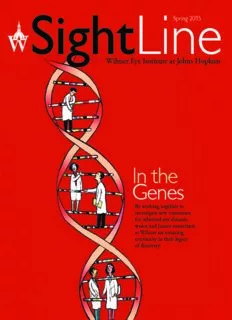
In the
Genes
By working together to
investigate new treatments
for inherited eye diseases,
senior and junior researchers
at Wilmer are ensuring
continuity in their legacy
of discovery.
c
a
ontents
s see it
Insight
3
‘Bionic Eye’ Brings Sight
to the Blind
An artificial retinal implant is taking patients
PhO out of blackness and into the light.
tO by Dear Wilmer Friends and Family,
k
EIt 4 Insight
h
w In July, the Wilmer Eye Institute Innovations Strengthen
EllER will celebrate its 90th birthday. Dr. Residency Training Program
William Holland Wilmer started us on A revamped curriculum is already bearing
a marathon course to alleviate human fruit among Wilmer’s residents.
suffering from eye disease, predicated
on the strategy that the most progress 6 Insight
would be made by putting together Start Me Up
patients, expert clinicians, great Thanks to a thriving “ecosystem of
scientists and stellar young students. innovation,” Wilmer entrepreneurs are
Our mission is as important today as more quickly moving their discoveries from
it was then, with a recent survey of the the lab to the marketplace.
American public revealing that fear of blindness is the No. 1 health
concern in the United States, ahead of cancer, dementia and AIDS. 8 Impact
Changing Lives in Africa
Following Dr. Wilmer’s prescription, Wilmer finds itself in the
From Ethiopia to Zambia, a Wilmer team is
homestretch toward the end of its first century in a remarkably
working to provide affordable, high-quality
healthy position. With 144 full-time faculty; 1,000 of the most
cataract surgery to those who need it most.
dedicated nurses, technicians and staff; 40 endowed professorships;
the most brilliant young trainees; facilities that are second to none in
the world in size (greater than 500,000 square feet) and functionality; 13 Impact
Chairs Around the World
and active collaborations around the world, Wilmer has never had a
Wilmer trainees are making their marks at
greater scope and global reach.
prestigious eye institutes across the globe.
What makes it seem as though we are now in a sprint is the dramatic
growth we’ve seen at Wilmer. Experiencing the demographic tidal 14
Cover Story
wave of the baby-boom generation, Wilmer’s clinical practice will
In the Genes
once again go through double-digit percentage growth this year
By working together to investigate new
as patients travel here from every state, as well as from 84 foreign
treatments for inherited eye diseases,
countries. In the realm of discovery, you will read about studies of
senior and junior researchers at Wilmer
gene therapy and stem cells to treat patients with disease. These
are ensuring continuity in their legacy of
therapies have moved from the laboratory to our patients. The so-
discovery.
called retina chip was conceived by Wilmer faculty years ago, and
today they are inserting these now Food and Drug Administration- 18 Eye to Eye
approved devices into patients here in Baltimore and at the King
Collaborating to Build Better
Khaled Eye Specialist Hospital in Saudi Arabia, the first hospital
Tools for Microsurgery
in the Middle East to provide this technology. In a dramatic
Grateful patient Bill Marriott has lent his
demonstration of scientific acceleration, the light-sensing “retina in a
support to the high-tech efforts of Peter
dish” developed under the leadership of Maria Valeria Canto-Soler,
Gehlbach and others working on “Star Wars
Ph.D., promises that before long, we will have the ability to literally
kind of stuff.”
replace the eye in patients who are blind.
As Wilmer enters the final decade of its first century, those of us who Events
20
work here today enjoy the benefits of the wisdom and work of those Wilmer Residents Association Reception, Dr.
who came before us—the marathon—plus the exhilaration of the Arnall Patz Endowed Professorship for the
incredibly rapid pace of biomedical innovation—the sprint—and the Lions Low Vision Center Commemoration
almost daily increase in our ability to improve the lives of those the and more.
world over.
Awards
22
Honoring Wilmer’s finest.
Peter J. McDonnell, M.D.
William Holland Wilmer Professor and Director
COVER IllustRatIOn by
sElçuk DEmIREl
2
SightLine SPRING 2015
i
nsight
James Handa in surgery
‘Bionic Eye’ Brings Sight to the Blind
E
lias “Louie” Konstantopoulos loves his morning been instrumental in both the selection of patients and in
routine. He ambles to the driveway and picks up their ongoing rehabilitation. Last year, the Food and Drug
the newspaper for his wife. Some days, he counts Administration approved the device. To date, 100 or so
the cars that pass. Though it sounds like any people worldwide have had it implanted.
pedestrian American morning, it is anything but “Patient selection is really critical to success. Louie is an
mundane because Konstantopoulos has been blind since engineer and very astute, but he’s still learning. Early on, he
1998. Retinitis pigmentosa robbed him of his sight. could see the cars, but that was about all. Now he can tell
The fact that Konstantopoulos can complete his routine a light car from a dark one,” says James Handa, M.D., the
without assistance is nothing short of a miracle. It was made Robert Bond Welch, M.D., Professor of Ophthalmology
possible by an operation at the Wilmer Eye Institute in June at Wilmer and the surgeon who implanted the device in
2009, in which an artificial retinal implant was inserted in Konstantopoulos’ eye.
his eye. Dagnelie oversees Konstantopoulos’ “brain training,”
The implant brings science fiction to life—a true “bionic teaching him how to recognize the images being transmitted
eye.” Konstantopoulos sports a pair of dark glasses fitted to his retina. “He can see shapes, shadows, the contrast
with a camera and a belt-pack computer that beam signals between dark and light colors, and has some depth
to a grid of electrodes at the back of his eye. The electrodes perception. A far cry from the total blackness that was his
stimulate cells in his retina and optic nerve, which carries world for years,” Dagnelie says.
the signals from his retina to his brain. Each electrode in the The company that makes the implant is now working on
implant’s modest 60-pixel array can convey about a dozen a version with 240 pixels—four times the resolution of the
shades of gray. current model—but Dagnelie cautions patience. It will take
The implant allows Konstantopoulos to discern the edge time. “There is a lot of research remaining to learn how to talk
of his sidewalk against a dark green lawn. He can make out to the retina. It’s really very early for this technology,” he says.
the white newspaper against the driveway blacktop. He can In the meantime, Handa is emboldened by the results.
watch the blur of cars that pass. He can see again. He tells of a woman in Los Angeles who, thanks to the
“The patient sees dots of light in various shades of gray implant, took in the moon over the Pacific Ocean and
that allow him to see,” explains Gislin Dagnelie, Ph.D., watched the moonbeams dance on the crashing waves below
an associate professor at Wilmer and the associate director for the first time in 30 years.
of the Lions Vision Research and Rehabilitation Center. “That was a moving experience,” he says. ■
Since clinical trials of the implant first began in 2007, —Andy Myers
Dagnelie has been the principal investigator, and he has
3
410-955-5080 SPRING 2015 SightLine
i
nsight
Innovations
w
hen Divya Sriku- Previously, residency programs were
maran, M.D., be- required to demonstrate only that
Strengthen
came program di- specific training objectives were
rector of Wilmer’s included. Now, they must also show
residency program that results are being achieved; a set of
Residency
in 2012, it was like stepping onto a milestones requires residents to reach
moving bus: Big changes—both inter- certain levels of knowledge and skill
Training nal and external—were sweeping the as they move through the program,
program. So the assistant professor of with assessments every six months to
ophthalmology grabbed the wheel and measure their progress.
Program began to steer the residency in which The changes caused Srikumaran
she herself had trained years earlier. and her team to begin restructuring.
The changes were both quantitative They revamped the curriculum to
and qualitative, and they would result suit the smaller number of residents,
in a more engaging program, happier shifting schedules to balance patient
residents and better patient care, needs with training requirements
Srikumaran says. On the numbers and making better use of precious
side, Wilmer’s program was shifting time with faculty. For example, many
from seven residents a year down to lectures are now recorded so that
five as it ended an affiliation with residents can view them independently
an outside hospital. Meanwhile, the and spend face-to-face time interacting
Accreditation Council for Graduate with the faculty. Wilmer hired a
Medical Education had reduced the physician assistant to provide extra
number of hours that residents may coverage in the emergency room and
work per week and per shift, in an inpatient wards to assist residents,
effort to address fatigue as a cause of allowing the residents to spend more
medical errors. time in the operating room and pursue
The council also had introduced other educational opportunities. Last
significant programmatic changes. December, the team assessed residents
4
SightLine SPRING 2015
Residency program leaders Fasika
Woreta, Divya Srikumaran and
against the new milestones for the first measure their progress against the Nick Mahoney, center, with Wilmer
time—the first step in ensuring they milestones and determine whether residents and faculty.
are providing what residents need to they have developed the skills to
learn, and that individual residents are take on additional responsibilities. materials in one place. Assistant
meeting expectations. For example, first-year residents professor of ophthalmology and
Because a residency program is practice microsurgical techniques in newly appointed associate program
central to a department as a whole, the the low-pressure, simulated setting director Fasika Woreta, M.D.,
changes are expected to reverberate of a practice lab. The work is done M.P.H., supervises the cornea and
beyond the program itself. “A strong under faculty supervision using cataract curriculum—the cornerstone
residency program definitely makes a stepwise curriculum. Once the of ophthalmology training. Also,
the whole department shine,” residents demonstrate competence, Shameema Sikder, M.D., assistant
Srikumaran says. they progress to performing supervised professor of ophthalmology, worked to
The results are in and show that surgery on patients. develop the microsurgical curriculum
Wilmer’s changes are already bearing Srikumaran has had plenty of and will lead the new Center of
fruit. Residents are logging more time help planning and implementing the Excellence in Surgical Innovation and
side by side with faculty—the heart innovations. One change began before Education, which promises to offer
of a resident’s experience—allowing her arrival, when associate professor even more opportunities for surgical
faculty to better help them set of ophthalmology Pradeep Ramulu, simulation and training.
individual goals and to mentor them M.D., Ph.D., piloted a new approach The changes have received financial
along that path. Residents also enjoy to didactics, introducing case-based support from Raymond Nichols, chair
more of the spontaneous moments teaching scenarios immediately and CEO of asset management firm
with their mentors that help form following Grand Rounds in lieu of BSC America, who was impressed
professional values and identities. the traditional lecture format. Nick when he learned of Srikumaran’s
“These opportunities come through Mahoney, M.D., assistant professor of work. “I saw what she was doing, and
off-the-cuff interactions; you can’t ophthalmology and newly appointed I thought it was something I wanted
force that chemistry,” Srikumaran says. associate program director, has to allocate funds to and help out,”
A clinical competency committee organized the milestone assessment Nichols says. ■
of four or five faculty members process and is currently creating a —Rachel Wallach
reviews residents’ assessments to website to house all resident education
5
410-955-5080 SPRING 2015 SightLine
Start
Me Up
Thanks to a thriving “ecosystem of innovation,”
Wilmer entrepreneurs are more quickly moving
their discoveries from the lab to the marketplace.
People at Wilmer refer to themselves as many things—
doctors and scientists, engineers and administrators, staff
and residents—but these days a growing number are
adopting an altogether different title: entrepreneur.
“The ideas flowing out of Wilmer have the power to
change lives, and Johns Hopkins is trying to help more
of these new discoveries and inventions become products
with the potential to transform patients’ lives,” says
Christy Wyskiel, a veteran life sciences investor who has
recently taken up the mantle as senior adviser for enterprise
development to Johns Hopkins University President
Ronald J. Daniels. She’s the driving force behind Johns
Hopkins Technology Ventures (ventures.jhu.edu).
Wyskiel’s job is to see that more of the transformational
ideas pouring out of Wilmer and other areas at Johns
Hopkins ascend to commercial viability, and that more
faculty, staff and residents become leaders in businesses—as
well as in their chosen medical fields.
One such company that Wyskiel was familiar with
before she came to Johns Hopkins is GrayBug, started by
Justin Hanes, Ph.D., a chemical and biomedical engineer
at Wilmer. Hanes has developed promising new nanoscale
drug delivery technologies to treat glaucoma, age-related
macular degeneration and other eye diseases. GrayBug is
developing new ways to deliver existing drugs, many of
which must currently be injected directly into the eye on an
all-too-regular basis.
Hanes and two other co-founders from Wilmer, Peter
Campochiaro, M.D., and Peter McDonnell, M.D., have
generated $5 million in startup funding for GrayBug.
“GrayBug’s technology acts like a time-release
mechanism with the potential for reducing the shots to
66
SightLine SPRING 2015
It can take a village to raise a company, and
FastForward is an important part of our village.
— Jordan Green, Ph.D.
once every four to six months or even less frequently,” Wilmer and also an entrepreneur, has seen a dramatic
Hanes says. “GrayBug and companies like it are products shift in the startup spirit at Johns Hopkins since she
of the ecosystem of innovation at Wilmer and the emphasis started her first venture in 2004. Her company, Aegeria, is
President Daniels has placed on entrepreneurship.” partnering with other companies to develop technologies
The startup culture is alive and well throughout and is working in collaboration with the Armed Forces
Wilmer, from the most nascent ideas to the more mature. Institute of Regenerative
Among the programs established at Johns Hopkins to Medicine on craniofacial
foster entrepreneurship is FastForward, a technology reconstruction.
accelerator that gives emerging technologies a much-needed Aegeria has been
commercial boost. making headlines, for
“It can take a village to raise a company, and instance, using tissue
FastForward is an important part of our village,” says regeneration to develop
Jordan Green, Ph.D., an associate professor of biomedical bioadhesive “glues”
engineering at Wilmer and one of the co-founders and membranes to heal
of AsclepiX Therapeutics LLC, which moved into traumatic eye injuries
FastForward last year. without scarring or tissue
AsclepiX was founded by Green and Aleksander rejection.
Popel, Ph.D., professor of biomedical engineering, to “Wilmer is bustling
commercialize their research with Campochiaro on new with innovative ideas,
peptide-based therapies to treat conditions ranging from a young faculty and a
“ Johns Hopkins is trying to help
degenerative eye diseases to cancer. competitive environment,
more of these new discoveries
AsclepiX drugs and their delivery systems block the and the university is and inventions become
activity of growth factors that cause new blood vessels to preparing soil for these products with the potential to
form, reduce fluid leakage and enable the regression of companies to grow. It’s a real transform patients’ lives,” says
abnormal vessels in the eye. cultural change,” Elisseeff Christy Wyskiel.
A second FastForward facility, FastForward East, says. She served on the
opened recently in the Rangos Building in the Science + Innovation Committee that generated a report describing what
Technology Park at Johns Hopkins, near the school of a robust ecosystem around Johns Hopkins could look like.
medicine. It provides startups with lab and office space, Says Wyskiel: “A great idea in the lab is only an idea
and, perhaps more importantly, offers mentorship and until it can help the people who need it. They have to
business advice that are often out of reach of most startups. become products first. Our mission at Wilmer, and at
“FastForward helped AsclepiX Therapeutics obtain Johns Hopkins as a whole, is to see more of these ideas
physical space, including chemistry and biology wet lab reach commercial success so we can change lives.” ■
space, for our full-time researchers to work,” Green says. —Andrew Meyers
Jennifer Elisseeff, Ph.D., a biomedical engineer at
7
410-955-5080 SPRING 2015 SightLine
Changing Lives
in Africa
By Joan Katherine
Cramer
8
SightLine SPRING 2015
karun arora
graduated from the Johns hopkins university
in 2010 with honors, a degree in biophysics—and a dream.
he had an obvious passion for scientifi c research, but he
wanted to take it out of the lab and make a direct and lasting
diff erence in the lives of as many people as possible.
Last summer, thanks to a gift from Roberta 2011 Hilton Foundation grant to explore the issue,
Heath and the sponsorship of mentor David S. Sommer enlisted Friedman—who is well known
Friedman, M.D., Ph.D., who runs the Dana for his international work; see SightLine, Spring
Center for Preventive Ophthalmology at Wilmer, 2014—to coordinate the Dana Center’s role in the
Arora spent 45 days in sub-Saharan Africa living collaboration with Aravind and the African surgical
that dream. He was there with a team of doctors centers.
from the Dana Center and from India’s Aravind Eye Th e major obstacle to providing cataract surgery
Hospital—the largest eye hospital in the world—as in the region is fi nancial: the relatively high cost of
part of an ambitious project funded by the Conrad medical training, equipment and infrastructure. But
N. Hilton Foundation. Th e project’s goal: to it can also be a matter of getting people to trust the
promote aff ordable, high-quality cataract surgery in a surgical procedure and the surgeon.
region with limited access to this essential vision care. Consider the experience of Daniel Oira Kiage,
“It was a life-changing experience,” says Arora, a distinguished professor of ophthalmology at Aga
now a second-year medical student at Johns Hopkins Khan University Hospital in Nairobi. He was so
who chose to delay medical school for nearly three inspired by the Hilton Cataract Initiative that he
years so he could work as a researcher in Friedman’s decided to open a surgery center in his native Kisii,
clinic. “My job was to travel to the fi ve participating an underserved town of some 200,000 people in
cataract surgery centers in four countries—Ethiopia, southwestern Kenya. He developed an eye hospital
Kenya, Nigeria and Zambia—and collect data that using screening outreach camps modeled on those
will show us over time how well things are working, run by the Aravind Eye Hospital.
while Dr. Friedman and the team were observing and
assessing the systems.”
Th e Hilton Cataract Initiative is the brainchild of
In sub-Saharan Africa, about 90
Dana Center founding director Alfred Sommer,
M.D., M.P.H., who is also dean emeritus of the percent of patients who need
Johns Hopkins Bloomberg School of Public Health.
cataract surgery fail to receive it.
For many years, he wanted to do something about
the dearth of cataract surgeries—only about 10
percent of what is needed—in sub-Saharan Africa.
When the project began to come together with a
9
410-955-5080 SPRING 2015 SightLine
Kenya: Friedman, Arora and a senior member of
the Aravind Eye Hospital preparing for a screening
camp, above left; patients await treatment at an
outreach center, above center. A well-regarded
My job was to travel to the local woman off ers counsel on the benefi ts of
cataract surgery, above right.
fi ve participating cataract
surgery centers in four
countries—Ethiopia, Kenya,
But many of the people who clearly needed surgery
Nigeria and Zambia. refused to have it. One of the highlights of Friedman’s
visit to Kenya occurred when he and the team enlisted the
—Karun Arora
support of an obviously well-regarded local woman, who was
willing to explain the surgery to her neighbors who needed
it. Her endorsement of both the surgery and of Kiage’s
qualifi cations resulted in a high acceptance rate and led to
changes in counseling at the camps. “It was moving and eye-
opening,” says Arora.
“It was interesting how diff erent the challenges were in
diff erent centers,” he further notes. “In Kenya, Dr. Kiage has
top-of-the-line equipment but needs to make the surgery
aff ordable enough and/or build enough goodwill to create
the volume necessary to sustain his operation. In Ethiopia,
Dr. Gezahgn Fitsum Bekele is doing a huge volume of
surgeries, but there is no regional supplier of equipment
and no one to repair the equipment when it breaks down.
Additionally, all of the sites are being transitioned to an
electronic medical record system being provided by Aravind
so that better records can be kept and progress tracked over
time. So Aravind—and there is a lot of exchange going
on—has sent staff to the sites to provide particular expertise,
such as setting up the electronic medical record system and
training the local staff to use it, and has brought some of
the local staff members to Aravind to train them for various
10
SightLine SPRING 2015
Description:From Ethiopia to Zambia, a Wilmer team is working to provide .. collaboration with Aravind and the African surgical centers. philosophy and management approach, which includes a gentle . of patients will develop metastases,”.