Table Of ContentMichael Ploof
CHAPTER ONE
CHAPTER TWO
CHAPTER THREE
CHAPTER FOUR
CHAPTER FIVE
CHAPTER SIX
CHAPTER SEVEN
CHAPTER EIGHT
CHAPTER NINE
CHAPTER TEN
CHAPTER ELEVEN
CHAPTER TWELVE
CHAPTER THIRTEEN
CHAPTER FOURTEEN
CHAPTER FIFTEEN
CHAPTER SIXTEEN
CHAPTER SEVENTEEN
CHAPTER EIGHTEEN
CHAPTER NINETEEN
CHAPTER TWENTY
CHAPTER TWENTY-ONE
CHAPTER TWENTY-TWO
CHAPTER TWENTY-THREE
CHAPTER TWENTY-FOUR
CHAPTER TWENTY-FIVE
CHAPTER TWENTY-SIX
CHAPTER TWENTY-SEVEN
Michael Ploof
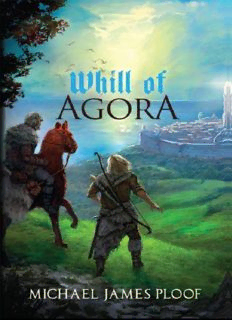
Whill of Agora
CHAPTER ONE
The Travelers
The full moon lingered like a magnificent pearl in an ocean of black. Fresh
snow gave a faint crunch as the riders’ horses made their way down the old road.
Cold, tired, and hungry, Whill and Abram rode silently toward Fendale.
Usually they would make camp with the setting of the sun, but not tonight.
The storm they had encountered the previous two days had set them back many
hours.
“We should still be in time for the Winter’s End Celebration,” Whill said.
“As long as we do not wander into another of those damned storms, we
should be plenty early,” answered Abram as he scoured the woods. Something
was on his mind, but Whill did not bother wondering what; he had thoughts of
his own. Like the feast they would enjoy the next night, and the music. The
Winter’s End Celebration of Fendale was always a great treat. It had been going
on as long as anyone could remember. People came from all surrounding towns
and villages to take part. Abram had brought Whill when he was only eleven
years old, and Whill had marveled at all the dancers, jugglers, acrobats, and
animal tamers that had performed. The knights of Eldalon had put on a mock
battle, and Whill sat in awe for hours watching them dual and joust. He had read
their history in the books Abram had given him as a young child. To see them in
person had been a surreal experience. The celebration had lasted all day and long
into the night. The food had been fit for kings, and the children had received
candy. Whill, now nineteen years old, was no less excited than he had been
when he was eleven.
“Do you think that King Mathus will attend this year?” wondered Whill.
Abram did not reply. He lifted his hand, motioning Whill to stop. Whill gently
slowed his horse and was about to ask what was wrong when Abram put a finger
to his lips.
Whill surveyed the surrounding forest, but he saw nothing but the
silhouettes of trees and the darkness beyond. Pine branches bent under the
weight of the snow, as did the birches, which in some spots bowed down almost
to the road. It was a world of white and black, shadows and moonlights. Minutes
passed, and still Whill neither saw nor heard anything. He looked over at Abram,
who sat like a statue upon his steed. Something indeed was wrong. Abram was
not suffering from his usual excess of paranoia: it was too quiet. Lost in his
thoughts of Fendale, Whill had not noticed, but now he did. In an almost
inaudible whisper, Abram told him to ready his bow. Whill did so as silently as
he could, with a sudden and intense feeling that someone was watching, waiting.
He resisted the urge to turn and look, but sat as still as he could, bow in hand, his
arrow ready. Abram had also readied his bow, and with a quick dart of his eyes
he indicated a part of the woods in front and to the left of himself. Whill peered
at the spot and at first saw nothing. Then he spotted sudden movement beyond
the trees. It was a strange black shape, quick and silent, darting from behind one
tree to hide behind another. It moved like a shadow, and Whill would have
mistaken it for one if not for the moonlight reflected in its eyes. Whill’s horse
gave a whine and began to stir, now alert to some danger. With a jerk Abram
turned to scowl at the scared beast, and as he did the forest erupted with
movement.
Abram hollered, “Ride, boy, ride!”
His heart hammering in his ears, Whill kicked the flanks of the horse,
which was eager to comply. Even as it began to speed into a full gallop, Whill
saw five black wolves dart out of the woods in front of them with alarming
speed. Without looking he knew that more raced at them from behind. Before he
could think he let loose an arrow at the closest wolf. With a cry the beast went
headfirst into the snow, an arrow protruding from its neck. Even before the
blood could flow, Whill had pulled another arrow as Abram took down another
of the approaching pack.
Instead of scaring the remaining beasts, the fall of the two wolves only
seemed to infuriate them. Baring teeth, they charged ever faster toward the
riders. In unison Whill and Abram let loose their arrows and dropped the two
closest wolves. Whill reached for another arrow to take down the last wolf when
suddenly two more wolves jumped at the legs of Abram’s horse. Teeth snapping,
they bit fiercely at its legs. A terrible cry issued from the horse as another wolf
attacked its front legs. Distracted by the attacking wolves, they had forgotten
about the oncoming wolf, which was now upon them. The wolf jumped up, jaws
snapping, into the face of Whill’s horse. Whill struggled to stay mounted and
lost hold of his bow. His horse reared, almost throwing him to the ground. Alert
to his trouble, Abram shot the wolf in the side as it rebounded and prepared to
lunge at the horse once more. Whill was now facing the right side of Abram’s
horse, whose legs were being ripped apart by the other three attacking wolves.
Abram’s horse jumped and kicked, trying to throw off the beasts, but they were
too many. Whill drew his sword, ready to charge, when another wolf attacked
his own horse from behind. He turned to see the wolf clawing its way up his
horse’s back, and with a swift blow he chopped its head clean off. He turned,
and to his horror he saw Abram’s horse go down under the wolves’ relentless
attack. The three attacking wolves then lunged forward as one onto Abram.
Jumping from his horse, Whill could not see Abram, only thick black coats of
matted fur thrashing and jerking where Abram had been.
With a cry Whill attacked with his sword. In a frenzy of slashing metal,
blood, and flying fur, he killed the wolves. In his fury he barely heard a low
growl behind him. He turned to see a nightmarish sight: six more wolves less
than ten feet away. They stood, hair raised, teeth bared, ready to attack. They
uttered low, menacing growls, all except the largest, which barked ravenously at
him. Whill knew why they hadn’t yet attacked. They were afraid.
Not knowing if Abram was alive or dead, Whill was not afraid but angry.
Rage welled in him and erupted into a primal scream. The wolves tensed and
backed a step. “Come on!” he screamed, challenging the wolves. “Come on!”
The wolves backed up, confused, looking at each other, at Whill, and at one
another again. Their mouths were closed. Then the large wolf answered Whill’s
challenge and charged straight at him, drool falling from his open mouth, and
lunged for Whill’s neck. Whill dropped to his knees, and as the wolf passed over
him he gutted the beast from neck to tail. The wolf landed in a dead heap.
Another charged, and Whill thrust his sword and impaled the beast with a
sickening crunch. Heaving the limp wolf to the side he ran at the remaining four,
eyes wild, his own growl now echoing through the forest.
With their leader dead, the wolves quickly retreated in the presence of this
fearless foe. Whill ran after them, actually wishing they would fight. He was so
enraged, he had forgotten about Abram.
As the wolves ran for the forest, Whill returned to his fallen friend.
Abram’s horse lay dying. Abram was pinned under the animal’s great weight,
and three more dead wolves lay atop him. Whill heaved the wolves off and was
devastated by what he saw. Blood covered every inch of Abram’s face. Whill
knelt next to him, tears in his eyes, and began to wipe the blood away. Abram
moaned and opened his eyes. Then, to Whill’s surprise, he smiled. “I thought we
were in trouble there for a minute,” he said.
“Are you all right?”
“Knock it off,” Abram grumbled, swatting his hand away. “I’m hurt but I’m
not dying. The blood is mostly from the wolves. Now help me get out from
under this poor horse.”
Whill heaved the saddle in an attempt to lift the horse enough to free
Abram’s leg, but to no avail.
“Don’t bother. My leg isn’t broken. Just help me pull it free before those
damned wolves get their courage back.”
Whill pulled on Abram’s leg above the knee. With many grunts and curses
from Abram, the leg came free.
Whill now saw the wounds on Abram’s arms. Shreds of fabric hung from
his sleeves, his hands were scratched and bloody, and large puncture wounds
covered his hands and forearms where he had tried to fend off the beasts. Whill
was amazed that Abram’s leg had not broken, but he guessed it was on account
of the soft snow. He took some extra shirts from his bags to use as bandages, and
a bottle of redclove.
“You did well,” said Abram as Whill began tearing the cloth into strips.
“Not well enough. You’re a bloody mess, and the horse is dead.”
“Stop being negative. It doesn’t become you.” Abram returned the smile.
“You killed many wolves and haven’t a scratch. That’s quite a feat for any man.”
Whill began applying the redclove to Abram’s wounds. A quick hiss
escaped Abram’s mouth as the liquid touched his torn flesh. Redclove worked
well on such wounds but burned like a hot brand.
“Besides, we still have your horse,” said Abram through clenched teeth.
“She can carry us both, and we can get a good bit of money for those wolf
hides.”
Whill marveled at the way Abram could always find good in anything.
Whill thought of the time their boat had sunk in the ocean. With no land in sight
and their cargo lost, Abram had said, “Well, at least we still have our arms to
swim to shore.” Whill had almost drowned laughing. Now he could only smile
and thank the gods that Abram was with him. To lose Abram would be to lose
his whole world.
Abram had taken care of Whill since he was a baby. His earliest memories
were of living in Sidnell, a small town on the eastern edge of Shierdon. Abram
had entrusted Whill to his sister for most of his childhood. Whill called her Aunt
Teera, she was a stout woman with an even bigger heart. She was the healer of
Sidnell, and Whill had lived comfortably with her and her three daughters till he
was eleven.
Abram stayed with them often but was usually gone for months at a time.
Whill would beg him to stay, but Abram would tell him he had to go and that
one day he would understand. Before leaving, Abram always gave Teera a list of
things he wanted Whill to learn in his absence. In this way Whill learned the
medicinal and culinary uses of every herb and plant in the known lands.
When Abram was home he taught Whill a great many things. Whill learned
to speak Elvish and Dwarvish, though he had never met anyone of either race.
He also learned a great deal of history of the kingdoms of Agora, its peoples, and
its geography. He learned sewing, cooking, tying a variety of knots, and
countless other skills. He never complained but mastered all that Abram set
before him, out of sheer love of learning and his own pleasure in making Abram
proud.
Whill knew that Abram was not his father, for he had told him so when
Whill was old enough to understand. When he asked who his parents were
Abram had only said, “I will tell you when you are ready, and I will judge when
that time is. I know that it is the one answer you seek to know most, but you
must trust me: some things in this world must not be known until the time is
right. Bear no hard feelings for me because of this. I only do it to protect you.”
Whill had wondered about his true lineage since that day but never asked
again, knowing Abram would not tell. Still, the question burned in him every
day of his waking life. Perhaps this burden led him to apply himself so strongly
to learn all else that he did not know.
Eventually the day came when Abram said he was leaving again, but that
this time Whill would go with him. On that warm June night Abram took him to
the seashore and said, “You have been very patient, and you are an excellent
student. There is nothing more for you to learn from my books, and Teera has
taught you much that I cannot. You are nearing manhood now, and I must now
teach you how a man protects himself with the fist and blade, and how to live in
the wild and on your own.”
From that day on Whill had been at Abram’s side as they traveled from one
end of Agora to the other and back again. They sailed the seas together and
braved the mountains, and always Whill was eager to learn more. Every day they
sparred or practiced with fists. Abram had taught him to hunt, use a bow, throw a
spear, use an axe, and wield a knife until Whill’s skill surpassed his own.
Now, sewing Abram’s larger gashes with needle and thread on this cold
March night, that June day on the shore seemed like decades ago. Whill had
become wise beyond his years and stronger than most his age. When he had
finished suturing, he looked at his work. “They should heal with little scarring.”
He began to bandage Abram’s arms.
“You are one of the most skilled healers I know. I’m sure they will heal
fine.” Abram grimaced as he put on an extra shirt and coat. “I will remove what
supplies I can from my horse, and make a fire while you skin all those hell-born
wolves. I would help, but I don’t want to ruin your stitch work with too much
movement.”
Whill collected the carcasses and went to work while Abram searched for
wood dry enough to burn. With flint and dried moss from one of his bags,
Abram managed a small fire. Whill worked tirelessly for hours until the first
morning light appeared in the sky. When the last hide was finished, Whill
washed his knife and arms with snow Abram had melted. After a breakfast of
dried meat and cheese, they set out once again toward Fendale.
With two riders, the extra supplies, and ten wolf hides to carry, the horse’s
pace was slow. “We are about twenty miles from Fendale,” Abram said. “At this
pace we will be there in about seven hours, including a couple of breaks for our
poor horse.”
“It will be nice to lie on a bed and eat warm food after that night.”
“Indeed it will.”