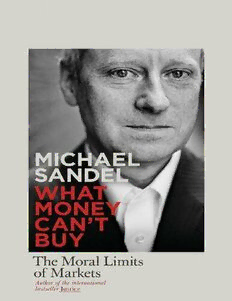
Table Of ContentMICHAEL J. SANDEL
What Money Can’t Buy
The Moral Limits of Markets
ALLEN LANE
an imprint of
PENGUIN BOOK
Contents
Introduction: Markets and Morals
Market Triumphalism
Everything for Sale
The Role of Markets
Our Rancorous Politics
1. Jumping the Queue
Airports, A musement Parks, Car Pool Lanes
Hired Line Standers
Ticket Scalpers
Concierge Doctors
Markets Versus Queues
Yosemite Campsites
Papal Masses
Springsteen Concerts
2. Incentives
Cash for Sterilization
The Economic Approach to Life
Paying Kids for Good Grades
Bribes to Lose Weight
Selling the Right to Immigrate
A Market in Refugees
Speeding Tickets and Subway Cheats
Tradable Procreation Permits
Tradable Pollution Permits
Carbon Offsets
Paying to Kill an Endangered Rhino
Ethics and Economics
3. How Markets Crowd Out Morals
Hired Friends
Bought Apologies and Wedding Toasts
The Case Against Gifts
Auctioning College Admission
Coercion and Corruption
Nuclear Waste Sites
Donation Days and Day-Care Pickups
Blood for Sale
Economizing Love
4. Markets in Life and Death
Janitors Insurance
Betting on Death
Internet Death Pools
Insurance Versus Gambling
The Terrorism Futures Market
The Lives of Strangers
Death Bonds
5. Naming Rights
Autographs for Sale
Corporate-Sponsored Home Runs
Luxury Skyboxes
Moneyball
Bathroom Advertising
Ads in Books
Body Billboards
Branding the Public Square
Branded Lifeguards and Nature Trails
Police Cars and Fire Hydrants
Commercials in the Classroom
Ads in Jails
The Skyboxification of Everyday Life
Notes
Acknowledgments
For Kiku, with love
Introduction: Markets and Morals
There are some things money can’t buy, but these days, not many. Today,
almost everything is up for sale. Here are a few examples:
A prison cell upgrade: $82 per night. In Santa Ana, California, and some other cities,
nonviolent offenders can pay for better accommodations—a clean, quiet jail cell, away from
1
the cells for nonpaying prisoners.
Access to the car pool lane while driving solo: $8 during rush hour. Minneapolis and other
cities are trying to ease traffic congestion by letting solo drivers pay to drive in car pool lanes,
2
at rates that vary according to traffic.
The services of an Indian surrogate mother to carry a pregnancy: $6,250. Western couples
seeking surrogates increasingly outsource the job to India, where the practice is legal and the
3
price is less than one-third the going rate in the United States.
The right to immigrate to the United States: $500,000. Foreigners who invest $500,000 and
create at least ten jobs in an area of high unemployment are eligible for a green card that
4
entitles them to permanent residency.
The right to shoot an endangered black rhino: $150,000. South Africa has begun letting
ranchers sell hunters the right to kill a limited number of rhinos, to give the ranchers an
5
incentive to raise and protect the endangered species.
The cell phone number of your doctor: $1,500 and up per year. A growing number of
“concierge” doctors offer cell phone access and same-day appointments for patients willing to
6
pay annual fees ranging from $1,500 to $25,000.
The right to emit a metric ton of carbon into the atmosphere: €13 (about $18). The European
Union runs a carbon emissions market that enables companies to buy and sell the right to
7
pollute.
Admission of your child to a prestigious university: ? Although the price is not posted,
officials from some top universities told The Wall Street Journal that they accept some less
than stellar students whose parents are wealthy and likely to make substantial financial
8
contributions.
Not everyone can afford to buy these things. But today there are lots of
new ways to make money. If you need to earn some extra cash,here are
some novel possibilities:
Rent out space on your forehead (or elsewhere on your body) to display commercial
advertising: $777. Air New Zealand hired thirty people to shave their heads and wear
9
temporary tattoos with the slogan “Need a change? Head down to New Zealand.”
Serve as a human guinea pig in a drug safety trial for a pharmaceutical company: $7,500. The
pay can be higher or lower, depending on the invasiveness of the procedure used to test the
10
drug’s effect, and the discomfort involved.
Fight in Somalia or Afghanistan for a private military company: $250 per month to $1,000 per
11
day. The pay varies according to qualifications, experience, and nationality.
Stand in line overnight on Capitol Hill to hold a place for a lobbyist who wants to attend a
congressional hearing: $15–$20 per hour. The lobbyists pay line-standing companies, who
12
hire homeless people and others to queue up.
If you are a second grader in an underachieving Dallas school, read a book: $2. To encourage
13
reading, the schools pay kids for each book they read.
If you are obese, lose fourteen pounds in four months: $378. Companies and health insurers
14
offer financial incentives for weight loss and other kinds of healthy behavior.
Buy the life insurance policy of an ailing or elderly person, pay the annual premiums while the
person is alive, and then collect the death benefit when he or she dies: potentially, millions
(depending on the policy). This form of betting on the lives of strangers has become a $30
15
billion industry. The sooner the stranger dies, the more the investor makes.
We live at a time when almost everything can be bought and sold. Over
the past three decades, markets—and market values—have come to govern
our lives as never before. We did not arrive at this condition through any
deliberate choice. It is almost as if it came upon us.
As the cold war ended, markets and market thinking enjoyed unrivaled
prestige, understandably so. No other mechanism for organizing the
production and distribution of goods had proved as successful at generating
affluence and prosperity. And yet, even as growing numbers of countries
around the world embraced market mechanisms in the operation of their
economies, something else was happening. Market values were coming to
play a greater and greater role in social life. Economics was becoming an
imperial domain. Today, the logic of buying and selling no longer applies to
material goods alone but increasingly governs the whole of life. It is time to
ask whether we want to live this way.
THE ERA OF MARKET TRIUMPHALISM
The years leading up to the financial crisis of 2008 were a heady time of
market faith and deregulation—an era of market triumphalism. The era
began in the early 1980s, when Ronald Reagan and Margaret Thatcher
proclaimed their conviction that markets, not government, held the key to
prosperity and freedom. And it continued in the 1990s, with the market-
friendly liberalism of Bill Clinton and Tony Blair, who moderated but
consolidated the faith that markets are the primary means for achieving the
public good.
Today, that faith is in doubt. The era of market triumphalism has come to
an end. The financial crisis did more than cast doubt on the ability of
markets to allocate risk efficiently. It also prompted a widespread sense that
markets have become detached from morals and that we need somehow to
reconnect them. But it’s not obvious what this would mean, or how we
should go about it.
Some say the moral failing at the heart of market triumphalism was
greed, which led to irresponsible risk taking. The solution, according to this
view, is to rein in greed, insist on greater integrity and responsibility among
bankers and Wall Street executives, and enact sensible regulations to
prevent a similar crisis from happening again.
This is, at best, a partial diagnosis. While it is certainly true that greed
played a role in the financial crisis, something bigger is at stake. The most
fateful change that unfolded during the past three decades was not an
increase in greed. It was the expansion of markets, and of market values,
into spheres of life where they don’t belong.
To contend with this condition, we need to do more than inveigh against
greed; we need to rethink the role that markets should play in our society.