Table Of ContentU.S. Fish and Wildlife Service
Wels Catfish (Silurus glanis)
Ecological Risk Screening Summary
Web Version – September 2014
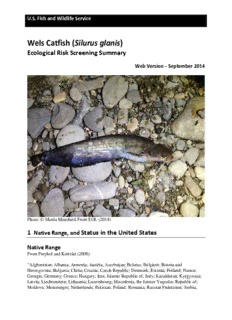
Photo: © Mattia Menchetti From EOL (2014)
1 Native Range, and Status in the United States
Native Range
From Freyhof and Kottelat (2008):
“Afghanistan; Albania; Armenia; Austria; Azerbaijan; Belarus; Belgium; Bosnia and
Herzegovina; Bulgaria; China; Croatia; Czech Republic; Denmark; Estonia; Finland; France;
Georgia; Germany; Greece; Hungary; Iran, Islamic Republic of; Italy; Kazakhstan; Kyrgyzstan;
Latvia; Liechtenstein; Lithuania; Luxembourg; Macedonia, the former Yugoslav Republic of;
Moldova; Montenegro; Netherlands; Pakistan; Poland; Romania; Russian Federation; Serbia;
Silurus glanis Ecological Risk Screening Summary
U.S. Fish and Wildlife Service – Web Version - 8/14/2012
Slovakia; Slovenia; Sweden; Switzerland; Tajikistan; Turkey; Turkmenistan; Ukraine;
Uzbekistan.”
Status in the United States
Not native to, or known to be established in, the United States.
Means of Introductions in the United States
This species has not been introduced to the United States.
2 Biology and Ecology
Taxonomic Hierarchy
From ITIS (2011):
“Kingdom Animalia
Phylum Chordata
Subphylum Vertebrata
Superclass Osteichthyes
Class Actinopterygii
Subclass Neopterygii
Infraclass Teleostei
Superorder Ostariophysi
Order Siluriformes
Family Siluridae Cuvier, 1816
Genus Silurus Linnaeus, 1758
Species Silurus glanis Linnaeus, 1758 – sheatfish
Taxonomic status: valid”
Size, Weight, Age Range
From Froese and Pauly (2011):
“Max length: 500 cm SL male/unsexed; (Kottelat et al. 2007 [cited by Froese and Pauly (2011)
but not accessed for this report]); common length : 300 cm TL male/unsexed; (Frimodt 1995
[cited by Froese and Pauly (2011) but not accessed for this report]); max. published weight:
306.0 kg (Frimodt 1995); max. reported age: 80 years (Kottelat et al. 2007) Length at first
maturity: Lm 87.1, range 86 - ? cm [World’s third largest freshwater fish].”
Environment
From Froese and Pauly (2011):
“Benthopelagic; non-migratory; freshwater; brackish; depth range 0 - 30 m (Frimodt 1995).”
2
Silurus glanis Ecological Risk Screening Summary
U.S. Fish and Wildlife Service – Web Version - 8/14/2012
Climate/Range
From Froese and Pauly (2011):
“Temperate; 4°C - 20°C (Baensch et al. 1991 [cited by Froese and Pauly (2011) but not accessed
for this report]); 62°N - 36°N, 0°E - 80°E.”
Distribution Outside of the United States
From Froese and Pauly (2011):
“Europe and Asia. North, Baltic, Black, Caspian and Aral Sea basins, as far north as southern
Sweden and Finland; Aegean Sea basin in Maritza and from Struma to Sperchios drainages;
Turkey. Absent from the rest of Mediterranean basin. Now widely introduced and translocated
throughout Europe and Lake Balkhash basin in Kazakhstan. Several countries report adverse
ecological impact after introduction. In Appendix III of the Bern Convention (protected fauna).”
From Freyhof and Kottelat (2008):
“Introduced in Rhône drainage in 1857 and in British Isles during second half of 19th century.
Now widely introduced and translocated throughout Europe and Lake Balkhash basin
(Kazakhstan).”
Means of Introduction Outside of the United States
From Froese and Pauly (2011):
Intentional introductions for aquaculture and sport fishing in Syria, the Netherlands, Italy,
France, China, and Portugal (Bartley 2006; Copp et al. 2009; Gandolfi et al. 1991; Keith et al.
2001; Ma et al. 2003; Pérez-Bote et al. 2005).
High potential for introduction from the pet trade as shown here:
http://www.monsterfishkeepers.com/forums/archive/index.php/t-1371.html.
From Lloyd (2012):
“In 1974, a German biologist and fishing aficionado, one Roland Lorkowsky, released a few
thousand fry of Wels catfish (Siluro - Silurus glanis) into the River Ebro at Flix. The fish adapted
frighteningly well to the warm murky waters and has now extended its range right up the Ebro
basin, and into the River Segre (Lleida) and the River Cinca (Huesca). It has also colonized
Lago Banyoles and Lago de Sau (Girona).”
From Couchman (2012):
“The catfish is widely distributed, but has a greater concentration in the counties of Bedfordshire,
Buckinghamshire, and Cambridgeshire. The Wels is not indigenous to this country and they
were first introduced into the "Shoulder of Mutton Lake" at Woburn Abbey in Bedfordshire in
3
Silurus glanis Ecological Risk Screening Summary
U.S. Fish and Wildlife Service – Web Version - 8/14/2012
1880. Since then they have been stocked both legally and illegally into many lakes throughout
the UK.”
Remarks
From Slone (2006):
“Silurus glanis is a commercial fish consumed by humans. This fish has boneless white flesh
that is low in fat and highly palatable. Technological research for artificial reproduction,
population genetics and conservation problems have been developed over the past 10 years in the
Czech Republic, France and other European countries. It is also a valued game fish in European
countries (Froese and Pauly 2011; Linhart et al. 2002 [cited by Slone (2006) but not accessed for
this report]).”
Short description
From Froese and Pauly (2011):
“Dorsal spines (total): 1; Dorsal soft rays (total): 4 - 5; Anal spines: 1; Anal soft rays: 83 - 95.
Distinguished from all other freshwater fishes in Europe by the following unique characters: two
pairs of mental barbels; and anal fin with 83-91½ rays. Differs further from the following
combination of features: body naked; large, depressed head; dorsal fin with 2-4½ rays; caudal fin
rounded or truncate; no adipose fin; and anal rays almost touching tail (Kottelat et al. 2007).
Caudal fin with 17 rays (Spillman 1961 [cited by Froese and Pauly (2011) but not accessed for
this report]).”
Biology
From Froese and Pauly (2011):
“Inhabits large and medium size lowland rivers, backwaters and well-vegetated lakes (Kottelat et
al. 2007). Occurs mainly in large lakes and rivers, although occasionally enters brackish water in
the Baltic and Black Seas (Frimodt 1995). Found in deep waters of dams constructed on the
lower reaches of rivers (Vostradovsky 1973 [cited by Froese and Pauly (2011) but not accessed
for this report]). A nocturnal predator, foraging near bottom and in water column. Larvae and
juveniles are benthic, feeding on a wide variety of invertebrates and fish. Adults prey on fish
and other aquatic vertebrates. Attains first sexual maturity at 2-3 years of age (Kottelat et al.
2007). Spawns in the salt water of the Aral Sea (at Kulandy) (Berg 1964 [cited by Froese and
Pauly (2011) but not accessed for this report]).”
“Locally threatened due to river regulation destroying shallow spawning sites (Kottelat et al.
2007).”
4
Silurus glanis Ecological Risk Screening Summary
U.S. Fish and Wildlife Service – Web Version - 8/14/2012
Human uses
From Froese and Pauly (2011):
“Fisheries: commercial; aquaculture: commercial; gamefish: commercial; food fish yes.
Marketed fresh, canned and frozen; can be pan-fried and baked (Frimodt 1995).”
Diseases
From Froese and Pauly (2011):
“Spring Viraemia of Carp, Viral diseases.”
From USGS (2012):
“Common carp belonging to the Cyprinidae family are the principal host species of SVCV.
Natural infections of SVCV have also occurred in other cyprinid fish. Fish species from other
families of Poeciliidae, Esocidae, Centrarchidae, Siluridae, and Salmonidae have also been
infected by SVCV. Due to the highly infectious nature of SVCV and potential impact this virus
could have on susceptible fish populations globally, any detection of SVCV requires notification
within 48 hours to the Office of Internationale Epizootic (OIE), the organization charged with
regulating world animal health. SVCV is one of only nine piscine viruses recognized worldwide
by the OIE as a notifiable animal disease.”
Threat to humans
From Froese and Pauly (2011):
“Potential pest.”
3 Impacts of Introductions
From Lloyd (2012):
“The results have been catastrophic. In many stretches, the fish has almost completely wiped out
several autochthonous species with its voracious appetite, hence its local nickname, 'The Ebro
Monster'.”
From Bruguera (2007):
“Due to its morphologic characteristics including its large size, enormous mouth, great length,
and its habits as a voracious predator it is a serious danger to the populations of native fish and
other vertebrates (amphibians, mammals, birds, etc.) that can see effects to their abundance and
survival. Due to the significant alteration of the trophic structure of the affected ecological
communities, the Wels catfish may also reduce the quality of the water of our impounded waters,
which supply a large part of the population. [Translated from Spanish]”
5
Silurus glanis Ecological Risk Screening Summary
U.S. Fish and Wildlife Service – Web Version - 8/14/2012
From Copp et al. (2009):
“Potential impacts in its introduced European range include disease transmission,
hybridization (in Greece with native endemic Aristotle’s catfish [Silurus aristotelis]),
predation on native species, and possibly the modification of food web structure in some
regions.”
From Kottelatand and Freyhof (2007):
“Threatens the largest population of Chondrostoma phoxinus in Lake Busko.”
From Boulêtreau et al. (2011):
“Here, the observed aggregations of alien fish (S. glanis) potentially represent the highest
biogeochemical hotspots ever reported for freshwater ecosystems, as our estimates correspond to
83–286 fold and 17–56 fold the maximal fish excretion values for phosphorus and nitrogen,
respectively, reported in the literature (McIntyre et al. 2008; Schaus 1997 [cited by Boulêtreau et
al. (2011) but not accessed for this report]). Therefore, these aggregations can potentially have
strong implications on ecosystem functioning since these fish may translocate nutrients from
their feeding areas, concentrate locally these nutrients in the aggregation area and subsequently
affect primary production and nutrient cycling. Therefore, this phenomenon represents another
example of unexpected potential ecological impacts of alien species (Cucherousset 2011 [cited
by Boulêtreau et al. (2011) but not accessed for this report]).”
6
Silurus glanis Ecological Risk Screening Summary
U.S. Fish and Wildlife Service – Web Version - 8/14/2012
4 Global Distribution
Figure 1. Global distribution of S. glanis. Map from Google Earth.
5 Distribution in the United States
No known U.S. locations.
6 CLIMATCH
Summary of Climate Matching Analysis
The climate match (Australian Bureau of Rural Sciences 2010; 16 climate variables; Euclidean
Distance) was high for a large portion of the country. Very high matches were found in the Great
Lakes states, the western plains, and the interior northwest. Climate 6 match indicated that the
continental United States has a very high climate match. The range for very high climate match
is 0.103 and greater, climate match of the Wels catfish is 0.632.
7
Silurus glanis Ecological Risk Screening Summary
U.S. Fish and Wildlife Service – Web Version - 8/14/2012
Figure 2. CLIMATCH source map showing weather stations selected as source locations (red)
and non-source locations (blue) for S. glanis climate matching. Source locations from Froese
and Pauly (2011).
Figure 3. Map of CLIMATCH (Australian Bureau of Rural Sciences 2010) climate matches for
S. glanis in the continental United States based on source locations reported by Froese and Pauly
(2011). 0= Lowest match, 10=Highest match.
8
Silurus glanis Ecological Risk Screening Summary
U.S. Fish and Wildlife Service – Web Version - 8/14/2012
Table 1. CLIMATCH (Australian Bureau of Rural Sciences 2010) climate match scores.
CLIMATCH Score 0 1 2 3 4 5 6 7 8 9 10
Count 3 15 63 77 223 344 628 470 147 0 0
Climate 6 Proportion = 0.632 (High)
7 Certainty of Assessment
Information on the biology, invasion history, and impacts of this species is sufficient to give an
accurate description of the risk posed by this species. Certainty of this assessment is high.
8 Risk Assessment
Summary of Current U.S. Status
Establishment and impacts in Europe documented. The main impacts of concern are effects
predation on prey fish, competition with predators, disease transmission, and habitat alteration. S.
glanis has been purposefully stocked, and inadvertently stocked in the wild along with other
species. S. glanis is a species that could potentially be imported for sport fishing, aquaculture,
live food trade, or use in the pet trade.
Assessment Elements
• History of Invasiveness (See Section 3): High
• Climate Match (See Section 6): High
• Certainty of Assessment (See Section 7): High
• Overall Risk Assessment: High
Table 1. Generalized, projected impacts of S. glanis on natural resources of the continental
United States. The climate match is high between the native/established ranges of S. glanis and
that of the continental United States. Therefore, details of impacts are too numerous to list in
this screening report. Specific details of impacts will depend on local ecological structure (i.e.,
fish species composition, population abundance, and community structure; food resource
biomass and community structure; and habitat variables).
Projected
Level of
Impact to
Wildlife
Resources of Description of Projections of Impacts to
Threat the U.S. Impact Wildlife Resources of the U.S.
Habitat Degradation High High population Water quality degradation
densities of S. impacts are projected to be
glanis could lead to greatest wherever established
extremely high populations result high
9
Silurus glanis Ecological Risk Screening Summary
U.S. Fish and Wildlife Service – Web Version - 8/14/2012
nutrient loads. abundance of S. glanis, and in
Indirect effect of lentic systems or slow-moving
food web alteration lotic systems where fast flow and
could be water discharge are not present to
quality degradation efficiently transport high nutrient
(Boulêtreau et al. loads downstream.
2011).
Species High S. glanis has been Species most likely to be
Extirpation/Extinction responsible for impacted are benthic native fish
numerous native species (particularly cyprinids)
species population that would be seen as prey for S.
reductions in glanis, as this species more
Europe through commonly feeds near the bottom
predation (Copp et of the water column. Non-fish
al. 2009). Stomach species such as mollusks could
contents of S. also be significantly impacted.
glanis from the This is particularly a concern if S.
Tarn River (France) glanis becomes established in
indicated a waters where either native
dominance of cyprinds or mollusks are
cyprinid fishes, and imperiled.
benthic
prey (mollusks and
crayfish) in their
diet (Syväranta et
al. 2010). Birds,
amphibian, and
mammals were also
documented in the
diet of Tarn River S.
glanis.
Food Web Disruption High Drastic food web In any habitat S. glanis invades,
disruptions caused native prey fishes (particularly
by S. glanis due to cyprinids and mollusks) are at
its level of risk to be depleted. Trophic
predation on native levels occupied by these species
species as seen in are at risk of being either being
Spain (Iberianature disrupted or eliminated from the
2011; Inavsiber food web.
2011).
Degradation of Fish High See description of See projected impacts to U.S.
Stocks impact for Food wildlife resources listed in
Web Disruption, Species Extirpation/Extinction
and Predation. above. Also, Spring Viraemia of
Carp (SVCV) virus has also been
10
Description:“In 1974, a German biologist and fishing aficionado, one Roland Lorkowsky, released a few thousand fry of Wels catfish (Siluro - Silurus glanis) into the River Ebro