Table Of ContentA Backwoods Home Anthology
248
The Third Year
By Rudy Behrens
(This introductory overview to water-
wheels is the first of a three-part series. The
second installment (Issue No. 17) will be
about undershot and no-head wheels, and the
third installment (Issue No. 18) will deal with
overshot wheels.—Editor)
he creak of an old, wooden moss-
covered wheel lazily driving a gristmill
in a long lost past is how most people
think of a small scale water power. Of
course water power is old. Historical
records put it at around 4000 years old.
While that makes it an ancient tech-
nology, that doesn’t make it an antique
technology. If you have ever consid-
ered windmills, think of a water wheel
as a windmill that uses a fluid 824
times as dense. In other words, 824
times as powerful. On the negative side,
you need access to a good stream,
while the wind is everywhere. I am
making this comparison to show that
water power isn’t any more complicat-
ed than wind power to understand
How they work
Waterwheels run because “gravity”
causes a “mass” of water to fall some
distance (HEAD). This energy is
absorbed by the wheel to do work.
There is more than one way to absorb
the energy, so wheels have evolved
into two classes:
• reaction
• impulse
Reaction, uses the moving water to
create a pressure differential like an
airplane wing. These are correctly
called “turbine’s.” A propeller is the
most common example of the type.
They have many advantages, but
most of the advantages benefit profes-
sional or large-scale users. While very
efficient and compact they require
more “tending” than a non-profes-
sional may be able to provide. While
they can be automated sufficiently to
allow unattended operation, these con-
trols are very costly and really can’t
be justified for a non-professional
power plant.
For this reason I recommend
impulse type water wheels. These func-
tion by transferring the momentum of
the moving water to the machine.
The energy transfer is similar to one
billiard ball transferring its energy to
another. Because of this, impulse
wheels have a very high efficiency, and
more importantly, have a constant effi-
ciency over varying stream conditions.
On a small, variable stream (a typi-
cal home/farm stream) an impulse
wheel can produce more than twice
the. kilowatt hours of a reaction
wheel. Impulse wheels are available in
several types, each designed for a spe-
cific type of stream.
No-head water motor
No-head—If you have a stream with
an average velocity of 4 feet per
second or higher (preferably higher),
you can use a no-head water motor.
These are a relatively new innovation.
While they are somewhat inefficient
compared to more traditional designs,
they have the advantage that they do
not need a dam of any sort. The time,
expense and just plain hassles associ-
ated with building a dam make
these designs very desirable. There are
three choices:
• 1. a simple paddle wheel (Be sure
to use a large diameter).
• 2. a Scheider Lift Translator. This
is a patented design. The company
is located in the area of
Sacramento, CA.
Waterpower for personal use
ALTERNATIVE ENERGY
T
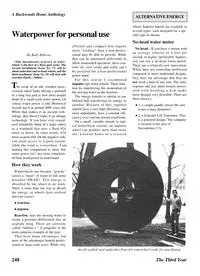
An all-welded steel undershot Poncelot waterwheel ready for installation.
A Backwoods Home Anthology
249
The Third Year
• 3. A FITZ C-Rotor and the
Scheider Lift Translator are
autonomous generators, con-
tainipg the wheel, generator, and
regulator in a single unit. You just
place one in a stream and connect
the power cable to a load. Both
designs are quite cost-effective as
a personal power source.
Undershot wheel
Undershot wheels range from simple
paddle wheels placed in a stream to
Poncelot Wheels. They were devel-
oped in France during the 18th centu-
ry. They are good for small to medium
flows and heads from 1 foot to 12 feet.
If properly designed, a Poncelot can
be 85% efficient or more. Even an
amateur-built wheel can be over 75%
efficient.
Overshot wheel
Overshot wheels are the kind people
associate with Currier & Ives engrav-
ings. While many were made of wood,
after 1840 most were made of metal.
For small streams and heads up to 25
feet, these are still the best choice for
a home/farm user. The old FITZ I-X-L
designed in 1862 was tested at the
University of Wisconsin in 1913. It
proved to be 93% efficient.
Crossflow turbines
Crossflow turbines are incorrectly
called a turbine since they work on the
impulse principal. They can best be
described as undershot wheels in a
can. They are useful for small to large
flows and heads from 10 feet to 100
feet. They are close tolerance devices
so we wouldn’t recommend this
design to an amateur builder unless
you have some machining experience.
A Pelton wheel is a high head variant
of the crossflow, best used with heads
of 50 feet or higher.
Site selection
Basically, the problem you have to
solve with site selection is this: How
can I make the most kilowatt hours
per year with the least expenditure of
time and money.
Surprisingly, wheel horsepower and
efficiency are not the most important
factors. This is because stream flows
vary over the year.
The best choice is the wheel that
delivers 50% or more of the theoreti-
cal power of the stream. In other
words, the total annual production
should be at least HALF of the pro-
duction you would get if the wheel ran
at full power all year long.
For example, there are 8760 hours in
a year. If you had a 100 kilowatt
wheel, it should produce 438,000 kilo-
watthours annually. (100 KW * 8760
* 50%). If it doesn’t, you should use a
smaller wheel. This isn’t as difficult to
calculate as it sounds. Power available
can be calculated as flow (in cubic
feet per second) times head (in feet)
divided by 11.8. This will give you
power in kilowatts. Divide this answer
by 0.746 to get horsepower.
Also remember a stream varies over
the year. The most important thing to
know for any waterwheel installation
is how much water is available, and
how much can you use. An oversized
wheel is both inefficient and a waste
of money. Plot the flows if you
can, or get stream flow data from the
U.S. Geological Survey. Usually a
flow that is met or exceeded 25%
of the time is a good How to size
your generator. While you may miss
some power during spring floods,
remember that they don’t occur often
enough to justify the expense of a
larger waterwheel.
Generator type?
When selecting a generator type,
decide if you want AC or DC power.
Will you co-generate with the electric
company or go it alone? If your power
plant is 25 kilowatts or larger, a self
regulated AC system is the best. If it is
smaller, or you want to supplement
with wind power or photovoltaics, DC
is the simplest to use. If you are co-
generating, a simple AC induction
system will work for any size power
plant. This is the absolute least cost
arrangement. Here is where the self-
regulating characteristics of impulse
wheels really pay off.
Wheel selection
Head is the real factor when select-
ing your wheel. Review the descrip-
tions above and make your choice.
The undershop wheel from the previous page, plus attached generator, installed.
Speed increaser
Impulse wheels turn slowly. This
was one reason reaction turbines were
invented. Today gearing is very reli-
able so it is no longer necessary to direct
drive a generator. This also allows use
of more efficient 4-pole (1800 rpm)
generators. Any industrial enclosed
drive will work. Do not use auto trans-
missions. They were never intended
for continuous duty. The bearings and
casing are too light unless you are
making 10 kilowatts or less.
This is an overview of how water-
wheels can be used for personal power
plants. As in anything, attention to
detail is what separates success from
failure. Measure your stream carefully,
and don’t over-estimate your power
needs or building skills. Waterwheels
are heavy industrial machines.
On the other hand, don’t under-esti-
mate what one person looking to
change their piece of the world can
do. Before I bought the FITZ
Waterwheel company, I had been
through some hard times. Now 6 years
later, I operate 1250 kilowatts of gen-
erators commercially, providing clean,
environmentally safe power to over
1000 homes. I hope you have as much
fun and satisfaction with your water-
wheel, whatever the size.
(Rudy Behrens owns the FITZ Waterwheel
Company. 118 Sycamore CL, Collegeville,
PA 19426, Phone: (215) 489-6256.) ∆
A Backwoods Home Anthology
250
The Third Year
Summer Rain
The angry ones behind the hill
Just shook those dusty clouds until
the thunder roared,
the lightning came
to bring through
the summer rain.
June Knight
Caldwell, ID
Coyote
Ow-ow a-ooooo, she howled
Drowning out the hooting of the last spotted owl.
If you’d listen sharply, you’d hear shrill cries
As her pups poked their noses into the skies.
The temperature plummeted when the moon rose
Capturing their silhouettes as shadows transpose.
Their coats were priming for the winter ahead.
The pups knew not of blizzards or being underfed.
You say their existence appears somewhat bleak
Serving no purpose—reaching no peak?
Why, nature itself set-forth their goals
To chase prairie dogs, to unearth moles.
I can’t imagine sleeping out in a tent
Rolling over at night without ear half-bent,
Listening for the song they alone can sing,
The song of our wilderness ... vanishing.
Ow-ow a-oooooooo.
Hal Meili
Cheney, WA