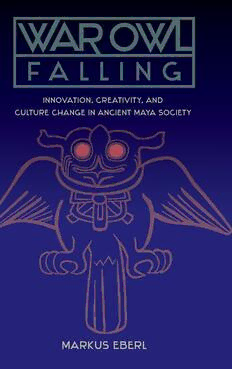
Table Of ContentWar Owl Falling
Maya Studies
University Press of Florida
Florida A&M University, Tallahassee
Florida Atlantic University, Boca Raton
Florida Gulf Coast University, Ft. Myers
Florida International University, Miami
Florida State University, Tallahassee
New College of Florida, Sarasota
University of Central Florida, Orlando
University of Florida, Gainesville
University of North Florida, Jacksonville
University of South Florida, Tampa
University of West Florida, Pensacola
WaR OWL
f a l l i n g
Innovation, Creativity, and Culture Change
in Ancient Maya Society
Markus Eberl
Foreword by Arlen F. Chase and Diane Z. Chase, Series Editors
University Press of Florida
Gainesville · Tallahassee · Tampa · Boca Raton
Pensacola · Orlando · Miami · Jacksonville · Ft. Myers · Sarasota
Copyright 2017 by Markus Eberl
All rights reserved
Printed in the United States of America on acid-free paper
All drawings, diagrams, photos, and tables are by the author unless otherwise noted.
This book may be available in an electronic edition.
22 21 20 19 18 17 6 5 4 3 2 1
Library of Congress Cataloging-in-Publication Data
Names: Eberl, Markus, author. | Chase, Arlen F. (Arlen Frank), 1953– author
of foreword. | Chase, Diane Z., author of foreword.
Title: War owl falling : innovation, creativity, and culture change in
ancient Maya society / Markus Eberl ; foreword by Arlen F. Chase and Diane
Chase, series editors.
Other titles: Maya studies.
Description: Gainesville : University Press of Florida, 2017. | Series: Maya
studies | Includes bibliographical references and index.
Identifiers: LCCN 2017016670 | ISBN 9780813056555 (cloth)
Subjects: LCSH: Mayas—History. | Mayas—Antiquities. | Maya art. |
Inscriptions, Mayan.
Classification: LCC F1435 .E24 2018 | DDC 972.81—dc23
LC record available at https://lccn.loc.gov/2017016670
The University Press of Florida is the scholarly publishing agency for the State University System
of Florida, comprising Florida A&M University, Florida Atlantic University, Florida Gulf Coast
University, Florida International University, Florida State University, New College of Florida,
University of Central Florida, University of Florida, University of North Florida, University of
South Florida, and University of West Florida.
University Press of Florida
15 Northwest 15th Street
Gainesville, FL 32611-2079
http://upress.ufl.edu
Contents
List of Figures vii
List of Tables ix
Foreword xi
Acknowledgments xiii
1. Flower Mountain Revealed: Innovation and Social Change in
Ancient Societies 1
2. Wings for Hummingbirds to Fly With: Creativity as a Play
of Symbols 33
3. Itzamnaaj’s Court: Creativity Embedded in Social Opportunity
Structures 65
4. Bleibt Alles Anders: Modeling Invention 100
5. A Ruler Just Like Me: Status, Power, and Innovation 132
6. Stillman Wanders, Babel Rises: Innovation’s Impact on
Structures 161
7. Names of the Owl: Exploring Creativity and Innovation 193
Notes 215
References Cited 219
Index 279
Figures
1.1. The founder couple emerges from Flower Mountain 2
1.2. The Maya area 3
1.3. K’awiil Chan K’inich, last king of Dos Pilas 4
1.4. Classic Maya history 23
1.5. The Petexbatún region in the southern Maya Lowlands 25
1.6. Map of the Late Classic village of Dos Ceibas 26
1.7. The Copan Valley in the southeastern Maya Lowlands 27
1.8. The House of the Bacabs 28
1.9. Late Classic kings and nobles of Copan 29
2.1. The rabbit-duck illusion 37
2.2. The burial of Dos Pilas King Itzamnaaj K’awiil 43
2.3. Creator god Itzamnaaj brings the maize god back to life 47
2.4. Itzamnaaj shows the mask he made 49
2.5. Creator god Itzamnaaj paints a temple 50
2.6. The rain god Chaak plants maize 50
2.7. Itzamnaaj grants the hummingbird its wings 52
2.8. Disguised as Itzamnaaj, nobleman Janaab Ajaw hands Palenque’s
royal headband to King K’inich Ahkal Mo’ Nahb 58
3.1. Itzamnaaj speaks to four artisans 66
3.2. Creator god Itzamnaaj teaches future scribes 67
3.3. Carved panel from Pomoy with artists’ signatures 70
3.4. Under the eyes of his nobles K’inich Ahkal Mo’ Nahb III becomes
king of Palenque 76
3.5. Growth of nonroyal elites in Classic Maya society 77
3.6. The Late Classic site of Nacimiento 79
3.7. Nacimiento and Dos Ceibas grow from hamlets into villages 80
3.8. Palatial Structure R27-83 in Dos Ceibas’s South Plaza 81
3.9. Cumulative wealth distribution at Nacimiento and Dos Ceibas 84
viii · Figures
3.10. Exchanging goods, services, and ideas in Classic Maya society 94
4.1. The ensoulment of Maya ceramic vessels 105
4.2. Cognitive map from present to future world 112
4.3. The ancestral couple emerges from a cave 116
4.4. Titles of Classic Maya artisans at Xcalumkin 121
4.5. Workshop in Structure 110B, Patio H, Copan’s Group 9N-8 122
4.6. Petrified wood from the Barranca Escondida 125
4.7. Map of Barranca Escondida, with locations of petrified wood 126
4.8. Image of drilling from the Dresden Codex 128
5.1. Group 9N-8 in the Las Sepulturas neighborhood 143
5.2. Structure 9N-81 in Copan’s Group 9N-8 145
5.3. Ballcourt marker from Copan’s Great Ballcourt 146
5.4. Reconstruction drawing of the East Court of Copan’s Acropolis 147
5.5. Structure 9N-67 and its mat motif in Copan’s Patio B 150
5.6. Royal scepters from the Maya Lowlands 152
5.7. Scepters and a mirror back from Copan’s Group 9N-8 155
5.8. Reused glyphic inscriptions in Copan’s Group 9N-8 158
6.1. Ornaments from the Petexbatún villages of Dos Ceibas and
Nacimiento 165
6.2. Accumulated social responses from individual cognitive maps and
actions 170
6.3. Profile views of Late Classic Maya ceramic vessels 174
6.4. Tikal’s new ceramic types, seventh and eighth centuries 176
6.5. Temporal distribution of period-ending rituals 178
6.6. Different examples of the glyph for ajaw, “lord” 179
6.7. Ajaw pendants worn by Maya rulers 180
6.8. Examples of owls from Nacimiento and Dos Ceibas 181
6.9. The owl as part of the warrior costume 182
6.10. Chronological change in ceramic motifs on Chaquiste Impressed
bowls from Petexbatún 187
7.1. Lower jaw with three shell teeth implants 199
7.2. Maya creation of space-time in the Madrid Codex 204
7.3. The downfall of Maya rulership 209
7.4. God Itzamnaaj reinvented as the chief priest 211
Tables
3.1. Learning sources for common crafts and skills in modern Highland
Maya villages 74
3.2. Characteristics of residential groups at Nacimiento and
Dos Ceibas 85
5.1. Corn varieties grown by fifty Hopi farmers 135
5.2. Complete and fragmented scepters from Copan residential
groups 153
6.1. Consumption of animal species by social status at Aguateca 163
6.2. Comparisons of presumed spindle whorls 168