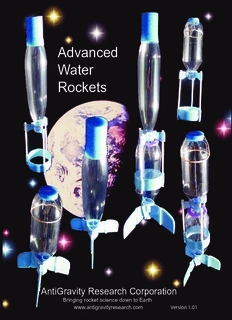
Table Of ContentAdvanced
Water
Rockets
AntiGravity Research Corporation
Bringing rocket science down to Earth
www.antigravityresearch.com Version 1.01
Page 2
Advanced Water Rockets from AntiGravity Research Corporation
Table of Contents
Important Legal Agreement . . . . . . . . . . . . . . . . . . 3 Ozone Probe & Extreme 2-Stage
Ozone Probe 2-Stage Rocket . . . . . . . . . . . . . . . . . 33
How To Use This Manual . . . . . . . . . . . . . . . . . . . . . . 4 Extreme 2-Stage Rocket. . . . . . . . . . . . . . . . . . . . . . . . 34
Preparing a 2-Liter Bottle for Your Rocket . . . 35
Bumper Installation . . . . . . . . . . . . . . . . . . . . . . . . . . . . 36
Using your Water Rocket Safely . . . . . . . . . . . . . . 5
Assembling the Tripod Fins . . . . . . . . . . . . . . . . . . . 37
Assembling the Ring Fin . . . . . . . . . . . . . . . . . . . . . . 38
Who Uses AntiGravity Rockets? . . . . . . . . . . . . . . 6 Assembling the Struts . . . . . . . . . . . . . . . . . . . . . . . . . 39
Combining Struts & Ring Fin . . . . . . . . . . . . . . . . . . 40
The Rocket Fuel Supply . . . . . . . . . . . . . . . . . . . . . . . . 41
How Does A Rocket Work? . . . . . . . . . . . . . . . . . . . . 7
Adding Water & Connecting the Launcher . 42
Guide Rod Setup & Launch Preparation . . . . . 43
Why do AntiGravity Rockets Fly Higher? . . . . 8
Launching the Rocket . . . . . . . . . . . . . . . . . . . . . . . . . 44
Troubleshooting the 2-Stage Rocket . . . . . . . . 45
The Environment and Water Rockets. . . . . . . . . 9
The Payload Rocket . . . . . . . . . . . . . . . . . . . . . . . . . . . . . 46
Payload Rocket Instructions . . . . . . . . . . . . . . . . . . 47
Choosing an Air Pump for Your Rocket . . . . . 10
Payload Rocket Extra Instructions . . . . . . . . . . . . 48
Skylab & SkyLab Extreme The Rocket Car . . . . . . . . . . . . . . . . . . . . . . . . . . . . . . . . . . . . . 49
Rocket Car Instructions . . . . . . . . . . . . . . . . . . . . . . . . 50
Skylab Water Rocket Kit . . . . . . . . . . . . . . . . . . . . . . . 11
Rocket Car Extra Instructions . . . . . . . . . . . . . . . . . 51
SkyLab Extreme Water Rocket Kit . . . . . . . . . . . . 12
Preparing a 2 Liter Bottle for Your Rocket . . . 13 Ultimate Water Rocket
Bumper Installation . . . . . . . . . . . . . . . . . . . . . . . . . . . . 14
Experimenter’s Kit . . . . . . . . . . . . . . . . . . . . . 52
Assembling the Tripod Fins . . . . . . . . . . . . . . . . . . . 15
Water, Nozzle & Launcher Installation . . . . . . . 53
Installing the Guide Tube . . . . . . . . . . . . . . . . . . . . . . 16
Experimenting with the Double Fin . . . . . . . . . 54
The Rocket Fuel Supply . . . . . . . . . . . . . . . . . . . . . . . . 17
Adding Water & Connecting the Launcher. . 18
Fifty Pak of Rockets . . . . . . . . . . . . . . . . . . . . . . . . . . . . 55
Guide Rod Setup & Launch Preparation. . . . . 19
Launching the Rocket . . . . . . . . . . . . . . . . . . . . . . . . . 20 The Rocket Dodgeball Kit . . . . . . . . . . . . . . . . . . . . 56
Quick One-Page Skylab Instructions . . . . . . . . . 21
The Rocket Pump . . . . . . . . . . . . . . . . . . . . . . . . . . . . . . 57
High Altitude Pro & Extreme Screamer
Components for Your Water Rocket . . . . . . . . . 58
High Altitude Pro Water Rocket Kit . . . . . . . . . . . 22
Extreme Screamer Water Rocket Kit . . . . . . . . . 23 The SuperBottle . . . . . . . . . . . . . . . . . . . . . . . . . . . . . . . 59
Preparing a 2 Liter Bottle for Your Rocket . . . 24
Bumper Installation . . . . . . . . . . . . . . . . . . . . . . . . . . . . 25 The Launchers . . . . . . . . . . . . . . . . . . . . . . . . . . . . . . . . . 60
Assembling the Ring Fin . . . . . . . . . . . . . . . . . . . . . . 26 The Versatile Launcher. . . . . . . . . . . . . . . . . . . . . . . . . 61
Assembling the Struts . . . . . . . . . . . . . . . . . . . . . . . . . 27 Using the Versatile Launcher . . . . . . . . .62
Combining Struts & Ring Fin . . . . . . . . . . . . . . . . . 28
The Rocket Fuel Supply . . . . . . . . . . . . . . . . . . . . . . . 29 How the Rocket Fins are Made . . . . . . . . . . . . . . 63
Adding Water & Connecting the Launcher. . 30
Guide Rod Setup & Launch Preparation . . . . 31 Rocket Maintenance and Repair . . . . . . . . . . . . 64
Launching the Rocket . . . . . . . . . . . . . . . . . . . . . . . . . 32
Achieving Extra Altitude. . . . . . . . . . . . . . . . . . . . . . . 65
Price List . . . . . . . . . . . . . . . . . . . . . . . . . . . . . . . . . . . . . . . 66
www.antigravityresearch.com email: [email protected] toll-free: 1-866-546-8633 phone 604-824-9021 fax 604-648-8192
Page 3
IMPORTANT LEGAL AGREEMENT
The following terms form a legal agreement between you (“Consumer”) and AntiGravity Research Corporation
("AntiGravity"). By using this product and/or its documentation (hereinafter referred to as "product") as
provided or in any subsequent form, you acknowledge that you have read, understood, and agree, to be bound
by these terms and to comply with all applicable laws and regulations. If you do not agree to these terms, do
not use this product and return it, for a full refund, to the original place of purchase.
PRODUCT LIABILITY LIMITATION
AntiGravity shall not be liable for any consequential or incidental damages, injury, loss or expenses arising
from the use or inability to use this product for any purposes whatsoever, or for any willful or accidental
misuse of the product. By using the product, the consumer acknowledges that the product is intended for
specific educational and recreational purposes and that adult supervision, caution and reasonable care should
be exercised in its use. Unacceptable uses include but are not limited to, launching the product into the flight
path of aircraft, launching the product toward people or vehicles, or using the product to create an explosive
device or using the product in any way which may cause injury to self or others. The consumer agrees to
release AntiGravity, it's owners, employees, heirs, assigns, officers, agents and associates from any and all
liability, claims, demands or actions or causes of actions arising from or blame whatever arising out of any
damage, injury, loss or death resulting from any cause whatever, whether the result of misuse, the fault of
the user, a defect in the product or from any other cause whatever, regardless of intention. No action or
representation written or verbal on the part of AntiGravity or any other can amend, make void, or alter
this product liability limitation in any way at all. The consumer agrees to all of the terms of this limitation
when using the product. If you do not agree to these terms, then do NOT use the product and return it, for
a full refund, to the original place of purchase.
DISCLAIMERS
AntiGravity explicitly states that this product is not meant for use by unsupervised children and is not meant
for use with any air pump other than a standard low pressure hand-powered bicycle air pump, nor is it meant
for use with any bottle other than a plastic bottle that previously contained fizzy pop. Using any air pump
capable of applying more than 80 pounds per square inch of pressure or using anything other than a pop
bottle is strongly DISCOURAGED.
JURISDICTION
AntiGravity is located in and operates from Chilliwack in the province of British Columbia, Canada and no
other location. The laws of the province of British Columbia shall govern these terms and conditions and
any dispute related thereto without regard to choice of law rules. Consumer hereby consents and agrees
to exclusive jurisdiction and venue of courts in New Westminster, British Columbia, Canada. Use of this
product is unauthorized in any jurisdiction that does not give effe ct to all of these terms including, without
limitation, this paragraph.
SEVERABILITY
If any part of this agreement is deemed to be invalid or unenforceable for any reason, then such invalid or
unenforceable provision shall be deemed superceded by a valid and enforceable provision that most closely
matches the intent of the original provision and the remainder of the agreement shall remain in effect.
*****
www.antigravityresearch.com email: [email protected] toll-free: 1-866-546-8633
phone 604-824-9021 fax 604-648-8192
Page 4
How To Use This Manual
Before going any further in this manual or with your AntiGravity water rocket, make sure that you have
read and agree to the Important Legal Agreement on the previous page.
Among other things, this manual contains the instructions you will need to assemble your rocket. To find
your way around, you will need to enable the Adobe Acrobat Reader bookmarks tab. Click on the arrow
beside the rocket type you need to assemble and it will show you a list of the pertinant pages.
Print out the pages if you think you will need them in the field. If you don’t have a printer,
assemble your rocket beside your computer while you have these pages on your screen.
Moving around in the rocket book
Bookmarks - every page in this book is listed in the Adobe Acrobat Reader bookmark list. If
you click on the title of a page, that page will be displayed. If there is an arrow in front of a
bookmark it means that it is a section heading. You can click the arrow to display all the
pages in that section.
Zoom - Use this Acrobat tool to zoom out to see an overall view of a page, or
to zoom in so you can look at the finest details. Whichever zoom level you
choose will stay that way from page to page until you change it.
Search for Text - you can instantly go to the next occurance of a word or phrase
using search for text.
Hand Tool - move the page up or down when you press the mouse and move the
hand.
Pageup & Pagedown keys - press pageup on your computer keyboard to move to
the previous page or pagedown to move to the next page.
Scroll wheel - on your computer mouse, the scrollwheel is very useful to scroll
through this book from page to page.
But don’t just read about the rocket you have. Take a look at all the rockets. Notice the similarities
and differences. Plan to take on a more challenging rocket once you have mastered the one you
have. You will probably notice one thing about all of AntiGravity’s rockets here in this book: they are
all very simple. At AntiGravity, we don’t just want to sell you a rocket. We want to teach you how
rockets work, and we hope you will use your imagination and inventiveness to start where we left
off, and to go far beyond our own limited designs.
www.antigravityresearch.com email: [email protected] toll-free: 1-866-546-8633 phone 604-824-9021 fax 604-648-8192
Page 5
Using your Water Rocket Safely
Although AntiGravity water rockets are made to be as safe as possible to use, there are some
very important rules you will need to follow for the safety of yourself and others. Most of these
rules are just common sense, but nonetheless it is important to keep these in mind as you use
your rocket, to ensure that you have a safe and enjoyable rocketing experience.
1. Only launch with adult supervision, in a wide open field, far away from trees, buildings, roads,
people and electrical wires.
2. Never put anything in your water rocket but air, water and sometimes non-toxic handwash-type
dish soap.
3. Never launch your rocket at or near people, animals, automobiles, aircraft or buildings.
4. Never launch your rocket anywhere near aircraft landing or takeoff locations or into the path of
an aircraft.
5. Never launch your rocket under overhead electrical wires or during a lightning storm.
6. Stay at least 20 feet away from the rocket when it is being pressurized, and insist that all other
people also stay at least 20 feet away from it, in case the bottle bursts.
7. Don’t put any more than the recommended amount of water in any rocket bottle, or the rocket
may lift off sideways.
8. Never launch your rocket indoors.
9. Only use a hand-powered pump to pressurize your rocket. Never use an electric or automatic
pump or compressor.
10. Only use plastic pop bottles that have previously been used to hold fizzy pop. Never use water
bottles because they are too thin and cannot hold the required pressure. Never use glass bottles,
because of the danger of heavy impact or sharp broken glass shards.
11. Never climb up in dangerous places or to dangerous altitudes to retrieve a rocket. It is better to
lose your rocket than to jeopardize the safety of yourself or others.
During the course of your rocket experience you will probably run across some situations that
don’t match any of the above. Always decide in favor of safety for yourself and others.
There may be other precautions to keep in mind that apply to specific types of rockets. These
precautions will be included in the instructions for each individual type of rocket.
www.antigravityresearch.com email: [email protected] toll-free: 1-866-546-8633 phone 604-824-9021 fax 604-648-8192
Page 6
Who Uses AntiGravity Rockets?
Not only are AntiGravity rockets an excellent activity for all ages, they have found their way into
many specialized markets that we never would have imagined. And even though most of our
rockets are enjoyed by individuals and families, our customer list reads like the who’s-who of
business, entertainment, education, science and national defense. Below is a small sampling of
the many interesting and unusual organizations who use AntiGravity rockets.
Corporate & Defense Science Education Centers
American Honda Corporation Questacon, National Science & Technology
Deep Space Systems, Inc. Center, Australia
NBC Special Effects Department Liminal Labs, Black Rock Space Program
Federal Aviation Administration NASA & Honeywell’s FMA Live show
Whirlpool Corporation Auckland Observatory, NZ
US Army AstroCamp, Guided Discoveries
US Navy Jack’s Mythbusters
US Naval Academy Young Scientist Camp
US Naval Research Laboratory Interactive Learning Systems
Genesis Innovation Apollo Career Center
Fantastic Machine, Los Angeles, CA Future Scientists and Engineers of America
Horizon Air Ground Support Mad Science of Sacramento Valley
Waikato Hospital, Department of Pathology, NZ St. Louis Science Center
Orion Science Center
Universities & Colleges
Ispace, Inc., Interactive Science, Space &
Aeronautics Center for Education
Princeton University
Owls Head Transportation Museum
Princeton University Prep Program
Mississippi State University
Schools, Parks & Family Programs
Ohio University, Mechanical Engineering
Dept.
Parks Canada
University of Montana Western
Notre Dame Academy
Georgia Institute of Technology, Aerospace
Holy Trinity School
Engineering Dept.
Robert Bosch Gymnasium, Germany
Fresno Pacific University
Summit High School
University of Philadelphia, School of Medi-
Thomas Jefferson High School
cine
Boy Scouts
Iowa State University
Ranney School, Tinton Falls, NJ
Keele University, School of Chemistry and
Coal Creek Canyon School
Physics, UK
Our Lady of the Lake CCS
Jesus College, Cambridge, UK
York English Primary School and Kindergarten, HK
University of Wisconsin, Madison
Clark County School District
Lee College, Department of Physics
Deep Cove School, Sidney, BC
Penn State University
St. John’s School
University of Alaska, Fairbanks, College of
Arvida Middle School
Engineering & Mines
ENAACT Family Academy
Yakima Valley Community College
Project Lead the Way
Fox Meadow Middle School
Great River School
City of Jacksonville
www.antigravityresearch.com email: [email protected] toll-free: 1-866-546-8633 phone 604-824-9021 fax 604-648-8192
Page 7
How Does A Rocket Work?
Where does the rocket’s power come from? - When you pump your bicycle air pump fifty times, the
work that you do is being stored inside the pop bottle as compressed air. Air is very springy and when it
gets a chance, it bounces back to its original volume. The only way it can do that is to come rushing out
the nozzle at the bottom of the rocket. You feel tired after doing fifty pumps because you have deliv-
ered some of your energy to the rocket. But the rocket now contains the energy that you have lost, in
the form of compressed air.
How a rocket moves - The rocket moves forward by throwing its exhaust (the air and water) out
the nozzle as fast as possible. It does not push on anything, like the ground or atmosphere.
Example: if you were sitting in a small boat full of baseballs and one-by-one threw the baseballs out
the back of the boat, the boat would move forward on the water. The faster you threw the baseballs
out the back of the boat, the more force would be applied to moving the boat forward. This is not a
very good way of moving your boat around. And indeed, it is a very inefficient way of moving a
rocket around, but what else can you do? There’s nothing to push on in outer space.
How a rocket goes straight - A rocket is like an archery arrow. As it moves through the air, the
heavy front of the arrow falls forward and the wind pushes the fins to the back. To make the rocket
go straighter, you can make the front heavier, or make the fins bigger or put the fins farther back.
AntiGravity rockets all use bigger fins as far back as possible instead of more weight. That way they
don’t have to work as hard to travel very high, and they’re much safer when they come down
because they are so much lighter. Outer space rockets don’t have any fins because there is no air
out there to push the fins back. They use gyro-sensors to automatically aim the nozzle in different
directions to keep the rocket pointed straight.
What do the guide rod and guide tube do? In the first fraction of a second when a rocket is lifting off of
the ground, it is not going fast enough for the fins to keep it pointed straight up. As soon as it is off of
the ground it would tumble in a random direction around it’s center of gravity. Then as it picks up speed
it would head off in an unpredictable direction. The guide tube keeps the rocket pointed straight up as
it slides up the guide rod until the rocket is going fast enough for the fins to keep it stable.
How does the AntiGravity launcher work? The yellow bulb at the end of the filling hose is com-
pletely closed except for a tiny one-way pinhole valve. When you pump up the rocket with air, the
pressure in the hose makes the bulb expand and press on the inside of the rocket nozzle. The air also
pushes through the pinhole to fill the rocket. When the pressure in the rocket bottle reaches about 80
pounds per square inch, the bulb cannot hold on to the rocket anymore and it is pushed out of the
nozzle by the air in the bottle. Or if you disconnect the pump from the filling hose, the pressure inside
the bulb is reduced to zero and the pressure in the bottle shrinks the bulb and pushes it out. The
launcher requires no special stand or bulky hardware because the rocket stands on its own fins.
www.antigravityresearch.com email: [email protected] toll-free: 1-866-546-8633 phone 604-824-9021 fax 604-648-8192
Page 8
Why do AntiGravity Water Rockets fly higher?
Most water rockets are made using the open neck of the pop bottle as the exhaust nozzle. Although this is convenient, the
large nozzle is grossly mismatched to the job requirements. With most water rocketry, the real job is to lift a pop bottle, which
weighs only 50 grams, into the air as high as possible. The open neck nozzle, with its thrust of about 55 pounds (25,000 grams)
is about 40 times as much as we really need. And in rocket science, one bad design decision always leads to many more, in
order to compensate. At AntiGravity, we take a different approach. Each very simple nozzle is sized exactly to the require-
ments of the job. In the list below, you can see what advantages come from having a properly sized nozzle.
Rocket Car
Single
1 or upper
The open neck of a pop bottle, Stage
stage of
shown actual size, is a typical of rocket
2-stage
most water rocket nozzles. It
has 40 times as much thrust as is required,
and expends its energy 40 times faster
than required.
On the right are the four different sizes of
AntiGravity nozzles, each precisely cut,
centered and sized perfectly for the Payload
intended job. rocket
Booster Stage
for 2-Stage
2 rocket
When a rocket travels too fast, it encounters
much more air friction than when it travels
slowly. The open-neck rocket has about ten
times the air friction of the much slower-moving AntiGravity
AntiGravity rockets. rocket
Open-neck
rocket
3
When there is too much air friction, people try to
compensate by adding more weight to the rocket so it
will “coast” better. The open-neck rockets often weigh
more than one pound (454 grams) empty. The extra
weight adds no energy and is much harder to lift. And
they have to lift about a kilogram of water.
AntiGravity rockets typically weigh only 60 grams
empty and they only need to lift 100 grams of water.
There is no energy spent lifting useless weight.
4
The open-neck rocket has a burst of energy that is spent
very quickly, somewhat like a pop gun.
Each AntiGravity rocket is powered almost all the way to the
top of its flight, with an impressive vapor trail that makes
it look and sound like it’s going into orbit.
www.antigravityresearch.com email: [email protected] toll-free: 1-866-546-8633 phone 604-824-9021 fax 604-648-8192
Page 9
AntiGravity’s Water Rockets:
An Environmentally
Friendly Activity
Water rocketry has as its main principle the re-using of an empty
beverage container, which is itself easily recycled.
The fuel that it uses consists of the same air that
we breathe, and fresh water that we drink.
The plastic rocket parts and launcher are all themselves recyclable,
being made of polyethylene polypropylene and polystyrene.
The packaging we use for shipping the rocket to you is made of cardboard
and paper with no glossy inks or printed surfaces, for ease of recycling.
All brochures and instructions are distributed as paperless
PDF files from the website to minimize paper usage and
i
waste. You only use paper for exactly the pages you need.
And perhaps most importantly, the activity of launching water
rockets gets you outdoors into the sunshine and fresh air, away
from computers, video games, big screen TVs and job stress, and
provides an excellent opportunity for positive intergenerational
interaction between family, friends and neighbors.
www.antigravityresearch.com email: [email protected]
toll-free: 1-866-546-8633 phone 604-824-9021 fax 604-648-8192
Page 10
Choosing an Air Pump for your Rocket
The best pump for use with AntiGravity rockets is a vertical hand powered pump with a stand-on base.
The barrel should be 1.25 inch diameter, and the handle should have a 20 inch stroke.
Foot operated pump -
pressure too low, pumping
is cumbersome, high
failure rate.
Tiny bike pump -
Takes too long to fill a rocket.
Air mattress pump - Electric air compressors -
pressure is too low. can burst the launcher bulb.
Best
Better
Good
AntiGravity’s Rocket Pump -
Name brand pump -
Generic pump -
has a 1.25 inch barrel, 20 inch
has a 1.25 inch barrel and
has a 1.5 inch barrel,
stroke, and a pressure reservoir
a 20 inch stroke. Good
a 20 inch stroke. Somewhat
tank to dissipate heat and
performance, relatively
difficult to pump, but useable.
absorb pressure peaks. Very
good reliability.
high performance, reliability
and ease of pumping.
www.antigravityresearch.com email: [email protected] toll-free: 1-866-546-8633 phone 604-824-9021 fax 604-648-8192
Description:Version 1.01. Bringing rocket science down to Earth . Advanced Water Rockets from AntiGravity Research Corporation . go straighter, you can make the front heavier, or make the fins bigger or put the fins farther back. AntiGravity