Table Of ContentThe ARAKAN PROJECT
______________________________________________________________________________
Unregistered Rohingya refugees in Bangladesh:
Crackdown, forced displacement and hunger
11 February 2010
Chris Lewa, Coordinator,
The Arakan Project,
Bangkok,
THAILAND
Email: [email protected]
‘This place has become a trap. We can enter but we cannot go out! I do not
know what will happen here. The situation is getting worse day by day.’
(Interview # 3)
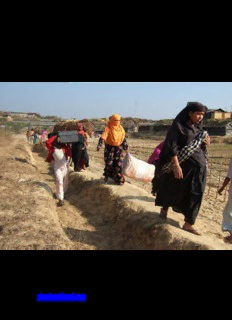
Many children
are begging
for food to
provide a meal
for their
families
‘This camp is not good for
us. We cannot go out to
find work and no one
helps us with food aid. If
we are not allowed to
collect firewood in the
hills, what will happen to
us? How shall we
survive?’
(Interview #1)
Every day, registered refugees in the adjacent Kutupalong Refugee Camp
share their meagre ration with hungry children of the makeshift camp.
Table of contents
Map of Cox’s Bazar District
SUMMARY AND RECOMMENDATIONS
1. Background …… 2
2. The current crackdown …… 3
2.1 – Possible reasons for the crackdown
2.2 – Chronology of events
(cid:131) Bandarban District
(cid:131) Cox’s Bazar District
2.3 – Arrests and push-backs
(cid:131) Push-backs/Informal deportation to Burma
(cid:131) Imprisonment and risk of indefinite detention in Bangladesh
3. Consequences of the crackdown …… 7
(cid:131) Aggression by the local population
(cid:131) Forced displacement and hunger
4. The Kutupalong makeshift camp: At the brink of a Humanitarian Disaster 9
Annexes ….... 12
1 – Detailed chronology of incidents as recorded by the Arakan Project field team
2 – Short interviews with Rohingya displaced to the Kutupalong makeshift camp
The Arakan Project is a research-based advocacy group monitoring the Rohingya
situation in Burma/Myanmar and in other countries in the Asian region in order to
promote their human rights and their protection as refugees.
The Arakan Project is a member of the Asia-Pacific Refugee Rights Network.
The ARAKAN PROJECT
________________________________________________________________________________________________________________
Unregistered Rohingya refugees in Bangladesh:
Crackdown, forced displacement and hunger
An unprecedented crackdown by Bangladesh law enforcement agencies
against unregistered Rohingya refugees who had settled outside the two
official refugee camps in Cox’s Bazar District started on 2 January 2010. More
than 500 Rohingyas were subsequently arrested in January and the crackdown
continues. Some of those arrested were pushed back across the Burmese
border and others were charged under immigration legislation and sent to jail.
In parallel to the roundups, there is a resurgence of anti-Rohingya movements
among the local population and of anti-Rohingya propaganda in the local
media fuelling xenophobia and pressing the government to take action against
the Rohingya. A similar campaign started earlier in 2009 in Bandarban District
and is still ongoing.
Over the last few weeks, fearing arrest, harassment or facing expulsion, more
than 5,000 self-settled Rohingya have already fled their homes and most
flocked to the Kutupalong makeshift camp in Ukhia in search of safety. The
makeshift camp population is now estimated to have swelled to over 30,000.
Forced displacement appears to be a device to push the vulnerable
unregistered Rohingya into this camp.
The makeshift camp residents, including uprooted families, do not receive
food assistance and are now denied access to livelihood as they would face
arrest if they left the camp to find work. Food insecurity and hunger is
spreading rapidly and a serious humanitarian crisis is looming.
RECOMMENDATIONS
We urge the Government of Bangladesh:
1. To immediately cease arrests, push-backs and forced displacement of the
unregistered Rohingya population in Cox’s Bazar and Bandarban Districts
2. To recognise that the unregistered Rohingyas are stateless asylum seekers who
fled persecution in Burma and are in need of international protection; and
3. To provide them with adequate protection, access to livelihood and other basic
services.
1
1. BACKGROUND
The Rohingya are an ethnic, religious and linguistic minority in Burma/Myanmar inhabiting
mostly the three townships of North Arakan bordering Bangladesh. Their number in North
Arakan is estimated at about 725,000. Professing Islam and of South Asian descent, they are
related to the Chittagonian Bengali across the border but are distinct from the majority
population of Burma, who are of Southeast Asian origin and mostly Buddhist. They
gradually faced exclusion in Burma, especially since the military takeover in 1962. They
were rendered stateless by the 1982 Burma Citizenship Law which mainly confers the right to
a nationality on members of the 135 ‘national races’ listed by the government, among which
the Rohingya do not feature. Denial of citizenship is the key mechanism of exclusion,
institutionalising discrimination and arbitrary treatment against this group. Severe
restrictions on their movement and marriages, arbitrary arrest, extortion, forced labour and
confiscation of land are imposed on them. The combination of restrictions and abuses has
also a dramatic impact on their economic survival.
Hundreds of thousands of stateless Rohingyas have fled brutal oppression in Burma.
Impoverished Bangladesh already witnessed two mass exoduses of 250,000 Rohingya
refugees in 1978 and again in 1991/92, which were followed by forced repatriation. Today,
28,000 remain in two precarious refugee camps assisted by the UNHCR and a few NGOs.
But the exodus has never stopped and new arrivals do not have access to the existing refugee
camps and there is no mechanism for them to seek protection.
The unregistered Rohingya
An estimated 200,000 unregistered Rohingya refugees have settled among the local
population, in slums and villages mostly throughout Cox’s Bazar District but also in smaller
numbers in the Chittagong Hill Tracts, eking out a hand-to-mouth existence without any
humanitarian assistance, vulnerable to exploitation and arrest. While keeping them invisible
and portraying them as economic migrants, Bangladesh has generally tolerated their
presence, but anti-Rohingya sentiments have steadily grown among the local population,
manipulated by the local political elite and the media.
Back in 2002, in response to threats of eviction, a first makeshift camp was established near
Teknaf and the 10,000 residents were ultimately relocated to a new site in Leda in June 2008.
In early 2008, a new makeshift camp started sprawling around the Kutupalong refugee camp
as a consequence of eviction threats against self-settled Rohingya during the voter
registration preceding the national election of December 2008. As the population kept
increasing, sections of the makeshift camp were demolished by the Bangladesh authorities on
three occasions in June and July 2009.
In parallel, at the end of 2007, the Bangladesh law enforcement agencies started arresting and
pushing back Rohingya across the border to Burma. Initially, only new arrivals were targeted
but, since mid-2009, self-settled refugees have also been deported.
2
2. THE CURRENT CRACKDOWN
The recent crackdown is unprecedented as, for the first time, law enforcement agencies – the
police and the BDR (Bangladesh border security forces) – are actively involved in rounding
up unregistered Rohingya at their workplace, along roads, on buses and in their homes,
simultaneously in all sub-districts where Rohingyas have settled.
At the same time, a xenophobic campaign is being orchestrated by Anti-Rohingya
Committees formed and allegedly funded by the local political elite, voicing their hostility to
the Rohingya presence more loudly than ever and demanding that the government take action
against the Rohingya. Announcements have been disseminated by loudspeakers in villages
and towns ordering the Rohingya to leave and also threatening locals harbouring them with
arrest and prosecution. The local media act as a campaign vehicle for anti-Rohingya
propaganda.
This would suggest a concerted strategy instigated at the central government level and not
just an occasional outburst of anti-Rohingya sentiments at the local level.
2.1 – Possible reasons for the crackdown
The reasons behind this crackdown as well as its objectives still remain obscure to The
Arakan Project and other observers in the area. It is particularly puzzling as the government
had responded positively to donors and other stakeholders in 2009 in considering registration
for this population.
However, the fact that mass displacement is directed toward the makeshift camp would
indicate intent to evacuate unregistered Rohingyas from mixed settlements where they used
to live in order to separate them from the local population and regroup them in the
Kutupalong makeshift camp.
Some observers believe that the crackdown is certainly an attempt by Bangladesh to stop the
continuous trickle of Rohingya asylum seekers from Burma by spreading panic among the
unregistered population. Sources in Burma estimate that about 8,000 Rohingyas fled in 2009
- a larger number compared to the previous year. Bangladesh is concerned that the national
election planned in Burma for late 2010 and the erection of a border fence may generate
further instability and could result in increased outflows of Rohingya refugees. The anti-
Rohingya drive may therefore be intended to act as a deterrence strategy. Following the
spread of the crackdown to the whole of Cox’s Bazar District, Rohingya asylum seekers from
North Arakan have practically ceased to cross the border.
2.2 - Chronology of events
Two phases in the current crackdown can be identified so far:
- in Bandarban District of the Chittagong Hill Tracts where it started in mid-July 2009 and
intensified in October
- in Cox’s Bazar District where arrests began on 2 January 2010.
3
(cid:131) Bandarban District
The voter list updating by the Bangladesh Election Commission appears to be a trigger rather
than the main motive. In Bandarban District, initial arrests and push-backs of Rohingya
residents coincided with the voter list updating exercise in mid-July and stepped up in
October after the Election Commission announced that voter lists would be re-examined in 8
sub-districts (4 in Bandarban District in the Chittagong Hill Tracts and 4 in Cox’s Bazar
District) 1 on allegations that many Rohingyas had been fraudulently included in the electoral
roll with the help of election officials and local political representatives.
Sub-districts earmarked for voter list review
Cox’s Bazar District Bandarban District
Cox’s Bazar Municipality Bandarban Municipality
Ukhia Naikongchari
Teknaf Alikadam
Ramu Lama
(cid:131) Cox’s Bazar District
However, in Cox’s Bazar town, police raids started on 3 January, after the voter list had
already been reviewed and finalised in December 2009 and cannot therefore be attributed to
the updating exercise.
The crackdown in Cox’s Bazar District follows the announcement in the Bangladesh national
media2 picked up by the BBC and other international wire services on 29 December 2009
that Myanmar had agreed to the repatriation of 9,000 Rohingya refugees during a meeting
between Bangladesh Foreign Secretary Mijarul Quayes and Myanmar Deputy Foreign
Minister U Maung Myint. This was clearly a political statement for domestic consumption.
The figure discussed at the meeting was reportedly 6,000 and not 9,000. Moreover, 6,000
refugees had already been cleared for repatriation in the 1990s but had refused to return.
While there was nothing new in this announcement and no sign in the refugee camps that a
repatriation exercise was imminent, the local media started stirring up local sentiment against
the Rohingya.
The sequence of events and incidents that follow pointed to a disturbing coordination and
alliance between three stakeholders: law enforcement agencies (police and BDR), civil
society through Anti-Rohingya Committees3 led and allegedly funded by the local political
elite of the ruling party, the Awami League, and local media as a campaign vehicle inciting
intolerance.
1 The Daily Star, ‘EC to probe Rohingyas on voter lists’, 3 October 2009
http://www.thedailystar.net/newDesign/print_news.php?nid=90181
2 The Daily Star, ‘Myanmar to repatriate 9,000 Rohingyas’, 28 December 2009
3 Anti-Rohingya Committees are active in Ukhia and Teknaf, not in Cox’s Bazar. The one in Teknaf was
established in 1996 but the one in Ukhia was formed in 2009. Their leadership belongs to the Awami League in
power but their membership also includes supporters of opposition parties. They became particularly vocal in
late 2009.
4
- 29 December 2009: A misleading political declaration that Myanmar had agreed to the
repatriation of 9,000 refugees was published in the media.
- 31 December 2009: The Minister for Food and Disaster Management, Dr. Abdur Razzak,
accompanied by the local Awami League MP, Abdur Rahaman Bodi, visited the refugee
camps and interviewed refugees who reiterated that they would not repatriate voluntarily
before significant improvements take place in Burma. The same day, the Anti-Rohingya
Committee in Teknaf delivered a speech demanding that the Rohingya be cleared out of the
area.
- 2 January 2010: Seven local newspapers in Cox’s Bazar claimed that hundreds of
Rohingya refugees escaped from the camps in fear of repatriation4. Our refugee team denied
such movements. Police started arresting Rohingyas on buses travelling from Teknaf
towards Cox’s Bazar, mostly unregistered refugees, not camp refugees.
- 3 January 2010: Police raids started in Cox’s Bazar town, initially targeting Rohingya
rickshaw-pullers.
- 13 January 2010: The Anti-Rohingya Committee in Ukhia held a meeting demanding that
the government take action to stop infiltration of Rohingya into Bangladesh and move ahead
with repatriation. The same day the crackdown intensified in Ukhia. Police also put up a
temporary checkpoint along the Teknaf-Cox’s Bazar road near the Kutupalong camp, aimed
at curtailing Rohingya movement.
- 14 January 2010: The local media stated that the crackdown was not effective because
Bangladeshis protect the Rohingyas and called for prosecution of anyone harbouring them5.
- 15-16 January 2010: Crackdowns started in various locations in Teknaf Sub-district. In
Teknaf town and many villages, there were public announcements by loudspeakers that all
Rohingyas should leave and that locals sheltering them would also be arrested.
- 18 January 2010: The Anti-Rohingya Committee in Ukhia organised a meeting with
international NGOs but their demands were mostly business-oriented.
- 21-22 January 2010: Rohingya tenants, evicted from their rented rooms in Teknaf, started
gathering and putting up shanties near the Teknaf bus terminal but the police ousted them the
next day and told them to return to their homes.
- 24 January 2010: The BDR commander held a meeting with local reporters seeking their
cooperation in the crackdown in the ‘national interest’.
- 25 January 2010: A human chain was organised in Ukhia by an Anti-Rohingya Youth
Committee with the slogan: “Kick out Rohingyas! Save the Country!”
- 28 January 2010: The Anti-Rohingya Committee of Teknaf met once more and again
pushed their 7-point demand for a greater Chittagong free of Rohingya.
4 The Daily Ajker Deshbidesh, ‘Rohingyas unwilling to repatriate scatter in different places’, 2 January 2010
5 The Daily Dainandin, ‘Absconding Rohingyas are sheltered by locals: civil society suggests to lodge sedition
case against their protectors’, 14 January 2010 (translated from Bengali)
5
Description:Page 1. The ARAKAN PROJECT. Unregistered Rohingya refugees in Bangladesh: Crackdown, forced displacement and hunger. 11 February