Table Of ContentDocuments on Canadian Arctic Sovereignty and Security
UNFURLING THE AIR FORCE ENSIGN
IN THE CANADIAN ARCTIC
The 1922 Eastern Arctic and
1927-28 Hudson Strait Expeditions
P. Whitney Lackenbauer and K.C. Eyre
Documents on Canadian Arctic Sovereignty and Security (DCASS)
ISSN 2368-4569
Series Editors:
P. Whitney Lackenbauer
Adam Lajeunesse
Managing Editor: Ryan Dean
Unfurling the Air Force Ensign in the Canadian Arctic: The 1922 Eastern Arctic and 1927-
28 Hudson Strait Expeditions
P. Whitney Lackenbauer and K.C. Eyre
DCASS Number 3, 2015
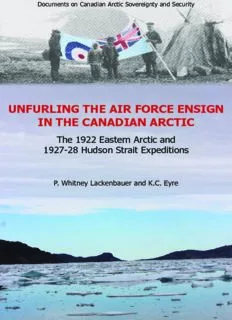
Cover: landscape image by P. Whitney Lackenbauer; DND photo 13080 (top)
Cover design: Daniel Heidt
Centre for Military and Strategic Studies Centre on Foreign Policy and Federalism
University of Calgary St. Jerome’s University
2500 University Dr. N.W. 290 Westmount Road N.
Calgary, AB T2N 1N4 Waterloo, ON N2L 3G3
Tel: 403.220.4030 Tel: 519.884.8110 ext. 28233
www.cmss.ucalgary.ca www.sju.ca/cfpf
Copyright © the authors/editors, 2015
Permission policies are outlined on our website
http://cmss.ucalgary.ca/research/arctic-document-series
Unfurling the Air Force Ensign in the Canadian
Arctic: The 1922 Eastern Arctic and 1927-28
Hudson Strait Expeditions
P. Whitney Lackenbauer, Ph.D.
and
K.C. Eyre, Ph.D.
Contents
Introduction: The Air Force and the Opening of the Canadian Arctic in the Interwar
Period ...................................................................................................................... iv
The Logan Report (1922).................................................................................... xi
1927-28 Hudson Strait Expedition ................................................................. xviii
1. R.A. Logan, Report on Aviation in the Arctic Archipelago, 1922 .......................... 1
Aviation and Northern Canada ........................................................................... 1
The Northern Archipelago .................................................................................. 4
Aircraft Uses ...................................................................................................... 14
Ice Conditions................................................................................................... 17
Climatic Conditions .......................................................................................... 20
Aircraft and Accessories ..................................................................................... 22
Transportation .................................................................................................. 29
Personnel .......................................................................................................... 33
Navigation, Wireless and Photography .............................................................. 35
Fuel, Food and Clothing ................................................................................... 41
Eskimos............................................................................................................. 44
Craig Harbour................................................................................................... 47
Dundas Harbour ............................................................................................... 52
Pond’s Inlet ....................................................................................................... 53
Suggestions ....................................................................................................... 58
2. F/L T.A. Lawrence, Report on the Hudson Strait Expedition 1927-28. .............. 66
Part 1 Intention................................................................................................. 66
Part II – Methods of Execution ......................................................................... 67
Part III – Organization ...................................................................................... 67
Part IV - Locating and Establishment of Bases ................................................... 69
Part V – Operations .......................................................................................... 72
ii
Part VI – Statistics ............................................................................................. 80
Part VII – Operational and General Flying Conditions ..................................... 81
Part VIII – Photographic Conditions and Photographic Equipment .................. 83
Part IX – Aircraft and Aircraft Engines .............................................................. 84
Part X – Aircraft Emergency Equipment ........................................................... 88
Part XI –Flying Clothing ................................................................................... 90
Part XII- General Equipment and Supplies ........................................................ 93
Part XIII – Buildings ......................................................................................... 96
Part XIV – Aircraft Instruments ........................................................................ 98
Part XV – Medical Equipment .......................................................................... 99
Part XVI – General Living Conditions ............................................................ 100
Part XVII – Recommendations. ...................................................................... 102
About the Editors ................................................................................................. 107
iii
Introduction: The Air Force and the Opening of the Canadian
Arctic in the Interwar Period
The twentieth century advance into the Arctic owes more to the
aeroplane than any other factor.
-- Terence Armstrong, (1958)1
Canadian armed forces have been involved periodically in the North since the days of
the Klondike Gold Rush in 1898. The intensity and degree of this involvement have
reflected the changing perceptions of the North as they relate to defence, sovereignty,
and national development.
For its part, the Royal Canadian Air Force made its first forays into the North in the
interwar years as an agent of national development. As this volume reveals, the early
expeditions took place in what now would be called a “whole of government” context.
The Department of the Interior approached the Air Board to send an aviation expert
(Squadron Leader Robert A. Logan) on the 1922 Canadian Arctic Expedition to
reconnoitre (without a plane) and discern the feasibility of operating aircraft in the
Arctic. His comprehensive report painted a detailed picture of the conditions in
Canada’s Arctic Archipelago, conceptualized what contributions aircraft could make
to northern development, and recommended which airframes could withstand the
severe environment. Five years later, the RCAF gained its first Arctic flying experience
when it deployed six aircraft into Hudson Strait area to conduct an aerial survey in
support of plans to open Churchill as an ocean shipping port. Squadron Leader
Thomas A. Lawrence’s detailed report encapsulates the main results of the 1927-28
expedition, which marked the first concerted effort to use aircraft for ice and weather
reconnaissance in the Canadian Arctic and produced significant insights into
conditions along Hudson Strait. While often overshadowed by the exploits of bush
pilots who opened the Canadian North, these landmark documents provide examples
of how the Air Force has contributed to northern exploration and built “an enviable
record of efficient arctic operations.”2
* * *
1 Terence Armstrong, The Russians in the Arctic: Aspects of Soviet Exploration and Exploitation of
the Far North, 1937-57 (Fair Lawn, NJ: Essential Books, 1958), 62.
2 Moira Dunbar and Keith Greenaway, Arctic Canada from the Air (Ottawa: Defence Research
Board, 1956), 480.
iv
At the end of the Great War, Canadian attention again turned to the unresolved issue
of sovereignty over the islands of the Eastern Arctic. There had been no official
Canadian presence in the area since Captain J.E. Bernier’s 1910 expedition (the third
of his prewar patrols in the Coast Guard Ship Arctic), even though Dominion
Astronomer Dr. W.F. King’s 1904 commissioned study of the problem of sovereignty
in the Arctic had concluded that Canada’s claim was imperfect. Furthermore, strong
rumours circulated in Ottawa that other nations were preparing to occupy sites in the
“Canadian North.” The Danes, long established in Greenland, were reportedly
planning an expedition to Ellesmere Island, an area they regarded as unclaimed. The
Norwegians had an historic but undeveloped claim to the islands west of Ellesmere,
thanks to the explorations and discoveries of Otto Sverdrup in 1903-1905. American
sponsored explorations were apparently in the offing and it was reported that a
recently published American atlas showed Ellesmere in the same colour as Alaska—an
ominous sign to concerned Canadians.3
In response to these perceived threats, the Department of the Interior formed a small
group of senior civil servants into the Advisory Technical Board in 1919. The Board’s
mandate was twofold: to determine whether the Canadian title to the Arctic islands
was worth developing; and, if so, to recommend what steps should be taken to
establish such a title. The focus of the study was on the islands of the Eastern Arctic,
but in some respects it touched on factors affecting the entire archipelago. Although
the federal government and Canadians more generally perceived neither the potential
value nor the importance of the islands, the Board found many compelling reasons for
Canada to perfect her claim to the region. “Ellesmere and the other northern islands,
have always been regarded in Canada as Canadian,” it noted, “and there doubtless
would be strong sentiment against their being taken possession of by any other flag.”4
3 On these developments, see Gordon W. Smith, A Historical and Legal Study of Sovereignty in
the Canadian North, 1870-1942, ed. P. Whitney Lackenbauer (Calgary: University of Calgary
Press, 2014); Janice Cavell and Jeff Noakes, Acts of Occupation: Canada and Arctic Sovereignty,
1918-25 (Vancouver: UBC Press, 2010); and Janice Cavell, “Sector claims and counter-claims:
Joseph Elzéar Bernier, the Canadian government, and Arctic sovereignty, 1898-1934,” Polar
Record 50/3 (July 2014): 293-310.
4 Canada, Department of the Interior, Report by the Sub-Committee of the Advisory Technical
Board (henceforth ATB Report), (n.d. 1919?). There are apparently several drafts of this report
extending well into 1920. The one referred to here is probably the first draft. It was submitted
to the Commissioner of the RCMP in January 1920. Eyre originally accessed the report in the
RCMP Historical Section, file G-516-37, Sovereignty over Islands Lying North of the Mainland
of Canada (henceforth RCMP Northern Sovereignty), vol. 2. It has since been transferred to the
Library and Archives Canada (LAC), Record Group (RG) 18, accession 1984/-85/084, vol.33,
file G-516-37. On the ATB, see Cavell and Noakes, Acts of Occupation, 57-62.
v
The emotional and nationalistic nature of the issue would probably, in itself, have
been strong enough to cause the Board to recommend development of the Canadian
claim. In any case, the Board produced several other perceptive and far-sighted
reasons for action. For example, they noted the role the islands might play in civil and
military aviation, broaching a subject that was to beguile and haunt defence planners
in the late 1940s and early 1950s. As the Board saw it, “It would be undesirable and
dangerous to allow another nation to get a foothold in the north now that aerial
navigation has become so far advanced.” Nor was the significance of the Alaska
precedent lost on the Board members. They were well aware that the unknown land
that had been dubbed “Seward’s Folly” at the time of purchase not only turned out to
be a literal gold mine but also eventually yielded substantial other resources. It was
anticipated that the Arctic Archipelago might well contain vast reserves of mineral
wealth. There was even at that early date the suspicion voiced that oil might be
discovered in the more westerly islands. Clearly, for a wide variety of reasons, the
Board thought that it was in Canada’s immediate interest to develop her sovereign
claim.
Interestingly, none of the major legal reports written in 1920 and 1921 suggested that
the government utilize the sector principle to bolster Canada’s sovereignty position in
the Arctic. Instead, all called for further acts of occupation.5 Of the various methods
by which a state can acquire territory within the established conventions of
international law, the Board saw occupation as most appropriate to the case of the
islands of the Eastern Arctic. Occupation required more than just a symbolic act such
as the hoisting of a flag. A real claim to sovereignty, through occupation, had to be
based upon a physical presence and the establishment of government administration
in the area.6 Obviously, some agents of the Canadian government were going to have
to go north.
The Board was quite definite as to who these agents ought to be: sovereignty in the
Eastern Arctic was to be established by the Royal Canadian Mounted Police. The men
of the Force had already established a presence in the Yukon, the Mackenzie, and
along the fringes of Hudson Bay. It seemed natural that now they should be sent
farther afield. The Board does not appear even to have considered such alternatives as
a military garrison or a civil agency of the Department of the Interior.
5 See Peter Kikkert and P. Whitney Lackenbauer, Legal Appraisals of Canada’s Arctic Sovereignty:
Key Documents, 1904-58, Documents on Canadian Arctic Sovereignty and Security (DCASS)
No. 2 (Calgary and Waterloo: Centre on Military and Strategic Studies/Centre on Foreign
Policy and Federalism), 2014.
6 ATB Report.
vi
The Report produced by the Advisory Technical Board became the key planning
document for subsequent Canadian occupation of the Eastern Arctic. Virtually all its
recommended programs and approaches were eventually implemented. The one area
where the opinion of the Board differed from that of the Cabinet was the need for
haste. The bureaucrats thought that immediate action was imperative; the politicians
perceived no such pressure.
The members of the Board were concerned with the need “to get there first,” but by
the time the Report had been fully considered in the Department and the Cabinet, it
was mid-1920 and the summer shipping season was too far advanced for Canada to
do anything concrete that year. It was the potential Danish “threat” to Ellesmere
Island that most concerned the Department of the Interior. The Board went so far as
to outline a tentative plan to be used if definite evidence became available that the
Danish government was going to support an expedition in 1920. They recommended
that Canada should attempt to borrow an airship from the imperial government,
which could be loaded with a group of RCMP constables and a winter’s worth of
supplies, then launched from Scotland towards the Pole. Over Ellesmere Island, the
police could parachute onto the island in time to greet the Danes.7 Given the state of
the art of arctic aerial navigation and parachuting technology, it is fortunate for the
police that there never was a need to implement this hare-brained pre-emptive
scheme.
At first glance, it would seem that it would have been reasonable to turn to the
Department of Militia and Defence for the men for this contingency plan. “Airborne
operations,” as the mass parachuting of troops was to become known in the next war,
were still a phenomenon of the future. Parachuting in the early 1920s was still very
much a fairground display stunt or, increasingly, a lifesaving means for aviators. The
link between parachuting and the military had yet to be formed.8
In another sense, this minor plan is illustrative of the manner in which the defence
establishment was regarded in Canada. There is no evidence that the Department of
the Interior ever even considered consultation with the Department of Militia and
Defence on any aspect of the problem. On the other hand, it is unlikely that the
military would have had the slightest interest in the project had they been
7 In point of fact the Danish government was quite helpful to Canada when the expedition was
actually launched, and continued to provide assistance during the period 1922-25. See Smith,
Historical and Legal Study, and Cavell and Noakes, Acts of Occupation.
8 Brigadier-General William Mitchell’s plan to drop the 1st Division of the American
Expeditionary Force behind German lines at Metz in support of the 1919 offensive had
naturally not come to fruition, fortunately for the American troops as the concept was ahead of
the technology required to support it.
vii
Description:Unfurling the Air Force Ensign in the Canadian Arctic: The 1922 Eastern Arctic and 1927-. 28 Hudson Strait medical officer, a radio engineer, a signaller from the Royal Canadian Corps of. Signals, an .. various ways to increase our knowledge of the natural resources of the country to make that