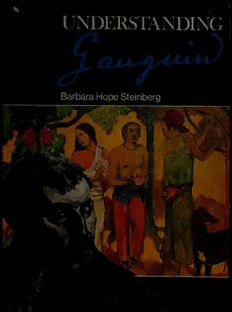
Table Of ContentUNDERSTANDING
Barbara Hope Steinberg
A
r - .**
1
:.,,
Wu&NM toflWiOOM
UNDERSTANDING
Hope
Barbara Steinberg
An
analysis of the work of the legendary
rebel artist of the 19th century
Self-portraitwithaHalo
1889
Oilonpanel
31ix20iin
(79.4x51.4cm)
NationalGalleryofArt.
Washington DC,
ChesterDaleCollection
A&W
Publishedby
VISUALLIBRARY
NewYorkandLondon
Originated,designedand
producedbyTrewin
CopplestonePublishing
Ltd,London
©
TrewinCopplestone
PublishingLtd1976
Filmsetand
reproducedby
PhotoprintPlatesLtd,
Rayleigh, Essex
PrintedinGreatBritainby
ChromoworksLtd,
Nottingham
Allrightsreserved.Nopart
ofthispublicationmaybe
reproduced,recordedor
transmittedinanyformor
byanymeans,whether
electronicormechanical,
includingphotocopy,
microfilm,recordingor
anyinformationstorage
andretrievalsystem,
withoutpermissionin
writingfromTrewin
CopplestonePublishing
Ltd,London
LibraryofCongress
CatalogCardNumber:
75-37495
ISBN0-89104-033-1
Gauguin: His Life and Times
The legend of Paul Gauguin is perhaps the
most famous in art history he was the man
:
who abandoned civilization in middle age
and fled to the tropics to paint. Like many
legends, it is a great oversimplification.
GauguinwasborninParisin 1848, during
the Revolution. His father, Clovis, was a
journalist, but it was his mother, Aline-
Marie, and her family, who influenced Gau-
guin most. She was the daughter of the en-
graver, Andre Chazal, and Flora Tristan.
Chazal tried to murderhiswife, andwas im-
prisoned. Florawastheillegitimatedaughter
ofTherese Laisnay and a Spanishcolonel of
aristocraticfamily, Don MarianodeTristan
Moscoso. His family were wealthy and
powerful Peruvian settlers; Gauguin be-
lieved that they had intermarried with Inca
PortraitofMette
1877 nobles. Certainly, Flora went to Peru; the
Whitemarble book she wrote about her travels launched
h 13in her on a literary career. Eventually she be-
(33cm)
Courtauld Institute came a revolutionary social reformer. Gau-
Galleries. guin worshipped her, and was profoundly
London
affected by her romantic rebellion.
Emigrating to Peru with his family to Eventually,however,Gauguin'sguardian,
escape the Revolution, Clovis died on the Gustave Arosa, got Gauguin a job on the
voyage. Aline and her children, however, Parisstockexchange. Gauguin settleddown
stayed with powerful relatives in Lima until to a bourgeois life, marrying a Danish
Gauguinwassix. Thislifeofeaseinanexotic governess, Mette Gad, in 1873; she bore
paradise haunted Gauguin, and he spentthe him five children. But Gauguin was already
rest of his life trying to return to his child- moving toward an artist's life when he mar-
hoodEden. Assoon aspossible, heattempt- ried. He studied Arosa's fine collection of
ed to escape from the dull misery ofprovin- modern French paintings, and began paint-
cial France; from 1865 to 1871, he served in ing under the tutelage ofArosa's daughter,
the merchant marine and French navy. Marguerite. By 1879, Gauguin himselfwas
collectingart,primarilyImpressionistwork,
and he worked with Camille Pissarro (1831-
1903), who encouraged him greatly.
In 1882, French finance was in trouble. It
seems as likely that Gauguin lost hisjob as
that he resigned. By 1883, he had become a
full-time painter. He moved to Rouen to be
near Pissarro, and to live more cheaply.
Mette, meanwhile, took the children to
Copenhagen, where she supported them by
teaching and translating. Gauguin joined
them in 1884, but theyearwasnota success.
He loathed her staid, middle-class family
and friends, and did everything possible to
offend them.
A
(1p8o0r3t-ra1it84o4f)F.loGraauTgruiisnt'ans In 1886, GauguinleftParisforPontAven,
grandmother ty in Brittany. He fell in love with its primitive
:
I
Photographtakenatthe people and wild landscape; it was, indeed,
PensionGloanec,
his first great step towards his rejection of
Pont-AvenofGauguinand
hisfriends.Gauguinis Western sophistication and civilization.
seatedinthefrontrow. Continuingon thispath, hewent to Panama
in 1887. Sickness and poverty drove him
away from Martinique, where he had con-
tinuedafterPanama, butthevisit borefruit
the brilliant colours and flat designs of his
newpaintings markedadefinitivedeparture
from Impressionism. In 1888, hereturnedto
Brittany,andsoonconsolidatedhisprogress.
His paintings became solid, monumental,
and poetic. About this time, he became
friendly with Emile Bernard (1868-1941).
There was considerable argument between
them about who was actually responsible
forthestylisticrevolutioncalledcloissonisme,
in which flat, bright areas ofcolourwereen-
closed by dark lines. It seems likely that
Bernard originated it, but Gauguin took the
idea much further.
It must be observed that Gauguin was
always incapable of treating friends as
Camille Pissarro:Gauguin
CarvingtheLittle equals. He insisted on dominating Bernard
Parisienne and Schuffenecker, another painter, and
1880-81 later, the artists Meyer de Haan and Seru-
Drawing
Nationalmuseum. sier. His disciples gave him enormous psy-
Stockholm chological and financial support, but when
-
they finally rebelled, Gauguin was furious.
Nowhere is this more evident than in his
relationship with Van Gogh.
In 1888, primarily to please Theo Van
Gogh (an art dealer who might help him),
Gauguin stayed with Vincent Van Gogh in
Aries for ten weeks. There was unremitting
tension between them. Van Gogh wanted
an artistic fraternity, but Gauguin insisted
on being the master. Van Gogh gladly be-
came his pupil, but the concepts that Gau-
guinforcedonhim-therejectionofnatural-
ism and working abstractly from memory
were totally alien. This conflict stimulated
Gauguin, but drove Van Gogh over the
brink to madness. AfterattackingGauguin,
Sectionofalettertoanunknowncollectorc. 1896
10*91in (25.4x24cm)
Mrand MrsAlex M. LewytCollection.NewYork
BonjourMonsieurGauguin
1889
36ix29in
(113x92cm)
NationalGallery.
Prague
Self-portraitforVanGogh
1888
Oiloncanvas
17f*21fin
(44.1x54.8cm)
Rijksmuseum
VincentVanGogh.
Amsterdam
AndtheGoldoftheir
Bodies
1901
Oiloncanvas
26|*29|in
(67*75.9cm)
Museedu Louvre,
Paris
he cut off his own earlobe and sent it to a gant. He dressed flamboyantly, decorated
prostitute. Gauguin notified Theo and re- his apartment exotically, and took a foreign
turned to Paris. mistress, Annah, the (alleged) Javanese. In
In 1889, Gauguin went back to Brittany, 1894, he went to Pont Aven. In a fight with
goingfromPortAventothemoreremoteLe some sailors over Annah, he broke his leg.
Pouldu. By this time, he was the acknowl- While he was bedridden, Annah sacked his
edged master there, with a growing reputa- studioandlefthim.
tion. His fame spread, and by late 1890, he Embittered, Gauguin left France forever,
was in close touch with the Symbolist and returned to Tahiti in 1895. He settled at
writers. Yet, perversely, he abandoned this Punaauia with anew mistress, Pahura, until
possibility ofFrench success to go to Tahiti 1901. Bedevilled by conjunctivitis and the
in 1891. syphilis which would kill him, crippled by
With the official status ofan artist on an his bad leg, and desperately poor, he alter-
unpaid mission, Gauguin embarked on his nated between happiness and misery. In
greatest adventure. Afterhis arrival he soon 1897, disasters multiplied: his favourite
movedfromPapeeteto Mataiea, seekingthe daughter, Aline, died, precipitating thefinal
realTahitiofhisdreams. HetookaTahitian break with Mette; he had to move, and he
wife, Teha'amana, and lived like a native. becamemuchsicker. Eventually,heattempt-
ButtheoldTahitianculturewasgone Tahiti ed suicide, but failed.
;
was now merely a poor French colony. Dis- In 1901, Gauguin moved to the more pri-
appointed, and increasinglyill with syphilis, mitive Marquesas Islands, still in search of
Gauguin was eventually repatriated to hisdream. Formuch ofhislastfiveyears, he
France in 1893. Despite his physical and didnotpaintalot,butworkedasadraughts-
mental torment, his stay in Tahiti changed man andjournalist. Yet, despite the horror
his life and marked him forever. His vision ofthis time, he produced during these years
triumphed over reality, and gave birth to someofhisfinestpaintings-radiant, lyrical,
rich, goldenpaintingsinwhichhecelebrated and mysterious. In 1903, Gauguin died. The
the carefree existence and primitive splen- paradise he never really found in life now
dour ofhis dreams. exists forever, immortalized in his art. By
In Paris, Gauguin found himself out of sacrificing family, friends, and life itself,
touch. Hewasdistant, withdrawn, andarro- Paul Gauguin did return to Eden.
Technique
TheSeaweedHarvesters Gauguin has long been acknowledged to be
1889 one ofthemostflamboyant rebelsinthehis-
Oil
Nomeasurementsavailable tory of art. Despite this, his painting tech-
Folkwang Museum, nique seems to have developed in much the
Essen same way as that of the vast majority of
Western artists, however revolutionary or
conservative they may otherwise have been.
The artist, when a child, paints freely and
inventively, without any technical restraints
orinhibitions. Ashebecomesmoreawareof
his talent, heattempts toachievea moredis-
ciplined, tighter realism, usually with a high
degree of finish. He will then be influenced
byartistsslightlyolderthenhimself, andwill
apply paint in their manner. Only then will
he gradually develop his own style and his
own technique.
So it was with Gauguin. Even in his very
earlyflirtationwithrealism, hewasinfluenc-
DetailoftheseatedwomanfromTheSeaweedHarvesters edbyImpressionism.Soonhefellcompletely
DetailfromBarbaricTales
BarbaricTales1902Oiloncanvas51£x36 n
j
(129.9*91.4cm) FolkwangMuseum. Essen
paint thin and flat, however vivid and in-
tense the colour. Fortunately, necessity ac-
companied invention in his case, since he
could not afford much paint, particularly
towards the end ofhis life.
Gauguin's work was always controlled
and carefully conceived there was nothing
;
of the wild man in his technique. In one
aspect, however, it did show his rebellious
nature, his eagerness to experiment: Gau-
guinwouldpaintonalmostanything.Coarse
canvas, paper, wood, glass, silk, doors,
walls, and windows all provided adequate
surfaces for his work. Because the paint was
so very thin, the surface below almost
alwaysshowedthroughit,andhemoreoften
than not exposed these unusual surfaces
under the spell of the Impressionists, and deliberately.
for some time painted in the Impressionist Both paintings on these pages are charac-
style: loosely, in small blobs and flecks, teristic of Gauguin's mature technique. In
following the direction of each form. This theearlierpainting,TheSeaweedHarvesters,
created a rich, lively surface of vibrating we see the paint applied in long, parallel
colours. strokes,followingthecontoursofeachform.
Eventually, however, Gauguin became These strokes are built into simplified
dissatisfied with Impressionism. In discard- shapes, with little variation ofcolour within
ingtheImpressionistconceptionoftheartist each shape. Broad contour lines enclose
asaneyerecordingnature,healsocastoffhis each shape. This combination of emphatic
Impressionist technique. In developing his line, simplified shapes, and paint applied
own technique, Gauguin followed yet an- thinly with little change in the direction or
otherclassicpath in art history. length ofstrokes, makesa flat, bold pattern.
Thera has always been a dichotomy be- ThesameistrueofthelaterBarbaricTales,
tween ariists who emphasize line, and those butherethesurfaceisdevelopedwithgreater
who emphasize colour. The former usually subtlety. Thecontour lines are not so harsh;
apply paint thinly, keeping the surface flat, sometimesthey are omitted. Thereisgreater
whilethecolouristsusethick,juicyimpastos, variation in the colours and strokes within
enlivened by exciting brush work. Though each shape, but less extreme contrasts be-
Gauguin wasafinecolourist-indeed, some- tweencolours. Thereis an airy, atmospheric
times a brilliant one-the essential nature of quality in much ofthebrushwork, and it isa
hisworkwaslinear. Hence,hekepttheactual warm, mellow, and unified vision.
Use ofColour
realisticcolourentirely. Colourbecame, for
Gauguin, a totally imaginative conception.
He used it to create a mood, to charge a
painting with emotion, and to establish a
complex, intricate, ambiguous symbolism.
In one of Gauguin's mature works, The
Vision after the Sermon on this page, we see
apowerfulembodimentofthisrevolutionary
use ofcolour. The painting depicts a group
of Breton villagers departing from church.
Underthe influenceofthesermon they have
just heard, they see a vision ofJacob wrest-
lingwiththeAngel. Thevillagersthemselves
are painted in dull, sombre hues, colours
closetothoseofreality,withoutbeingtotally
realistic. They are, in fact, simplified and
subdued to form the greatest possible con-
trast with the rest of the painting. So, too,
TheVisionaftertheSermon
1i
Oiloncanvas
28fx36iin
(73x92.1 cm)
NationalGalleryof
Scotland,
Edinburgh
DetailofJacobandthe
Angelfrom TheVisionafter
theSermon
Gauguin was one of the most adventurous
andinventivecolouristsinmodernpainting.
Heextendedtheroleofcolourfarbeyondthe
boundariesfixedbytraditionintocompletely
newterritory. Mostartistshaveusedcolour,
however carefully composed, primarily to
reproduce the colours seen in nature; so,
too, did Gauguin, at first. In his early Im-
pressionist works, he used flickering strokes
ofcolour to capture the effect of the many
colours, lights, and shadows he saw in each
object. Gradually, he simplified this, paint-
ingeach massin theonecolourwhichseem-
ed to dominate it. Eventually, he eschewed