Table Of Contentfill VllfllfiffHfl
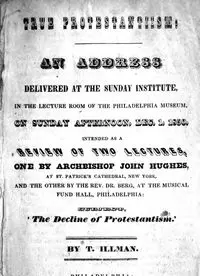
DELIVERED AT THE SUNDAY INSTITUTE,
IN THE LECTURE ROOM OF THE PHILADELPHIA MUSEUM,
INTENDED AS A
ONE BY ARCHBISHOP JOHN HUGHES,
AT
ST. PATRICK'S CATHEDRAL, NEW YORK,
AND THE OTHER BY THE REV. DR. BERG, AT THE MUSICAL
FUND HALL, PHILADELPHIA:
The Decline of Protestantism.'
BY
T« VL1MAS.
PHILADELPHIA:
PETERMAN8>> WOOD,
No. 3 Ledger Building, one door below Chesnut Street,
FOR THE SUNDAY INSTITUTE.
1850.
The author, in submitting his views to the public, has done
so in compliance with the request of a number of friends who
were present at the Sunday Institute, Lecture Room, Chinese
Museum, on the occasion of his addressing the audience there
assembled the few observations suggested to his mind by read-
ing and hearing the Lectures of Archbishop Hughes and Rev.
Dr. Berg,
to which they refer.
In the claims he has made
for the
largest possible freedom of thought and expression in
matters of mere
opinion, even religious opinion, he thinks he
has not exceeded
the
latitude
permitted, or
is becoming the
denizen of this great
city, founded by the ever memorable,
and one
of the worthiest and noblest advocates
of
civil and
religious liberty, William Penn.
The comparison of the
rival claims
to
infallibility on the
part of both the Catholic and Protestant Churches, and the
grounds on which
their pretensions are
based, are derived
from the perusal of a work by the Rev. Theodore Parker,
some three or four
years ago;
but
as
this work
is not ac-
cessible
at
this time, the
author
of
this
little pamphlet,
al-
though he
has endeavoured
to
the
best
of
his
ability and
recollection,
to
use
the
phraseology of
the work
in
ques-
tion, which made a strong
impression
on
his
mind
at
the
time, (as
it could not
fail
to do on
that of every honest
in-
quirer
after
truth,)—yet,
whilst he
has borrowed some of
the ideas, and even made use of the expressions, as far as his
recollection served,
still he could not
venture
to put them
forth as quotations from Mr. Parker without manifest injustice
to that gentleman
•, and, at the same time, if he should have
expressed any thing
clearly, satisfactorily, or definitely upon
this
point, he
takes much
pleasure
in
acknowledging
the
source from whence
it has been obtained.
toot mmesimotml
^^^^
About a fortnight
since,
the Catholic Archbishop, John Hughes, left our
shores
for Europe: before
his
departure, however, he contrived to leave us
something
to remember him.
It will
readily be conjectured that we allude
to
his lecture
at
St.
Patrick's
Cathedral, New York, on
the
"Decline
of Protestantism!"—which,
however
it may have pleased and
edified
the
faithful
of the Catholic communion,
has
caused
the
most
lively
feelings
of indignation and dissatisfaction among the Protestant
portion
of society.
We
have
read
this lecture of his with some
little
attention, and we have,
also,
read
some remarks which
his Protestant hearers and
readers have
made upon
it ;
moreover, we have listened
to an eloquent address on this
same interesting subject
delivered by the Rev. Dr. Berg, of
this
city,
at
the Musical Fund
Hall,
which was
attended
by an overwhelming
audi-
ence,
nearly
all
the
clergy of the
city being
present, and probably very
many from remote places.
As a matter,
of course,
the Bishop was
all on
one side, and
the learned and eloquent Doctor as much on the
other.
It
may therefore be
interesting
to endeavour
at least
to
look
at
the matter
with some degree of impartiality, to try and hold the scales even, and ascer-
tain,
if possible, in whose
favour
the cause of Truth
and Justice
ought
to
preponderate.
We sincerely wish we had
the time and
ability to submit
the whole matter
to
this audience in the manner we would desire to do, but
whatever may be our deficiencies, we have at least one qualification for the
task,—impartiality,—no predilections in the matter
:
indeed, we almost feel
that amiable indifference which a certain
lady was
said
to have expressed
when
she witnessed
the
conflict between
her husband and
the
bear,
the
merits of each were
so nicely balanced,
that she could
scarcely determine
which
she
hoped
might
obtain
the
victory.
With something of the same
feeling we have read and listened
to both sides of
this
question;
it
is, how-
ever, possible that, in a severe self-examination, we might detect some slight
leaning,
if we have any leaning at all, in favour of what the Doctor and the
Archbishop term Protestantism, although not enough to disturb our impar-
tiality,
for we
can
see
no
merit whatever
in
Catholicism,
and,
like
the
woman
in the
story we
1 have
told you, her natural feelings and sympathies
might be awakened
in
favour of her
husband when she perceived him
in
danger, however worthless he might otherwise be.
In like manner Protestant-
ism might command our respect and support; and we should be sorry indeed
that Catholicism should gain the ascendancy at its expense.
In order
to understand
the
merits
oi*
this controversy, it will be proper
to make some
effort to define, as well as we can, "What
is Catholicism,"
and "What
is
Protestantism."
Both the Catholic Bishop and the Protest-
ant clergyman have attempted
the definition, and each according
to
their
J
/,
own views and predilections.
It
is an ungracious task to sit in judgment
upon these two systems of religion, and when we
call up
to
our remem-
brance the long catalogue of evil which history presents to our view, and the
measureless
atrocities
inflicted by both Churches upon those who have be-
come obnoxious
to
their
influence,
it
is
difficult
to assume
the necessary
calmness and discrimination befitting the occasion ;—but aiming as much as
possible to waive all these considerations, we will endeavour to arrive at the
principle or cause of action
in each, and
this will assist us much in deter-
mining their respective merits.
The grand principle of the Catholic Church is neither more nor less than
authority.
It claims the most absolute control over the empire of mind, and
requires every son and daughter of Adam, every ruler, government, or indi-
vidual upon the face of the whole
earth
to submit to
its dictation upon all
matters whatever, inasmuch as
this Church, with her bishops, priests, and
clergy, have received some divine patent right which enables her to perceive
and determine with the utmost accuracy and
precision the exact truth in all
matters that affect mankind.
The grand
principle of the Catholic Church
is the divine inspiration of God, acting, as they say, upon the
official mem-
bers of the Church, that is, on
its
councils, priests
in
their orders, and in
measure
according
to
their
respective
rank and
dignity upwards
to the
Pope,
its infallible head.
It
explicitly denies mankind
to trust reason, or
to get at truth
at first-hand.
For this the layman must depend upon the
clergy, and the clergyman must depend upon the whole Church represented
by the Fathers and Councils, and idealized in
its head.
Thus the Church is
the sole judge of doctrine and practice, with power to bind or loose, to remit
sins or retain them, and claims authority, demands absolute submission from
the world under pain of punishment with fagots in this world and hell in the
next, those men who will
not believe
as
the Church has commanded them!
Monstrous as this claim is on the part of the Catholic Church,
it is very far
from being overstated, rather the reverse; and
if you doubt
it, pray read
Bishop Hughes's Lecture on
» 4 The Church and
the World," delivered in
this building—and
his
present lecture
is
not deficient in language of
the
same
arrogant and
assuming
character.
When we think of such daring
insults
offered
to
this mighty nation, with
all
its power,
ability,
learning,
and
intelligence,
we
can
scarcely
imagine we
are
well awake—we
can
scarcely realize that we should be so insulted
as
to be gravely told that if
we want to know any thing, or learn any thing,
it must be from a man who
is himself bound down both in mind and body to the car of a foreign despot,
who is hostile to every thing republican, and is exerting himself to take from
mankind their
rights, even
at the
sacrifice of oceans of the purest blood
—
from
a man
who,
from some
strange, unimaginable
source,
has
obtained
such a stock of wisdom and intelligence that he would fain take us all under
his
charge,
and
like
Dominie Sampson
in
reference
to Harry Bertram,
although we
have
attained
the
full
stature and
intelligence of manhood,
reduce us clown to our alphabet and primer.
It is scarcely worth our while
to
put ourselves
to the expense
of ever
so small a charge of indignation.
We have no
fears, no fears whatever of this becoming a Catholic country;
we have, comparatively speaking, no native Catholics—it
is impossible: we
can never, never become
so degraded, so low, so imbecile
as
to surrender
our judgment and consciences
to the
charge of a Catholic priest.
No, we
look on all the mummeries of your Church, Bishop Hughes, precisely as we
regard the exhibition of Punch and Judy—it may, and does amuse us lome-
5
e
times,
•* when we are in the vein," but can never affect our judgment or o
r
,
hearts—we have outgrown
such
childish
absurdities.
Well
did Dr. Bei
repudiate
the
notion
with
which
the Bishop has doubtless
possessed
Pi
Nono,
his
holiness
at Rome,
that
this
country,
this
free and
enlightenea
country,
is,
by means
of
his
exertions, and
those
of
his
brother Jesuits,
to become proselyted to
the
superstitions
of Catholicism.
(It
is admitted
that such are then* wishes, and to
such an
object
are
their exertions unre-
mittingly
directed.)
The Pope
wants us
:
for
Catholicism
is
waning
in
Europe.
It
is necessary we should be converted!
" Converted to what?"'
indignantly exclaimed Dr. Berg, "to the abominable fooleries of a. system"
which
is,
he
truly said, " as insulting
to God
as
it
is degrading to man.'*
And
the
Doctor, with much humour, told us of a supposed attempt on the
part of the Archbishop to convince one of our shrewd Quakers that the best
method of praying was by means of a string of beads—the honest, intelligent
Quaker
did
rather
drily and contemptuously
reject
the
proffered counsel
with "Nay, nay, friend
John,
I
perceive
that
in
all
things
thou
art
too
superstitious."
We have no fears on this head, Archbishop Hughes.
You may try and try
again; strut about the streets of Baltimore with a gilt
crosier, and make our
boys
laugh, or go
to Rome and get a Cardinal's red hat given you by the
Pope, and
stick
that upon your head, you will obtain no reverence from us
thereby; for let us do our very best, we can regard the crosier but as a fool's
bauble, and the hat but as a fool's cap.
The heart of the nation is sound to
its inmost core;
there are no holes for Popes, Bishops, Cardinals, and priests
to creep in:
all
the reverence, respect, and
support which
Catholicism has
or can
obtain
here,
is from
poor,
misguided and
illiterate
foreigners who
throng
our
shores;
whose
children even
throw
aside
the ignorance
and
superstition of
their
parents, and
learn
to be wiser
and
better
citizens.
Every
dollar
in money,
and
every particle
of
respect which
the Bishop
has
obtained,
has
been rendered by these
illiterate,
uudiscerning
foreign-
ers, whose industry and credulity he has turned
to
his own advantage.
As
for Americans,
if ever he
has extracted
a few fifty cent pieces from
their
pockets, it was with no feelings of respect or veneration, but simply for
the
purposes of amusement, and with precisely the same views and feelings as
we go to see the clown at the circus, or some comedy or farce at the theatre,
mere curiosity and amusement.
Further
to define the Church of Rome
is
unnecessary at present, and this audience must be aware that we could not
in a month half
tell
our
story, as
its
history embraces
all that
is wild and
wicked,
all
the monstrosities of the
darkest pagan
superstitions, with the
dreams of fanatics, or the conjectures of addle-pated
philosophers, with pre-
tended revelations, jugglery, and lying wonders, all by the pains and indus-
try of
priests wrought
into
religious dogmas, and imposed upon men under
the severest
penalties, both temporal and spiritual; and as at one time there
were no
printed books, and nobody but
the
priests
could
read
at
all, and
even few of them, we can
easily account
for
priestly ascendancy—for that
darkness which covered and
still
covers the
earth, and
the gross ignorance
of
the people.
And now we will leave Catholicism for
the present, and inquire "What
is Protestantism?"
Its very name almost answers the question.
The doc-
trines and practices of holy mother Church were so insulting to men's reason
and
understanding, they were
so revolting and
indigestible that men pro-
>
tested and
rebelled
against them.
It
is perfectly true, as the Doctor has^
6
told us, that this mutiny began long before
the
time of Luther,
in
1517.
Every now and then some intelligent man would express some doubts of the
rubbish which Catholicism taught the people, and even whole bodies of men
would revolt from Papal tyranny.
"Four times," says Macaulay, "since
the Church of Rome was established in Western Christendom has the human
intellect risen up against her yoke/'
We also know it was not moral influ-
ence on which the Church relied;
it had
got the sword
into
its possession,
and it was unsparingly employed in support of the Church.
The Inquisition
every now and then was armed with new powers, and
inspired with new
energy, and
if any thing approaching
to
distrust of the Church's teaching
was discovered,
it was met by persecution of that nature which crushes and
bows down all but a very few choice spirits of a more select and higher order.
Whoever was suspected of heresy, whatever
his rank, his learning, had
to
purify himself to the satisfaction of a vigilant, a severe tribunal, or to die by
fire; and
Protestantism^ endured
this nobly, stood
in
the very front of the
battle, and fought for the rights, the highest, best of
all
rights, and the most
valuable of
all
liberties, the freedom of the mind—and the
right of every
man to determine and judge for himself in matters of faith and conscience.
We honour the men, nay, more, we can almost worship the men who fought
and won the battle against Catholic usurpation and
priestly tyranny. We
honour them still; they were worthy of all imaginable honour, for they were
the
real
benefactors of mankind.
We would even honour now those who
place themselves in the breach and boldly resist the encroachments of Ca-
tholicism in our times, as we regard Catholicism as the curse of the world,
an unmitigated
evil, which
blights and withers every nation subject
to
its
influence!
We would honour
our
friends, Rev.
Dr. Berg and Rev. John
Chambers, and the host of clergymen
that assembled
at the Musical Fund
Hall on this occasion, and all who resist and oppose the contaminating and
injurious influence of Catholicism in this country—but we have some painful
recollections which come across our minds, and which very much tend to lessen
the respect with which we should otherwise regard their exertions. W
re should
be very sorry to do them
injustice, but we can scarcely help fancying that
we discover more of the rivalry of men of business than any actual feeling
or anxiety to promote the best
interests of humanity in
the exertions made
by our clerical friends in their opposition to the Church of Rome.
We hope
they have
higher,
holier motives; but we cannot
look
back
without some
very painful reminiscences and suspicion
at the course our friends have pre-
scribed
to themselves
in regard
to the question of "Capital Punishment,"
their invariable opposition to any effort which was deemed likely to
mitigate
human suffering, or tend to malte the burdens of life more endurable—their
constant support and countenance of slavery, which
it is admitted by one of
themselves, could not exist one moment but for
their connivance and
sanc-
tion; they could extinguish it with a breath, and with it the plague-spot, the
moral
leprosy of our
country, had
they
the moral
honesty,
integrity, and
courage we should
like them
to
possess.
The Rev. John Chambers,
(to
whom
our
Rev.
Doctor
paid
some
compliments
which we
did
not
dis-
tinctly hear or comprehend,) much
as we may approve of
his
exertions
in
the cause of temperance,
yet we can scarcely forget or forgive his opposition
to the free exercise of our
reason
and conscience
in
regard
to Sunday ob-
servances.
We cannot
reconcile
these
proceedings with
the
truly
noble
declaration of the Rev. Dr. Berg, at the Musical Fund Hall, "That as Pro-
testant's, we are bound by the veiy principles of our profession to accord to
BBS
all, and to defend the right of all
to
liberty of conscience, and to the free
and open discussion of the principles of their religion and our own, and as
Protestants we claim the same
privileges
for
ourselves. We demand no
more, and we will never accept
less; and we say with
all candour, that
if
any system of religion cannot endure the ordeal of searching investigation or
scrutiny,
it is because God never intended
it should flourish on soil conse-
crated to liberty."
This
is, indeed, a noble and glorious declaration on the
part of the Rev. Dr. Berg;
it is so good, so just, so true, so consistent with
the
true principles of liberty and
justice,
that when we
heard him
give
utterance
to
these
sentiments,
it was
impossible
to
help
conceiving
the
utmost respect and veneration for him
as a man, advocating
the
best and
dearest rights of man.
These noble sentiments ought to be inscribed in let-
ters of gold in all our churches, and
in every place of public
resort where
we meet
to discuss
religious
or even
political
principles.
We hope the
Rev. Doctor
uttered
this
from the inmost recesses of
his heart and with
no
mental
reservation,
and
that
he
is not,
like many
of
his
brethren,
who merely profess, or outwardly worship
the
celestial and radiant
deity,
Liberty, who draw nigh and honour her with
their
lips, whilst
their hearts
are sadly estranged.
Sunday restrictions, stoppages of the mails, steamboats,
and omnibusses, &c.&c, are little inconsistencies which rather detract from
the pleasure with which we should otherwise regard our
clerical friend's
exertions
in
opposition
to
the Scarlet Lady and Antichrist.
When Pro-
testantism first arrayed
itself against Papal tyranny, and
its broad banner
floated
in the breeze, there was inscribed upon
it "The Right of Private
Judgment,"—the true and broad
principle, the very sum and substance, the
marrow of the Rev. Doctor's noble declaration; and it was this which made
all
that portion of
the
civilized world who possessed the requisite moral
courage,
all
the good, the
noble, and the
true, flock
to
her standard—but
alas for human frailty
!
the promise exhibited on that standard has not been
redeemed.
Ye did run well, daring leaders; ye did run well for a time, at
least;—what did hinder you, that ye did not obey the truth ? Why disap-
point the hopes of the world ? The mystery is easily explained.
The
Protestant
clergy,
at
the
Reformation,
denied
the
authority,
the
infallibility, the inspiration claimed by the Catholic Church, and disputed its
powers; but it was soon discovered
that
this
principle, if admitted, would
strike
at the
root
of
all
priestly authority and
influence.
This was too
much—a great
deal more than
they wished
or
intended;
it would leave
man
to
his own reason and judgment, and destroy
the
trade; the
craft
was in imminent danger; man, once set at liberty, and allowed to think for
ijiimself, there is no telling what heretical
opinions he might adopt—perhaps
have gone right over to infidelity—Othello's occupation would be gone.
The
leaders of the
various
sects, who worked
together in
their
opposition
to
Papal usurpation, were willing, each and all of them, to become masters and
oppressors in their turn, but were too jealous of each other to permit any one
to be the
sovereign or
ruling power.
Yet the
case was becoming urgent,
and mankind would
revolt altogether from the iron sway, the clergy would
no
longer be
able
to
sit as a queen among the nations;
priestcraft shdbk
like a reed in the blast, or was dissolving as a rope of sand.
In this fearful
emergency the Bible was thought of, and invested with absolute control: mind,
reason, and conscience were once more bound in fetters, and compelled
to
bow to the priestly exposition of the revealed word of God.
The
Bible
is
very elastic—it suited
all the
sects, as each could explain the ambiguous
8
terms which
it contains
in any manner they please;
and, what was better,
it required
the
priest's art to accommodate the book
to the purposes
in-
tended.
There was, indeed, much and
fierce contention as to what books
should or should
not compose the sacred canon, or be considered divine!
Eventually king James, by his authority, decided
the
question.
The Pro-
testant world—some portion of them at least, murmured a little, but at length
submitted, and mankind was again brought under
the yoke, when they had
well-nigh escaped
as a bird from the fowler.
We would most respectfully
inquire of our friends and this audience, whether you have seriously thought
of inquiring as to the truth of the statements of our spiritual instructors in
regard to the Bible?
Is
it really divine ?
Are
all the books
therein
con-
tained really divine ? How do you know ?
Do you trust to their assertion r
If you have so trusted you have not done your duty to yourself, you are no
good Protestant
if, instead of using your own torch, you are making use of
the dim, uncertain
light of the
priest.
You have heard much, very much
about
the
Bible: but
have you
seriously,
attentively examined
the book,
ascertained what it contains, whence it comes, and by what authority it holds
its place?
If we look superficially, we discover it to be a collection of books
from different authors and times, and
there
is no reason whatever why we
should not deal with
it precisely as with other books, and examine it as we
would the works of Homer and Xenophon.
But
if we do, the Protestant
Church steps
in and
says,
" Beware, for you tread on
holy ground!"
It
tells us the Bible is a miraculous collection of miraculous books, every word
of which was
written by a miraculous inspiration from God, which was so
full, so complete, so infallible, that the authors delivered the truth, the whole
truth, and nothing but the truth—that it contains no false doctrine, or state-
ment, or fact, but sets forth all religious and moral truth which man needs,
or which
it
is
possible for man
to
obtain, and not the
smallest mixture of
error:
to doubt
this,
is
reckoned
an unpardonable
sin.
Accordingly,
a
peculiar method is
used
in
the
criticism and
interpretation such
as men
apply to no other ancient documents—-a deference is paid wholly independent
of
its
intrinsic
merits.
It
is presupposed that each book within the lids of
the Bible has a right to be there, and each sentence or word in it is infallibly
true.
Reason
has nothing to do in the premises, and the duty of belief
is
just
the same, whether the word contradicts our reason and conscience as
when
it agrees with them.
Is this opinion in regard to the Bible true, or not
true?
Surety there must be some means of ascertaining the fact: but are
there anv such means employed ?
Does
it not
rest altogether
on
the mere
assertions of our Protestant clergy—a mere assumption—and as baseless as
the infallibility of the Pope and the Church they have repudiated? By what
means, then,
is the infallibility of the Bible to be defended ?
Is
it on the
authority of the Church, which pretends
to some
miraculous
tradition
to
sustain
it?
The Roman Church deny the
fact, and
the Protestant denies
the
authority of
the Roman Church.
Tell
us,
Protestant
divines,
also,
whether ye have not used
the
Bible
as
an instrument of oppression and
cruelty, and frequently quoted various texts
to justify bloodshed and crime
of scarcely less turpitude than that practiced by the Roman Catholic Church.
We do not wish to taunt you with the use ye have made of such and similar
texts as
'« Samuel hewed Agag in pieces before the Lord"-—or "ye shall not
suffer
fca witch to live. "
In your persecutions, wars, and intolerant disposi-
tions, you have been
scarcely behind your predecessors
of
the
Catholic
Church, and our remembrance of the stern old Puritans of New England and
OScotland comes over our sph-it with a loathing which
all
their
indomitable
energy and
perseverance
in
the most trying
circumstances
will
scarcely
counterbalance.
If we
respect them, we
can never never
like them.
If
! these men's characters were formed, as they profess to
be, upon the Bible
models, we should have many serious doubts of the excellency or divinity of
the book ; nor can we avoid the deep conviction, that in like manner, as the
Catholics
have maintained in the very teeth of notorious
facts, that there
was no contradiction in the doctrines of their church,
its popes and councils,
*\ and more eminent fathers, and,
in the very face of reason, asserted that all
its
doctrines were true and
divine, so has the orthodox
Protestant, in the
teeth of facts equally notorious, denied that there was any contradiction
in
the doctrines of theBible, and
in the
face
of undeniable proofs to the con-
trary, declared every word of Scripture to be the word of God, and eternally
true 5 nay, more, the Protestant divines do maintain that the record of Scrip-
ture is
so sacred, that a divine providence
has watched over it and kept all
errors from the manuscript.
This they term plenary inspiration, quite upon
a par and fully equal to the Catholic claim of infallibility.
^* Verily, our Christian and Protestant friends, ye have not dealt honestly and
fairly by us in this matter.
How often have we heard you. in your pulpits,
praise up holy David and Samuel, Moses and Joshua, as good men and true,
and
sanctify
war,
bloodshedding,
cruelty and oppression ;
then
again, in
persecution ye have not been so very much behind your predecessors, and
if
ye have not quite equalled them, in these respects ye have been restrained by
want of power,
not
inclination.
Ye
did not
learn
persecution
from
the
Catholics, as ye have
told
us, Dr. Berg—the Catholics of Maryland under-
stood something of and
practiced
toleration, while the Protestants of New
England
were
engaged
in boring
holes
in
unoffending Quakers' tongues,
drowning Baptists, burning witches, with other enormities, which we, in our
times, can scarcely conceive of, but all of which, they imagined, were duly
enjoined upon them by a
careful study of the
Bible, and
as sacred
duties
inculcated in the holy scriptures. These matters were part and parcel of their
religion, which then, as now, is gloomy and cruel in its nature and character.
It aims to poison and destroy all the pleasures and enjoyments of
life, and
even the Deity is
represented
to us
as
a
cruel, exacting, relentless mon-
ster, whose only gratification it is to make men suffer
:
besides, ye have not
half cleared your skirts of Popish abominations ; you
still retain doctrines as
monstrous as those you have cast off; and in room of those you have rejected,
you
have added some not much behind the others
in
absurdity, so that it
requires
small additional
faith
to take in every thing the
Catholic Church
inculcates
in
doctrine and
practice, when we have fairly digested orthodox
Protestant
absurdities: but it will be quite as well to look
at the Rev. Dr's.
own definition of orthodox Protestantism, and we say orthodox, because any
other kind of Protestantism he will not admit to be Protestantism at all.
In
answer
to the question, what is Protestantism ?
the Rev. Dr. says, " I pro-
pose to answer this question by asking another, 'what is light?'
Suppose,"
says he, "this inquiry to be made by an unfortunate man, who has lived all
his life, like one possessed, among the tombs, or who has by a strange per-
version
of
reason
or
the
stress
of
circumstances
and
early
prejudices,
deliberately chosen
a subterranean
habitation,
he
is
suddenly brought out
into the sunshine, and dazzled and blinded, he asks with peevish impatience,
'what
is
this thing you call light ?'
He sees
it or blinks at
it, as its rays
fall upon the prism which hangs before his bleared eye balls, and he cries out
B
10
with
indignant amazement, what
a
confusion of colors, what a worse than
confounded and confounding blending of tints and hues.
Here is this thing
you call light looks blue, and there it is an azure, here it kindles into purple,
now it glows in crimson, and
there
it
is yellow, and now
it is green as the
grass in the Emerald
Isle.
What is this thing you call light ?
Away with
the nondescript, give me my subterranean shade.
Now what (he goes on to
say) what
is
Protestantism ?
It
is
the light of God's truth, the effulgence
which kindles in the inner man as the soul is baptized in the glow of revealed
religion.
It is the religion of the Bible.
The form which
it takes
or the
hues which it assumes depends upon the structure, the position, the capacity,
and the
conditions of the mind
that receives
it.
It strikes this man's con-
science and heart, and he is a Methodist, warm, red and glowing, and vocal;
it falls upon another, and he is a Presbyterian, true, regular blue;
it comes
upon another like the light azure tint of water, and he is a Baptist; and so
through all the bright and ever varying, yet all glorious
colors of the moral
rainbow,
it produces variety without the
sacrifice of real unity.'*
Now
all this is very pretty, highly wrought and
poetical, but it is never-
theless very unfortunate for the position
the Rev. Dr. assumes in opposition
to
Archbishop
Hughes'
declaration
that
«« Protestantism
has
declined."
Here
is
a general muster of all
the
battalions of Protestantism ; they are
called by their
respective names, and they consist but of Methodists, Pres-
byterians and Baptists, and if we add, to do the Rev. Dr. entire justice, the
Episcopalians of the English Church, all who are commonly termed evan-
gelical, who believe the plenary inspiration of the Holy Scriptures,
it
will
comprise all and every individual whom the Rev. Dr. and most of his reve-
rend brethren, (whom we saw in grim array, with their stiff white cravats, on
the same platform with himself at the Musical Fund
Hall,) all whom they
would admit as being entitled to the name of Protestants, and these embody all
the varied and ever varying beautiful and
glorious rays of which he gave us
so florid a description;
these
concentrated and combined form, he tells us,
the theory called light, and this is all the light we have or can have to illume
our path and form our moral sun.
To say nothing of the modesty of claims
like
these, or of the very small amount
of light with which
the world
is
favored, we would observe that if these specifications comprise
all who com-
pose the armies of Protestantism—if these are all your troops, all everywhere
throughout
the
world,
Sandwich
Islanders,
Hottentots, African
or New
Zealanders, the boasted labors of your missionaries, pray tell us honestly and
truly how many there may be under your standard, every man and woman in
America, in England, throughout the whole world.
Do you
really suppose
you can muster altogether throughout the whole world of pure evangelical
or orthodox Protestants five millions ? We very much doubt
it, of such a sort
as you, Rev. Dr. Berg, and you, Rev. John Chambers, and your brethren in
the
faith would
in the utmost stretch of your Christian love and
charity
admit to
be orthodox Protestants, or to whom, as you term
it, you would
extend the right hand of fellowship.
Now,
is it not temerity amounting to
sheer madness
for you to go forth boasting of yonr strength and power to
meet
this man
of Gath, and with
this
little band
to dare encounter
the
armies of the Philistines.
The fact is, and
it cannot be denied, that ye are
not true genuine Protestants
; ye never understood the very first principles of
religious
liberty.
The
Bishop inquires, and ye can give no
satisfactory
reply, "How can you make me
free to read the Holy Scriptures and judge
for
myself if you
tie me down to your Augsburg
Confession,
the We9t-