Table Of ContentTribe and State
in Asia through
Twenty-Five
Centuries
Tribe and State
in Asia through
Twenty-Five
Centuries
Sumit Guha
ASIA
SHORTS
Published by the Association for Asian Studies
Asia Shorts, Number 10
www.asianstudies.org
The Association for Asian Studies (AAS)
Formed in 1941, the Association for Asian Studies (AAS)—the largest society of
its kind, with over 6,500 members worldwide—is a scholarly, non-political, non-
profit professional association open to all persons interested in Asia. For further
information, please visit www.asianstudies.org.
©2021 by the Association for Asian Studies, Inc.
All Rights Reserved. Written permission must be secured to use or reproduce any
part of this book.
Published by Association for Asian Studies, 825 Victors Way, Suite 310, Ann Arbor,
MI 48108 USA
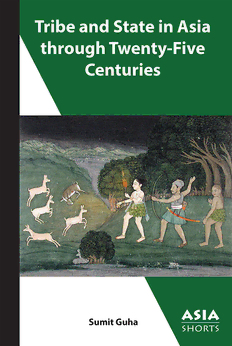
Cover image: A Bhil hunter with a flare, helping a hunter with a bow to hunt deer at
night. Source: https://commons.wikimedia.org/wiki/File:A_Bhil_hunter_with_a_flare,_
helping_a_hunter_with_a_bow_to_hunt_deer_at_night_(6125080998).jpg
Cheshire Cat image: https://commons.wikimedia.org/wiki/File:Alice_par_John_
Tenniel_24.png
Cataloging-in-Publication Data is available from the Library of Congress.
ASIA
SHORTS
“ASIA SHORTS” offers concise, engagingly-written titles written by highly-
qualified authors on topics of significance in Asian studies. Topics are intended
to be substantive, generate discussion and debate within the field, and attract
interest beyond it.
The AAS is exploring new ways of making rigorous, timely, and accessible work
by scholars in the field available to a wide audience of informed readers. This new
series complements and leverages the success of the pedagogically-oriented AAS
series, “Key Issues in Asian Studies” and is designed to engage broad audiences
with up-to-date scholarship on important topics in Asian studies.
“Asia Shorts” books:
• Have a clear point of view, a well-defined, and even provocative argument
rooted in a strong base of evidence and current scholarship.
• Are written in an accessible, jargon-free style suitable for non-specialist
audiences.
• Are written by a single author or a small group of authors (scholars,
journalists, or policymakers).
• Are rigorously peer reviewed.
For further information, visit the AAS website: www.asianstudies.org
AAS books are distributed by Columbia University Press.
For orders or inquiries, please visit https://cup.columbia.edu
About the Author
Sumit Guha is Professor of History at the University of Texas
at Austin. He was born in New Delhi, India and educated
in St. Stephen’s College and JNU Delhi before winning a
scholarship to the University of Cambridge, where he was
awarded the PhD in History in 1981. His books include
Environment and Ethnicity in India, 1200–1991, Health and
Population in South Asia from Earliest Times to the Present,
and Beyond Caste: Identity and Power in South Asia, Past and
Present.
His most recent book is History and Collective Memory in South Asia, 1200–
2000 (University of Washington Press, 2019). Developing out of the work of
Maurice Halbwachs, it is a long-period and comparative study of the frameworks
of collective memory. His next work is a study of the political ecology of empires
in South Asia from 1400 to 1900.
Acknowledgments
This book owes its origin to the gentle encouragement of Ramya Sreenivasan, who
first suggested that I write a comparative trans-Asian study for the AAS. It would
not exist without her help and support. Bill Tsutsui and Jon Wilson have helped me
concretize the project and answered many questions, both large and small, along
the way. When venturing out of my own specialization in South Asia, I have sought
the advice of many specialists who took the time to answer numerous queries. I
am therefore deeply indebted to Christopher Atwood for sharing his immense
knowledge of Mongolia and the Mongols, and to Erdenchuluu Khohchahar for
explaining the intricacies of Mongol terminology. Pamela Crossley has answered
many rounds of questions about China and the Manchu. Peter Golden took time
out of working on a new edition of his classic, An Introduction to the History of
the Turkic Peoples, to read and comment on an early draft. Alan Mikhail provided
an important etymology for an Arabic term. Indrani Chatterjee deepened my
understanding of social networks. Johannes Feddema generously offered access
to the underlying data for his revision of the Thornthwaite climate map. William
Delgado drew a simplified, gray-scale version for this book (Figure 2). Jon Wilson
helped create Figure 1 from open access materials. Two anonymous readers read
the manuscript closely and offered important suggestions for its improvement.
A third reader pointed to significant lacunae—since remedied. Mike Jauchen
patiently copyedited the text. Finally, Kirtan Patel read the proofs with an
unerring eye for errors. Needless to say, I am of course responsible for any errors,
oversimplifications, and overgeneralizations that may be found.
A Note on Transcriptions
I have for the sake of readability sought to eliminate diacriticals from this text.
Words from Sanskrit, Persian, Hindi, Marathi etc have only been used where
essential and transcribed in simple roman script forms. I do not read Mongolian
or Chinese and have therefore followed my source in rendering words from these
languages. I have however, given Pinyin equivalents in parenthesis for Wade-
Giles renderings where necessary. In no case have I changed an author’s preferred
rendering of her or his name.