Table Of ContentToward Camden
Black Outdoors / Innovations in
the Poetics of Study / A series edited by
J. Kameron Carter & Sarah Jane Cervenak
Toward
Camden
Mercy Romero
Duke University Press / Durham & London / 2021
© 2021 Duke University Press
All rights reserved
Printed in the United States of America on acid-f ree paper ∞
Designed by Aimee C. Harrison
Typeset in Portrait Text, Canela Text, and Univers LT Std
by Copperline Book Services
Library of Congress Cataloging-in-Publication Data
Names: Romero, Mercy, [date] author.
Title: Toward Camden / Mercy Romero.
Other titles: Black outdoors.
Description: Durham: Duke University Press, 2021. | Series: Black
outdoors | Includes bibliographical references and index.
Identifiers: Lccn 2020056098 (print)
Lccn 2020056099 (ebook)
isbn 9781478013785 (hardcover)
isbn 9781478014706 (paperback)
isbn 9781478022008 (ebook)
Subjects: Lcsh: Community development—New Jersey—Camden. |
Hispanic Americans—New Jersey—Camden—Social conditions. |
African Americans—New Jersey—Camden—Social conditions. |
Camden (N.J.)—Social conditions—20th century. | Camden (N.J.)—
Social life and customs—20th century. | Camden (N.J.)—Economic
conditions—20th century. | bisac: sociaL science / Sociology /
Urban | sociaL science / Ethnic Studies / American / Hispanic
American Studies
Classification: Lcc hn80. c32 r66 2021 (print) |
Lcc hn80. c32 (ebook) | ddc 307.1/40974987—dc23
Lc record available at https: //lccn.loc.gov/2020056098
Lc ebook record available at https: //lccn.loc.gov/2020056099
Publication of this book is supported by Duke University Press’s
Scholars of Color First Book Fund.
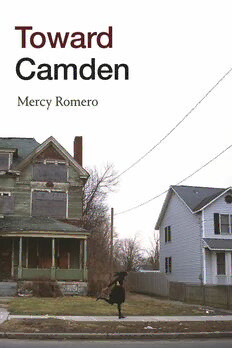
Cover art: Xaviera Simmons, Appear, Appease, Applaud (Also, Perhaps,
Maybe), 2008. Courtesy the artist and David Castillo Gallery.
Contents
Acknowledgments / vii /
Prologue / 1 /
Chapter One / 11 / Toward Camden
Chapter Two / 30 / Empty Lots
Chapter Three / 47 / Demolition Futures
Chapter Four / 68 / Halfway Houses
Epilogue / 93 / / Notes / 97 /
Bibliography / 111 / / Index / 121 /
This page intentionally left blank
ACknowledgments
/
I am grateful for the professors I met in California, especially José Da-
vid Saldivar, Patricia Hilden, Carlos Muñoz, Saidiya Hartman, Norma
Alarcón, and Gina Dent. I hope this book is in some way a tribute to
how much I learned from, appreciate, and admire each of them. Alfred
Arteaga was my professor and a dear friend. I miss him very much, the
sound of his voice, and the ease of our friendship. Being a graduate stu-
dent in Ethnic Studies at the University of California, Berkeley enriched
my experience. I am grateful to the graduate students I got to learn along-
side, and for all the people in this community who showed me so much
kindness. Thank you.
I began to consider this book many years ago in an Ethnic Studies
seminar with Professor Patricia Hilden, when she asked us to think for
a bit about the question, Where is home? Since then I have been fortu-
nate to travel to many places and share this writing. I am very grateful to
the folks with whom I shared each of these academic spaces, and for the
many questions that pushed me to think differently and further.
I feel very lucky to have life experiences and memories that begin, for
now, in Camden. My mother and father are central to how I have imag-
ined and approached this writing. My mother told me to “love the learn-
ing” when I was so nervous about leaving Camden to study elsewhere.
She breathed new life into me that night. This book is dedicated to her,
with all my love. Thank you for being my first and best teacher, for lov-
ing me as I am, and for so much laughter. I’m also shaped by my love for
my father and his love for me, especially when I have been sick. I hope
this book holds some part of what that love has meant for my under-
standing. Thank you for trusting me. Thank you for reading and loving
Walt Whitman and James Baldwin and for passing this love to me. That
I can turn to you both, even still, means the world to me. My three sis-
ters and their families hosted, fed, loved, and encouraged me when I was
out running around Camden, returning from the loneliness and confu-
sion of an empty and boarded up house or trying to sort out a language
to understand what was happening and write this book. I am thankful
that parts of me come from my sisters and that we come from the same
place. Thank you, M. J. P., for being the love in my life for a long time.
I love you. I am grateful to you and your family, especially your mom,
whose love and care for our kids made it possible for me to go to work and
not worry. I’m grateful for my family, and lately I’ve been thinking a lot
about my grandparents. Their migration stories and the places that made
them — Morovis, Barranquitas, Adjuntas, Jayuya, Ponce, Lorain, Bridge-
port, and Camden — turn and sound in my imagination and extend what
this book has taught me. Thanks to my beautiful and brilliant children
who have been with me as I’ve written this book. You showed me the
waves, the lightning, and the clear path; I am ever grateful for your cama-
raderie and love. May you know the full blessings of the Puerto Rican and
African American dreamers who made you, and may you be in service to
that vision.
I am so grateful for the many friendships made in Camden, New
York, and the Bay Area. All of the wonderful friends I have known ac-
company me, and through their examples they help me to have cour-
age. That they have my back is the spirit that opens the first chapter
of this book. Thanks to my colleagues for hiring me and for creating a
place and a way to work that brings me growth and happiness. Thanks
to my students who work so very hard and make the classroom vibrate
and matter. Thanks to Camden’s students, who inspired me from day
one and who are a blessing to the city and the world. Thanks to Ryan
Kendall, Susan Albury, Aimee Harrison, and the people at Duke Uni-
versity Press for publishing this book, and to the anonymous readers
viii Acknowledgments
who helped to usher it into print with so much kindness and generosity.
Thank you, Ken Wissoker, for your steady presence, patience, warmth of
heart, and encouragement. Thank you, Paula Durbin-Westby, for your
work on the index. Thank you, Camilo José Vergara, for allowing me to use
your photograph in this book. Thank you, Xaviera Simmons, for allowing
me to use your photograph as the cover art of this book. Thank you, Fred
Moten, for the thoughtfulness that serves as an epigraph to chapter 1.
Thank you, reader.
Acknowledgments ix