
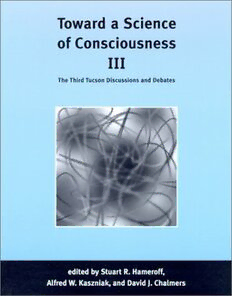
Download Toward a Science of Consciousness III: The Third Tucson Discussions and Debates (Complex Adaptive Systems) PDF Free - Full Version
Download Toward a Science of Consciousness III: The Third Tucson Discussions and Debates (Complex Adaptive Systems) by Stuart R. Hameroff, Alfred W. Kaszniak, David J. Chalmers in PDF format completely FREE. No registration required, no payment needed. Get instant access to this valuable resource on PDFdrive.to!
About Toward a Science of Consciousness III: The Third Tucson Discussions and Debates (Complex Adaptive Systems)
The third and final volume of these Tucson debates is considerably smaller than the mammoth Tucson II. It is as usual a mixed bag hitting a low with the incredible Science as the creation of Darwinian "just-so" story tautologies by psychologist Nicholas Humphrey. The vacuous neo-Darwinian argument that things are as they are as they had to evolve that way is repeated yet again by Humphrey for consciousness as if he has made some profound discovery!!! If one can point to any progress over the course of these conferences in the mid-1990s it was that Tucson III ends with a final section on Phenomenology with eight chapters - the best of which is by B. Alan Wallace on Buddhist Phenomenology. Many of these chapters refer to the need to learn from Hindu/Buddhist yogic phenomenology (many New-Age types are very biased towards Tibetan Buddhism)and Husserlian phenomenology as the only way to really understand Consciousness with its transformations into different states of which mainstream Western philosophy and science are totally ignorant. But even these chapters often start well pointing out the deficiencies of Western approaches but then the authors' own models are themselves based on the same sort of culturally-limited assumptions which they had only moments earlier been criticising! It is truly hard to shake off indoctrinations! For instance, Laughlin holds to the Neuronal Man myth and views consciousness as some emergent phenomenon in central nervous systems with no ontological argument to justify his views. Harry Hunt tries to explain away the mystical Light in terms of Gibson's sensory optical array and reduce profound ontological claims to simple, trivial metaphors! The great mystics all assert that the Light is NOT a sensory phenomenon and sensory processes are stopped in deep mysticism!!! Jonathan Shear conflates Kant's Transcendental Unity of Apprehension or "Transcendental Ego" with the mystical Pure Consciousness when the yogic traditions make it clear that the Ego is not the same as the Deeper Self of the Pure Consciousness and that the subject/object duality disappears only when the Ego dissolves into the Light of Pure Consciousness!!! In the first section on the "Explanatory Gap" Galen Strawson begins to appreciate the Neutral Monist panpsychist position but then refuses to budge from conceptions of "physical reality"- a term also used by Hameroff without any self-questioning. Only physicist Malin discussing Schrodinger's concept of Objectivation of Nature by Science and Whitehead's 'occasions' as "throbs" of experience (just like the Spanda (vibrations) of Nondual Kashmiri Shaivism) and astrophysicist Piet Hut who points out that we only know the outside ("physical") world as part of our internal subjective world and that a new metaphysical basis to science is needed begin to grasp that Objectivation is the despiritualization of Nature by abstraction and mistaking the concept for Reality itself! Harry Hunt makes a good point as to what whether the conference is about a Science of Consciousness or moving toward a Spiritualization of Science. All this confusion stems from the Mind/Body dualism which, as Werner Heisenberg pointed out in Physics and Philosophy, permeates the whole of Western Thought. Its roots go well beyond Descartes to the Christian myth of Creatio ex nihilo in which Nature is created out of Absolute Nothing by an anthropomorphic God completely separate from Creation (i.e. Spirit/Nature dualism). To cut a long story short, no resolution of the problem of consciousness in the West will come till the universal Light Pure Consciousness (the No-thing-ness Plenum/Void)is understood as the Ground of All Being and the physical World as a manifestation through energetic vibrations. The Buddhist/Whiteheadian emphasis on the energetic vibrations as discontinuities ignoring the universal Ground also leads nowhere as in Christian de Quincey's strange contribution. In fact, I had already identified the physical correlate of the inner Light of Pure Consciousness with the brainwaves of the Brainstem Reticular Activating system in 1994 (see my other reviews) so all this huff-and-puff and brouhaha at Tucson was like a lot of fish unaware of the ocean in which they were all swimming! See my The Oneness/Otherness Mystery and perhaps also Philosophy of Space and Time and the Inner Constitution of Nature by mathematical physicist and mystic Michael Whiteman(Heisenberg himself checked the chapter on Quantum Mechanics in this). Sutapas Bhattacharya
Detailed Information
| Author: | Stuart R. Hameroff, Alfred W. Kaszniak, David J. Chalmers |
|---|---|
| Publication Year: | 1999 |
| ISBN: | 9780262581813 |
| Pages: | 455 |
| Language: | English |
| File Size: | 3.57 |
| Format: | |
| Price: | FREE |
Safe & Secure Download - No registration required
Why Choose PDFdrive for Your Free Toward a Science of Consciousness III: The Third Tucson Discussions and Debates (Complex Adaptive Systems) Download?
- 100% Free: No hidden fees or subscriptions required for one book every day.
- No Registration: Immediate access is available without creating accounts for one book every day.
- Safe and Secure: Clean downloads without malware or viruses
- Multiple Formats: PDF, MOBI, Mpub,... optimized for all devices
- Educational Resource: Supporting knowledge sharing and learning
Frequently Asked Questions
Is it really free to download Toward a Science of Consciousness III: The Third Tucson Discussions and Debates (Complex Adaptive Systems) PDF?
Yes, on https://PDFdrive.to you can download Toward a Science of Consciousness III: The Third Tucson Discussions and Debates (Complex Adaptive Systems) by Stuart R. Hameroff, Alfred W. Kaszniak, David J. Chalmers completely free. We don't require any payment, subscription, or registration to access this PDF file. For 3 books every day.
How can I read Toward a Science of Consciousness III: The Third Tucson Discussions and Debates (Complex Adaptive Systems) on my mobile device?
After downloading Toward a Science of Consciousness III: The Third Tucson Discussions and Debates (Complex Adaptive Systems) PDF, you can open it with any PDF reader app on your phone or tablet. We recommend using Adobe Acrobat Reader, Apple Books, or Google Play Books for the best reading experience.
Is this the full version of Toward a Science of Consciousness III: The Third Tucson Discussions and Debates (Complex Adaptive Systems)?
Yes, this is the complete PDF version of Toward a Science of Consciousness III: The Third Tucson Discussions and Debates (Complex Adaptive Systems) by Stuart R. Hameroff, Alfred W. Kaszniak, David J. Chalmers. You will be able to read the entire content as in the printed version without missing any pages.
Is it legal to download Toward a Science of Consciousness III: The Third Tucson Discussions and Debates (Complex Adaptive Systems) PDF for free?
https://PDFdrive.to provides links to free educational resources available online. We do not store any files on our servers. Please be aware of copyright laws in your country before downloading.
The materials shared are intended for research, educational, and personal use in accordance with fair use principles.

