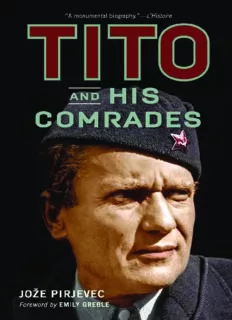
Table Of ContentTi t o
and His
Comrades
Ti t o
and His
Comrades
Jože Pirjevec
The University of Wisconsin Press
The University of Wisconsin Press
1930 Monroe Street, 3rd Floor
Madison, Wisconsin 53711-2059
uwpress.wisc.edu
3 Henrietta Street, Covent Garden
London WC2E 8LU, United Kingdom
eurospanbookstore.com
Originally published as Tito in tovariši © 2011 by Cankarjeva založba, Ljubljana
English translation copyright © 2018 by Jože Pirjevec
The Board of Regents of the University of Wisconsin System
All rights reserved. Except in the case of brief quotations embedded in critical
articles and reviews, no part of this publication may be reproduced, stored in a retrieval
system, transmitted in any format or by any means—digital, electronic, mechanical,
photocopying, recording, or otherwise—or conveyed via the Internet or a website
without written permission of the University of Wisconsin Press. Rights inquiries
should be directed to [email protected].
Printed in the United States of America
This book may be available in a digital edition.
Library of Congress Cataloging-in-Publication Data
Names: Pirjevec, Jože, 1940–, author.
Title: Tito and his comrades / Jože Pirjevec; foreword by Emily Greble.
Other titles: Tito in tovariši. English
Description: Madison, Wisconsin : The University of Wisconsin Press, [2018] |
Translated into English by Jože Pirjevec. | Originally published as: Tito in tovariši
(Ljubljana: Cankarjeva založba, 2011). | Includes bibliographical references and index.
Identifiers: LCCN 2017044551 | ISBN 9780299317706 (cloth : alk. paper)
Subjects: LCSH: Tito, Josip Broz, 1892–1980. | Tito, Josip Broz, 1892–1980—Friends and
associates. | Presidents—Yugoslavia—Biography. | Yugoslavia—History—1945–1980.
Classification: LCC DR1300 .P5713 2018 | DDC 949.702/3092 [B]—dc23
LC record available at https://lccn.loc.gov/2017044551
Contents
Foreword by Emily Greble vii
Acknowledgments xiii
Abbreviations xv
Introduction 3
1 The Young Broz: World War One, Imprisonment, and
His Rise in the Yugoslav Communist Party, 1892–1939 6
2 World War Two and the Partisan Struggle, 1939–1945 51
3 The Postwar Period: Consolidation of Power and
Confrontation with Stalin, 1945–1953 150
4 The Presidential Years: Creating the Non-Aligned Movement,
the Search for “Socialism with a Human Face,” and the
Struggle for Unity in Yugoslavia, 1953–1973 263
5 The Later Years: Yugoslavia in Economic and
Political Crisis, 1973–1980 392
6 Tito’s Death and His Political Legacy, 1980 434
Notes 457
Index 527
Foreword
Emily Greble
For three decades, Josip Broz Tito, the charismatic communist dictator of
Yugoslavia, sailed the world in a majestic yacht, the Galeb (seagull). He enter-
tained a motley crew of international celebrities, from Elizabeth Taylor and
Richard Burton to Nikita Khrushchev and Indira Gandhi. Never one to kow-
tow to the expectations of the bipolar Cold War world, Tito made his boat an
oasis of nonconformity. Under his rule, socialist Yugoslavia did things in its
own way. Today, Tito’s yacht lays abandoned in the port of Rijeka, Croatia.
Its hull is rusted, its deck dilapidated. Much like the tangled legacy of Josip
Broz Tito, the founding father and lifelong ruler of socialist Yugoslavia, locals
have mixed feelings about the abandoned ship. It is a nostalgic vestige of the
greatness of Tito’s Yugoslavia, and yet an unforgiving reminder of the state’s
wrenching collapse in the 1990s and the undoing of his legacy.
It is not easy to write the history of the founding father of one’s lost country.
A prominent historian whose career crisscrossed the Cold War border between
Yugoslavia and Italy, Jože Pirjevec is uniquely suited to do so. He studied in
Trieste and Vienna, held important academic positions in both Italy and Slo-
venia, and is familiar with the region’s many archives and the diverse historio-
graphical approaches to Yugoslav history around the world. A prolific author,
Pirjevec has written many highly regarded works on diverse subjects of Yugo-
slav history and has often been the first to lay the foundations of new avenues
of research.
In crafting Tito’s story, Pirjevec navigates a complex historiographical land-
scape. Tito’s predominating story long belonged under the tutelage of the Yugo-
slav state. Starting in the Second World War, Tito began to actively shape his
own legacy, a process he continued for the next few decades. Through inter-
views and several authorized biographies, he presented himself as a symbol of
unity and strength. Under his military leadership, the multiethnic Partisan army
vii
viii Foreword
drove the Nazis out of Yugoslavia. His political ingenuity led to the subsequent
foundation of a formidable socialist state. In 1948, when Stalin and the Comin-
form broke ties with Yugoslavia, hoping to force the young country to bend
to Soviet influence, Tito guided his country through a sequence of turbulent
global alliances with grit, vision, and cunning, emerging by the 1960s as the
leader of the powerful Non-Aligned Movement. These were the driving themes
of Tito’s story, which formed the centerpiece of predominantly hagiographic
biographies in both Serbo-Croatian and English. These studies looked sympa-
thetically upon the socialist experiment and credited Tito with its success,
ignoring the dictator’s role in the crimes communists committed under his rule.1
Tito’s biography became closely entwined with Yugoslavia’s foundational
myths and its political legacy. In the aftermath of the Second World War, con-
trol of the past was essential to solidifying new regimes and helping societies
heal from the traumas of war and genocide.2 Governments closely monitored
historical production, especially the public narrative of the war, and Yugoslav
efforts echoed this pan-European process. As a country created amid Fascist
occupation and international and civil war, socialist Yugoslavia’s foundational
myths emphasized two central concepts: “anti-Fascism” and “brotherhood and
unity.” These tropes highlighted the comradery of Yugoslavia’s diverse popu-
lations who fought in the Partisan army, papering over the bitter rivalries and
civil conflicts that had destabilized the region since the First World War,
as well as the nationalist factions that collaborated with the Nazis or fought
against the communists. Those who dissented in the early postwar years were
branded as Fascists. To promote this singular historical narrative, the regime
developed a cult of Partisan heroes through history books, posters, and news-
papers; it also held public rallies and parades and built memorial complexes
to fallen Partisan soldiers, which quickly became mandatory sites of pilgrimage
for Yugoslav youths.3 In Yugoslavia’s story, Tito was the devoted father, his
sons and daughters were the many diverse constituents of Yugoslavia. Occasional
dissident literature, notably works by Tito’s one-time communist comrade
Milovan Djilas, complicated Tito’s image by pointing out his more tactical and
less benevolent acts.4 But for the most part, after 1950, the Yugoslav and West-
ern public were sympathetic to Tito. Captivating and gregarious, he was known
as the man who beat the Nazis and defied Stalin, who collected exotic animals
on an Adriatic island, and who socialized with movie stars and world leaders.
In the aftermath of Tito’s death in 1980, historians began to challenge Yugo-
slavia’s grand foundational narratives and the story of Tito himself. Within
Yugoslavia, scholars documented crimes committed by Partisan soldiers during
the Second World War and unearthed stories of communist repression. They
also called attention to the falsities of historical production in the socialist era,
Foreword ix
encouraging critiques of Tito and the Yugoslav socialist project.5 Even Tito’s
official biographer, Vladimir Dedijer, published a controversial volume that
acknowledged the communists’ darker past.6 A renewed focus on human rights
in Eastern Europe, inspired by the Helsinki Accords in 1975, placed Tito’s leg-
acy under a more critical international lens as well.7
Several prominent historians of Yugoslavia in the United States and the
United Kingdom also rigorously reassessed key parts of Tito’s narrative and
Yugoslavia’s foundational moment in the Second World War. Among the ear-
liest works were Denison Rusinow and Sabrina Ramet’s influential studies
on the socialist Yugoslav state, which introduced readers to Tito’s dilemmas of
state-building and provided a nuanced analysis of the socialist political proj-
ect.8 Ivo Banac’s seminal work on the Tito-Stalin split clarified the vicious fac-
tionalism in Yugoslavia’s Communist Party and the ways that Tito, like other
communist dictators, used purges, camps, and repression to solidify control.9
Stevan K. Pavlowitch’s biography of Tito, published just as the Yugoslav state
collapsed, presented a more nuanced account of Tito’s accomplishments and
failures, introducing new questions for historians to consider when investigat-
ing Tito.10 But the majority of Communist Party and secret police archives
remained closed to foreign researchers well into the 1990s, leaving historians
without the essential tools for answering these questions and providing revi-
sions of the historical record. Many Western historians interested in Tito’s life
and career thus relied heavily on Allied documents; their prevailing interest, it
seems, was to investigate Yugoslavia’s place in the global history of the Second
World War and the Cold War, rather than to understand the country’s leader.11
Within the region, the unearthing of repressed histories took on a new char-
acter with the collapse of socialist Yugoslavia in 1991 and the subsequent foun-
dation of seven new countries.12 National leaders in Bosnia and Herzegovina,
Croatia, Kosovo, Macedonia, Montenegro, Serbia, and Slovenia revised the
stories of the Second World War and socialist Yugoslavia. Constructive his-
torical reevaluations unfortunately served as components in new, uncompro-
mising nationalist frameworks.13 Whereas Yugoslav histories had emphasized
how the Partisans crushed foreign Fascists and their domestic collaborators for
the sake of unifying Yugoslavia, nationalists sought to reclaim the Second
World War experience as a fight against communism. In these new national
histories, Yugoslavia—and by extension, Tito—had foiled their national self-
determination and sovereignty through harsh repression. Politicians actively
engaged in the practice of historical rehabilitation. People who had been con-
demned by the Tito regime as war criminals were recast as popular national
heroes.14 The new states played a central role in this process, with courts over-
turning socialist courts’ judgments and publicly condemning the process by
Description:This landmark biography reveals the life of one of the most powerful figures of the Cold War era. Josip Broz (1892–1980), nicknamed Tito, led Yugoslavia for nearly four decades with charisma, cunning, and an iron fist.With his Partisans he fought Hitler during World War II, and after the war he sh