Table Of Contentr
Raptor Res. 29(4):282-283
J.
© 1995 The Raptor Research Foundation, Inc.
Letters
Thirty-two Consecutive Years of Reproductive
Success at a Ferruginous Hawk Nest
A
short, solitary box elder tree {Acernegundo) in the Kindersley-Elna government pasture near Smiley, Saskatchewan,
Canada (51°30'N, 109^20'W), was occupied by nesting ferruginous hawks {Buteo regalis) since 1960. This nest was
successful for 32 consecutive years, 1961-92.
The nest tree was centered within the largest area of treeless pasture, and the nearest other suitable nest trees were
2 km away. This pasture, partly in native prairie grasses and partly in planted crested wheat grass (Agropyron cristatum),
contains 63,5 km^. This land proved to be unsuitable for profitable farming. Ten groves of trees at long-deserted
farmsites remain in the southern and western portions of this pasture, and are used for nesting by ferruginous hawks.
When first visited by Glen A. Fox on 15 May 1960, the ferruginous hawk nest was on a nearly horizontal branch,
3 m above the ground and contained three eggs. When Fox revisited the nest on 24 June it was deserted. Hubert
Solverson, the pasture manager, who took a special interest in this nest, told me that young had fledged from it annually
from 1961 through 1968.
My first visit was on 21 June 1969, when five young were banded in a nest tended by two light-phase adults. In
1973, the nest fell, and on 23 June, four young were found on the ground. Two had been crushed under the nest, one
had been trampled by cattle, and the one surviving young was restored to the nest remnant in the tree.
W. Saskatchewan
K-E Pasture
Solitary Tree
Mean
for
:
Solitary Tree
K-E Pasture
W.
Sask.
—————————
1 I I I I I I I I
1985 1990
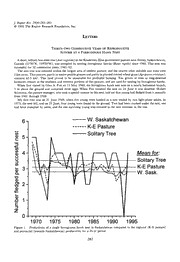
Figure 1. Productivity of a single ferruginous hawk nest in Saskatchewan compared to the regional (K-E pasture)
and provincial (western Saskatchewan) productivity for a 26-yr period.
282
——
December 1995 Letters 283
For 10 yr, from 1976 through 1985, one melanistic and one light-phase adult attended the nest, and in 1982 a third
(melanistic) adult was also in attendance. On 19 June 1993, the adult female had been preyed upon on her nest,
presumably by a golden eagle {Aquila chrysaetos) or a great horned owl {Bubo virginianus); no young hawks were
present. In 1994, the nest was occupied by two light-phase adults.
The productivity at this nest seems remarkable (1) in terms of 32 consecutive years of unfailing production and (2)
in the number of young fledged. The average number of fledglings per year, 3.5 (A^ = 25 recorded successful attempts),
is well above the long-term average of 3.1 for the remainder of the Kindersley-Elna pasture {N = 133) and 2.8 for
western Saskatchewan outside of the K-E pasture (A^ = 567; Fig. 1).
I wish to thank Josef Schmutz, Denver Holt, and Dick Clark for constructive comments, and Dick Clark for making
the graph. C. Stuart Houston, 863 University Drive, Saskatoon, Saskatchewan S7N Canada.
0J8,
/. Raptor Res. 29(4):283
© 1995 The Raptor Research Foundation, Inc.
Carrion Use by Northern Goshawks
Northern goshawks {Accipiter gentilis) feed on a wide variety of birds and mammals (R.T. Reynolds, et al. 1992,
USDA For. Ser. Gen. Tech. Rep. RM-217. Fort Collins, CO U.S.A.), but few accounts describe goshawks feeding
on carrion. J.H. Schnell (1958, Condor 60:377-403) stated that, “It seems highly unlikely that the goshawk would
forage for carrion under normal circumstances.” However, G.M. Sutton (1925, Wilson Bull. 37:193-199) reported a
goshawk shot while feeding on a black bear {Ursus americanus) carcass in Pennsylvania. Carrion use has also been
reported for two species of Australian goshawks {A. fasciatus and A. novaehollandiae; G.V. Czechura 1980, Raptor Res.
14:62-63).
Since 1992, four observations of northern goshawks using carrion have been reported to me. Three observations
(two in 1992, one in 1993) describe goshawks feeding on gut piles of mule deer {Odocoileus hemionus) left by hunters
in late October. Two of these cases involved adult birds and in the third case the bird’s age was not reported. One
observer reported the bird fed on the gut pile for at least 1 hr before departing. Another person observed a bird on
the same gut pile during two subsequent days, but it was unknown if it was the same bird on both occasions. All three
observations were from the Medicine Bow National Forest in southcentral Wyoming. The fourth observation ofcarrion
use was an adult goshawk seen feeding on a bison skull near Lewistown, Montana in early January 1995. The skull
m
was on top of an unused, wire dog kennel approximately 40 from an occupied house. These reports suggest that
carrion use by northern goshawks in the Rocky Mountain region may occur more often than generally believed. It is
unclear whether carrion is used by goshawks whenever available or only during periods of low prey availability.
However, switching to carrion only during stress periods seems unlikely given that observations occurred in three
different years. These observations may simply indicate that goshawks, like most predators, are opportunists and will
readily use carrion when available.
I thank K. Rodgers, S. Haas, J. Balcomb, and an observer, name unknown, for sharing with me their field
observations. John R. Squires, Rocky Mountain Forest and Range Experiment Station, 222 S. 22nd St., Laramie,
WY
82070 U.S.A.
/. Raptor Res. 29(4):283-284
© 1995 The Raptor Research Foundation, Inc.
Peregrine Falcon Takes a Fish in Idaho
Records ofperegrine falcons {Falcoperegrinus) catching or carrying fish are rare (D.A. Ratcliffe 1980, The peregrine
falcon, Buteo Books, Vermillion, SD U.S.A.). In the following we give an account of a peregrine falcon returning to
its nest site with a fish and summarize reported observations of fish predation or consumption by peregrine falcons.
On 8 July 1994, in southcentral Idaho we observed an adult peregrine falcon deliver a 15-20 cm salmonid to its
eyrie. The falcon could have acquired the fish in one of three ways: (1) by taking it from another bird such as an
We
osprey (Pandion haliaetus), (2) by capturing it alive, or (3) by scavenging a dead fish. could find only three accounts