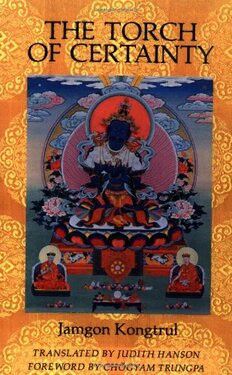
Table Of ContentTHE TORCH
OF CERTAINTY
Jamgon Kongtrul
TRA1 SLATED BY JUDITH HA l 0
FOR[~VORD BY CHOGYAlv1 TRU GPA
TheTorchof
Certainty
Jamgon Kongtrul
Translated jrt1tn the Tibetan by Judith Hanson
Foreword by Chogyam Trungpa
THE CLEAR UCIIT SEIUD
Shambhala
Boulder & Lnulon • 1977
1: Description and Background
The Torth of Certainty is an annotated translation of the Tibetan Bud
dhist meditation manual Nges-don sgron-me by Jamgon Kongtrul ('Jam
mgon Kong-sprul blo-gros mtha'-yas-pa, 1813-99). It contains practical
instructions and theoretical explanations of the "Four Foundations,"
(sngon-'gro) the most basic practices of the Kagyud sect of Tibetan
Buddhism.
Nges-don sgron-me is a commentary on the brief "root" text Lhan
(ig skyes-sbyor khrid by the ninth Karmapa, Wongchug Dorje ( dBang
phyug rDorje, 1556-1603). According to Deshung Rinpoche, the latter
is the shortest of three similar texts by the same author. The intermediate
one is Nges-don rgya-mtsho and the longest is Chos-sku mdZIIb-tshugs.
The final section of Nges-don sgron-me contains instructions on the
higher Mahamudra stage of doctrine and practice. This has not been
translated.
Throughout the text, Kongtrul writes in a semicolloquial style, using
irregular spelling, gramm~r and sentence structure not found in "classi
cal" Tibetan works such as Gampopa's Jewel Ornament of Liberation.
According to Kalu Rinpoche, Nges-don sgron-me provides exoteric
instructions (thun-mong-gi ~dams-ngag) on meditation according to the
Karma Kagyud sect of Mahayana-Vajrayana Buddhism.
Nges-don sgron-me is not read during actual meditation sessions,
but is studied before and between sessions as needed. The ninth Kar
mapa's 'Phags-lam bgrod-ptli shing-rta,1 the liturgy which is chanted
aloud during these sessions, has not been included in this work.
Before we describe the actual meditations, ' few remarks on the
nature of a Tibetan Buddhist sect, on the Karma Kagyud sect and on
Jamgon Kongtrul will be useful.
NATURE OF A TIBETAN BUDDHIST SECI'
A sect within Tibetan Buddhism is identified by several factors. Accord
ing to Tibetan teachers, the most important is the multidimensional
phenomenon known as "lineage." The central lineage of a sect includes
the succession of teachers-from the Buddha, through the Indian mas-
2 INTRODUCTION
tees, up to contemporary Tibetans-who transmitted the oral and written
teachings. Specialized lineages within a major sect include the teachers
who transmitted instructions for the practices especially emphasized by
that sect. These lineages will include some, but not all, of the teachers
in the central lineage.
Another factor is the body of oral and written teachings produced
by members of these lineages. This includes the sh111zg (zhtmg), or
authoritative Indian and Tibetan treatises, as well as other commentaries,
mstructional texts and ritual manuals.
A sect ts .also identified by its particular style of practice. The
Kagyud sect, which places great emphasis on meditation, is commonly
called a meditative tradition (sgr11b-brgy11d); while the Kadampa or
Gelugpa sect is known as a tradition of intellectual discipline ( blo
;byollg-brgylld)
Another identifying feature at one time was the group of monas
teries in which the monks and nuns lived, studied and practiced. One
monastery was usually the official headquarters for the sect and model
for the others. Each of the four major sects had scores of monasteries,
while some minor subsects seem to have had only one or two.
Lastly, a sect is identified by its spiritual head who is usually a high
ranking tulku.
THE KAGYUD SECT
Although Buddhism was known in Tibet as early as the sixth century
A.D., the four major sects-the Nyingmapa, Sakyapa, Kadampa (later
absorbed into the Gelugpa) and Kagyudpa did not emerge until the
eleventh century.
The Kagyudpa lineage begins with the Buddha Vajradhara (Dorje
Chang), symbol of supreme enlightenment. Vajradhara is not an his
torical Buddha like Shakyamuni, but one of many ever-present en
lightened beings who continually dispense their blessings. .Any indi
vidual involved in Kagyudpa practice is urged to view his guru as
Vajradhara in order to bring the Buddha closer and ensure the fruitful
ness of the guru-disciple relationship.
The second member of the lineage is the Indian mahasiddha Tilopa
(988-1069). He is said to have received instruction directly from Va
jradhara through visions and other extraordinary means.
The third member of the lineage is the Indian Naropa (1016-
1100), Tilopa's long-suffering disciple.2
INTRODUCTION 3
From Tilopa and Naropa originate the meditative practices with
which the sect is identified: the Six Yogas of Naropa (Na-ro'i (hos-drug)
and Mahamudra (PhJ•ag-rgya-(htn-po).
The first two divisicns of the sect originated with two Tibetan dis
ciples of Naropa. Khyungpo the yogin ( 1002-64) founded the Shangpa
Kagyud. Marpa the translator (1012-96) founded the Dagpo (Dwags
po) Kagyud. We will deal only with the latter.
Marpa was a layman whose thirst for learning drove him to under
take three costly and perilc..a .~ journeys to India. Each time, he obtained
important oral and written teachings. His momentous meeting with
Naropa, which Tilopa had prophesied, inspired his career as a major
proponent of the Vajrayar.a in Tibet.
Marpa transmitted Naropa's instructions to several disciples. The
most famous was Milarepa (1052-1135).• To compensate for an early
career in destructive black magic, Mila had to undergo years of painful
and frustrating service to his seemingly cruel and irrational guru. When
ever Mila began to despair, Marpa would give some hopeful sign. Thus,
Mila persisted for several years. After finally receiving the desired in
structions, he spent his life meditating in solitude, composing his famous
songs• and teaching.
Milarepa's best known disciple was Gampopa or Dagpo Lharje
(1079-1153). He founded many monasteries including Dagpo, after
which this division of the Kagyud sect is named. Gampopa became
Mila's disciple only after a thorough training in the intellectual and
moral discipline of the Kadampa system. Mila instructed him in the
meditative techniques transmitted by Tilopa, Naropa and Marpa. Gam
papa " ... combined the teachings of the bKa' -gdams and the experiences
of Mahamudra in a unique mmner so that the two streams united."•
Kagyud writers to the present day have drawn heavily on Gampopa's
voluminous works.
Gampopa's disciples founded the subsects of the Dagpo Kagyudpa,
the "Great Four" and the "~ser Eight."
'l..irtal Four"
(Founded by Gampopa's immediate disciples)
1. Karma Kagyud. founded by Dusum IQtyenpa (1110-93).
2. Baram Kagyud, founded by Barampa Dharma Wongchug
(ca. 1100).
3. Tshalpa Kagyud, founded by Tsondragpa (1123-94).
4. Phamo Kagyud, founded by Phamodrupa (1110-70).
4 INTRODUCTION
"Leuer Eight"
(Founded by Phamodrupa's disciples)
1. Drikhung Kagyud.
2. Talung Kagyud.
3. Tropu Kagyud.
4. Drugpa Kagyud orTod-drug, and its subsects:
~- May-drug.
6. Bar-drug.
...,_ Bar-ra.
8. Lho;drug.
From their inception in the twelfth and thirteenth centuries until
the Chinese takeover in 1959, these subsects have been active throughout
Tibet. Some, most notably the Karma and Drugpa Kagyud, now have
monasteries in India, Nepal, Bhutan, Sikkim and Scotland. Most of the
Tibetan Buddhist centers which have appeared in Europe and North
America in the past ten years were founded by two Karma Kagyud
Lamas: Chogyam Trungpa, Rinpoche and Kalu Rinpoche.8
THE KARMA KAGYUD SECT
The Karma Kagyud sect was founded by Dusum Khyenpa ( 1110-93),
the first Karmapa. The Karmapa is its highest tulku, and spiritual head.
Accordmg to Kalu Rinpoche, the Karmapa is the supreme spiritual au
thority for all the Kagyud subsects. As such, he officiates at key rituals
and is responsible for recognition of all the important Kagyudpa tulkus.
Karma Kagyudpas consider his spiritual status to be equal to that
of the Dalai Lama, head of the Gelugpa sect. Both are considered incar
nations of Avalokiteshvara, Bodhisattva of compassion. Both are ad
dressed as "wish-fulfilling gem" (}'id-bzhi11 11or-b11). But unlike the
Dalai Lama, the Karmapa was not officially connected with the central
government; i.e., he is not considered an incarnation of Songtsen Gampo
or another Tibetan ruler and has never shared the Dalai Lama's role as
a national symbol.
Although the Karmapa's official seat was at Tshurpu monastery in
central Tibet, most of the Karmapas were born in Kham (eastern Tibet).
Presently, the Karmapa's official seat is at Rumtek monastery in Sikkim.
The Karmapas exercised great spiritual and political influence in
Kham. Many of them maintained diplomatic ties with China and en
joyed Imperial patronage. 7
INTRODUCTION 5
The Karmapa is referred to as "Wearer of the Black Hat." This hat,
like a mitre, is a symbol of his spiritual authority. The original black
hat is said to have been presented to Dusum Khyenpa by the dakinis,
who wove it from the hair of a hundred thousand of their kind.
According to Kalu Rinpoche, this original hat was invisible to all
but those of great merit. A material replica was given to the fifth
Karmapa Deshin Shegpa (:384-1415) by the Yung-lo Emperor Ch'eng
tsu so that the black hat, a mere glimpse of which is said to guarantee
the beholder's rebirth in the higher realms, might be seen by all.•
This replica is thought to be the same one donned by the present
Karmapa, His Holiness Rongjung rigpay Dorje (b. 1924), when he
performed the Black Hat Ceremony in Europe and North America in
1974. This ceremony is the key ritual of the Karmapas. It re-enacts the
original "coronation" of Dusum Khyenpa by the dakinis, reaffirming the
place of each Karmapa in the Karmapa line and invoking Avalokiteshvara
as the source of that lineage.
There have been sixteen Karmapas to date:
1. Dusum Khyenpa (1110-93).
2. Karma Pakshi (1206-83).
3. Rongjung Dorje (1284-1339).
4. Rolpay Dorje (1340-83).
5. Deshin Shegpa (1384-1415).
6. Tongwa Dondan (1416-53).
7. Chodrag Gyatso (1454-1506).
8. Michod Dorje (1507-54).
9. Wongchug Dorje (1556-1603).
10. Choying Dorje (1604-74).
11. Yeshe Dorje (1675-1702).
12. Jongchub Dorje (1703-32).
13. Dudul Dorje (11~3-97).
14. Tegchog Dorje (1797-ca. 1845).
15. Khakhyab Dorje (ca. 1845-1924).
16. Rongjung rigpay Dorje (b. 1924).'
This list includes several statesmen, authors, and teachers.
The present Karmapa was educated at Tshurpu and now lives at
Rumtek monastery in Sikkim, the new seat of the Karma Kagyudpa.
Other important tulkus of the sect include the Shamar (Zhva-dmar)
or "Red Hat" Rinpoche, and the Situ, Gyaltshab and Pawo Rinpoches.
The Shamar line enjoyed periuds of political power in central Tibet but
6 INTRODUCTION
was officially terminated in the late eighteenth century due to the ninth
tulku's complicity in a Nepalese invasion. The line was revived by the
present Karmapa. The new Shamarpa was born in the early 1950's and
lives at Rumtek.
AU the Karmapas and most of the key tulkus of the sect are mem
bers of the "Golden Rosary of Wish-Fulfilling Gems," the specialized
Karma Kagyud lineage of Mahamudra teachers. A few others are in
cluded in this Mahamudra lineage because they were teachers or promi
nent disciples of a Karmapa. One of these few is our author Jamgon
Kongtrul, tuto~ to the fifteenth Karmapa.
BIOGRAPHICAL SKETCH OF JAMGON KONGTRUL
Jamgon Kongtrul ( 18U-99) was a versatile and prolific scholar whose
works span the entire field of traditional Tibetan learning. Characterized
by Smith10 as a "Tibetan Leonardo," Kongtrul was also a respected
physician, diplomat and powerful politician in his native Kham (eastern
Tibet).
Before receivmg any Buddhist training, Kongtrul was thoroughly
schooled in Bon by his nominal father Sonam Pel, a Bon Lama. Kongtrul
himself believed his natural father to be the Buddhist Lama Yungdrung
Tendzin of the eminent Khyungpo lineage.
Kongtrul's earliest Buddhist training was in the Nyingma tradition,
into which he was ordained at Zhe-chen monastery in 1832. A year later,
however, to qualify for a literary post at Palpung monastery, he had to
take reordination as a Karma Kagyud monk, a requirement whose
" ... pettiness and sectarianism distressed Kongtrul. ..." 11
This second ordination was conferred by Situ Padma Nyinjay ( 1774-
1853) whom Kongtrul invokes in Ngts-don sgron-me as his "root-guru."
He was then given the name with which he signed this text, Ngawong
Yontan Gyatso.
By thirty years of age Kongtrul had received teachings and em
powerments from sixty Lamas of diverse sects and lineages. Around this
time he was recognized as a tulku, a move whose intent was at least
partly political.n
Kongtrul accepted the authenticity of ltrma13 as did the Bonpos and
Nyingmapas. In 1855 he was recognized as alerlon by the terton Chogyur
Lingpa (1829-79).
Together with the Khampa scholar Jamyang Khyentse Wongpo
( 1820-92), he initiated the "unbiased" or rimay (ris-med) movement,