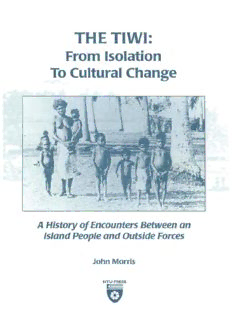
Table Of ContentTHE TIWI:
From Isolation
To Cultural Change
--
A History of Encounters Between an
Island People and Outside Forces
John Morris
NTU PRESS
tw•
THE TIWI:
From Isolation To Cultural Change
The Tiwi Islanders are unique in Aboriginal society, possessing a distinct
culture and language. Although isolated from mainland Aborigines for
thousands of years, they had intermittent contact with visitors from
Southeast Asia and Europe from at least the seventeenth century. The Tiwi:
From Isolation to Cultural Change is an ethnohistory, exploring the
reaction of the Tiwi to this exposure to outside cultures until 7918. The
presence of buffalo shooters and missionaries in the early years of the
nineteenth century signalled the beginning of social and cultural changes in
Tiwi society.
John Morris has been involved in Aboriginal affairs for over forty years. He
worked with the Tiwi people during the 7960s and early 1970s, and has
visited the islands on occasions since then. A sessional lecturer and tutor in
Indigenous Studies at the University of Bal/arat, he holds qualifications in
Anthropology, Aboriginal Studies and Aboriginal History.
THE TIWI:
From Isolation
To Cultural Change
A History of Encounters Between an Island
People and Outside Forces
John Morris
NTU PRESS
w
~
First published 2001
©John Morris
This book is copyright. Apart from any fair dealing for the purpose of private study, research,
criticism or review as permitted under the Copyright Act, no pan may be reproduced, by any process,
without written permission Enquiries should be made to the publisher, Northern Territory University
Press, Northern Territory University, Darwin NT 0909, Australia.
ISBN 1 876248 60 2
Typeset in 10/12.5 Helvetica
Printed in Darwin by NTUniprint
Northern Territory University, Darwin NT 0909
WARNING
The names of some Tiwi people who are now deceased appear in the following pages,
either as historical characters and/or as informants. Although the Tiwi community has
now modified its customary law on the use of the names of people who have passed
away, offence may be taken by some members of that community. The need to avoid
such offence is recognised and acknowledged, and I apologise if any distress does occur.
Similarly, I trust that the inclusion of photographs of deceased persons in this thesis will
not lead to discontent.
iii
CONTENTS
ACKNOWLEDGEMENTS ............................................................................................. ix
INTRODUCTION ............................................................................................................ 1
CHAPTER 1 The Traditional Tiwi -A Unique Society
(Pre-Contact Years) ....................................................................... 1O
CHAPTER 2 Survey, Intrusion and Conflict (The Distant Past to 1818) ......... 29
CHAPTER 3 Fort Dundas -Settlement of Doom (1824 - 1829) ...................... 41
CHAPTER 4 The Widening World - Indonesians to Australians
(1700 - 1894) ................................................................................. 60
CHAPTER 5 The Buffalo Shooters - The Opening Door
(1895 -1916) ................................................................................. 79
CHAPTER 6 The Door Is Flung Open -The Mission, The Tiwi and
the Wider World. (1911 - 1918) .................................................. 104
CONCLUSION
····································································································· 133
APPENDIX A ..................................................................................................... 139
BIBLIOGRAPHY ..................................................................................................... 141
INDEX ..................................................................................................... 157
v
FIGURES
Fig.1 The political sub-divisions of the Tiwi islands ......................................... 15
(as listed by Esther Babui).
Fig. 2 The political sub-divisions of the Tiwi Islands (as in popular use) .......... 15
Fig. 3 The Tiwi Totemic System (Yiminga) prior to 1945 ................................... 17
Fig. 4 The Food Economy of the Tiwi People ................................................... 23
Fig. 5 Rules to be Observed When at Anchor or in Harbour ............................ 47
Fig. 6 Regulations Relating to Vessels Arriving at Melville Island ..................... 47
Fig. 7 Regulations Respecting the Natives, and the Carrying of Fire Arms ...... 49
Fig. 8 Vessels Known to be Wrecked or Grounded Around the Tiwi Islands .... 67
up to 1918
Fig. 9 Women Seized from the Mainland by the Tiwi, Nineteenth Century ....... 70
Fig.10 Tiwi Women Taken from their Bands by the lwaidja Buffalo Shooters .... 86
Fig. 11 Protectors and Chief Protectors of Aborigines, ....................................... 90
Northern Territory 1869-i 919
Fig. 12 Government Residents and Administrators of the Northern Territory ..... 94
1869-1918
Fig. 13 Religious Staff, Bathurst Island Mission, 1911-1918 ............................. 112
Fig.14 Tiwi Girls Purchased by Bishop Gsell to the End of 1918 .................... 120
Fig.15 Tiwi Families of the Nineteenth and Early Twentieth Centuries ............ 134
vi
MAPS
Map 1 Location of the Tiwi Islands in Respect of Possible Outside Influences .... 5
Map2 The Land of the Tiwi People ...................................................................... 7
Map3 The Tiwi Bands or Political Sub-Divisions ................................................ 12
(according to Babui and Ward)
Map4 The Tiwi Bands or Political Sub-Divisions ................................................ 13
(as in anthropological and wider use)
Map5 The Creative Travels of Mudungkala (Murtankala) .................................. 19
Map6 Localities -Tiwi Islands ............................................................................ 34
Map7 Fort Dundas and its Environs .................................................................. 42
Map8 North Coast of New Holland/Northern Territory, Early Outposts .............. 50
Map9 The Tiwi and Neighbouring Tribes ........................................................... 69
Map10 Location of Tiwi Islands in Relation to Arnhem Land ............................... 80
and Daly River Region
vii
ILLUSTRATIONS
The late Jerry Kerinaiua, keeper of Tiwi oral history
2A The late Albert Kulappaku Croker, keeper of lwaidja -Tiwi oral history
28 The late Don Tipiamutta Hocking with his painting of the
Purukupali story
3 Pukamuni Poles, Bathurst Island
4 Bark painting of Macassan proa wrecked on Melville island
Artist Jerry Kerinaiua
5 Fort Dundas, Melville Island. (Courtesy Mitchell Library)
6 Tiwi men seated in camp, Melville Island, 1912
(Courtesy Museum of Victoria)
7 Tiwi woman and children on beach at Nguiu
SA Joe Cooper on horseback. (Courtesy Northern Territory Library)
88 Harry Cooper's grave, Darwin
9 Early mission building, Nguiu, 1912. Father Gsell on right
(Courtesy Museum of Victoria)
1O Joe Cooper and Father Gsell (wearing coat) at Nguiu
Sisters inside fence, with, apparently, children from the mainland
11. Dugout canoes off Paru. (Courtesy Northern Territory Library)
12 D.M. Sayers, John Gilruth and Joe Cooper. (Courtesy Museum of Victoria)
13 Father (later Bishop) F.X. Gsell. (Courtesy Hecate)
14 Tiwi children in dugout canoe off Paru. (Courtesy Northern Territory library)
(Unless otherwise indicated, the above photographs are from the Morris collection.)
These photographs are located near centre of book.
viii
Description:of Melville Island or Aimba Mootiara (Amba), as the trepangers called it, the voyages island blacks:'25 Three weeks after being wounded Cooper was back at The apocryphal version of Cooper's time on Melville Island has him