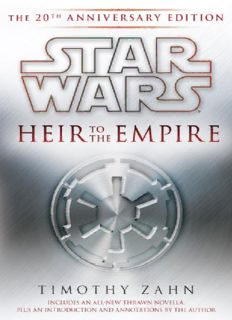
Table Of ContentStar Wars: Heir to the Empire is a work of fiction. Names, places, and incidents either are products of the
author’s imagination or are used fictitiously.
®
Copyright © 2011 by Lucasfilm Ltd. & or ™ where indicated.
All Rights Reserved. Used Under Authorization.
Published in the United States by Del Rey, an imprint of The Random House Publishing Group, a division
of Random House, Inc., New York.
DEL REY is a registered trademark and the Del Rey colophon is a trademark of Random House, Inc.
Originally published in hardcover in the United States by Bantam Spectra, an imprint of the Random House
Publishing Group, a division of Random House, Inc., 1991.
Mass market edition 1992
eISBN: 978-0-345-53000-4
www.starwars.com
www.delreybooks.com
v.3.1
v3.1
To all the fans of the Star Wars Expanded Universe:
Thanks for letting me be a part of your lives these past two decades. I hope
you’ve enjoyed it as much as I have.
Contents
Cover
Title Page
Copyright
Dedication
Foreword
Introduction
Chapter 1
Chapter 2
Chapter 3
Chapter 4
Chapter 5
Chapter 6
Chapter 7
Chapter 8
Chapter 9
Chapter 10
Chapter 11
Chapter 12
Chapter 13
Chapter 14
Chapter 15
Chapter 16
Chapter 17
Chapter 18
Chapter 19
Chapter 20
Chapter 21
Chapter 22
Chapter 23
Chapter 24
Chapter 25
Chapter 26
Chapter 27
Chapter 28
Chapter 29
Chapter 30
Chapter 31
Chapter 32
Afterword
Crisis of Faith: An Original Star Wars Novella
About the Author
Also by this Author
Introduction to the Star Wars Expanded Universe
Excerpt from Star Wars: The Thrawn Trilogy: Dark Force Rising
Introduction to the Old Republic Era
Excerpt from Star Wars: The Old Republic: Deceived
Introduction to the Rise of the Empire Era
Excerpt from Star Wars: Dark Lord: The Rise of Darth Vader
Introduction to the Rebellion Era
Excerpt from Star Wars: Allegiance
Introduction to the New Republic Era
Excerpt from Star Wars: X-Wing: Rogue Squadron
Introduction to the New Jedi Order Era
Excerpt from Star Wars: The New Jedi Order: Vector Prime
Introduction to the Legacy Era
Excerpt from Star Wars: Legacy of the Force: Betrayal
Excerpt from Star Wars: Fate of the Jedi: Outcast
Star Wars Novels Timeline
Author Annotations
F O R E W O R D
AT A TIME WHEN Star Wars is so firmly entrenched in our culture and so seemingly
ubiquitous, it’s hard to imagine a moment when it had all but disappeared from
sight.
But that was exactly the time we faced back in the late eighties.
Star Wars had a phenomenal run during the release of the original trilogy. The
films broke all box-office records. The toys sold like hotcakes. Younger
incarnations of us boogied to Star Wars disco music. And then it all stopped.
George stopped making the films. The boys who bought the toys moved on to
sports and girls, and the disco ducks hunkered down to begin their careers. The
world moved on.
By 1986, acting on the sage advice of our sole shareholder and resident Yoda,
Lucas Licensing decided it was time to give Star Wars a rest. A few years later,
with no new films on the horizon, we timidly started to think about what
products might now be of interest to Star Wars fans. The first thing we realized
was that our fan base had grown a bit older. The kids who bought the toys were
now in college. Fans who had been teens or adults when the films first came out
were probably starting careers or families. Where could we take Star Wars that
would be relevant to their lives?
It was clear to us that simply revisiting the past would be of marginal interest.
It was too early for a nostalgia play and, frankly, not very stimulating. We
needed to give fans something new, something that appealed to a more mature
sensibility. And, we reasoned, because Star Wars is all about story, the natural
ground to explore was books—books that could expand the story, starting with
the characters and situations so vividly established in the films and taking them
to places never before imagined.
I was the head of Licensing, and back then I had a tiny staff. My finance
director, Lucy Autrey Wilson, had been one of the company’s first employees.
Back in 1974, Lucy actually worked in George’s house and helped type the
scripts for Star Wars: A New Hope. She was a good finance person, but she was
a restless soul and had a passion for publishing. She had implored me for years
to give her the chance to make new publishing deals for Star Wars. And for
years I had responded to her not unlike the way that Han responds to Luke when
he says, “And who’s gonna fly it, kid? You?”
Fortunately for Lucy—and for all of us—by 1989 there was a convergence in
the Force. I was persuaded that it was time to restart our adult fiction publishing
program and seriously explore new stories in the Star Wars universe. And I was
willing to give Lucy the chance to find a publisher who shared our vision. But
before we could do that, there was one last hurdle. If we were to play in this
particular sandbox, we needed to consult the owner of the sandbox. So I went to
George Lucas and humbly requested permission to expand his universe. He was
appropriately skeptical (I seem to recall a response along the lines of, “No one is
going to buy this”) but supportive enough to give me the opportunity to fail. We
established some very basic guidelines: The stories would have to take place
after Return of the Jedi; events prior to A New Hope were off limits because if
George were ever to make more Star Wars films, that was where he would go;
and no major characters could be killed. Other than that, George made it clear
that he would be hands-off. It seemed so simple and straightforward. I don’t
think George or I had any idea what we were getting ourselves into.
Lucy went out and pitched the concept of a new series of Star Wars spin-off
books. She approached a number of publishers who felt that Star Wars was a
dead issue and passed on the opportunity. But to our great relief, one publisher—
Bantam Books—understood the vision: new Star Wars stories written by great
writers could really mobilize the fans. Lucy made the deal and Bantam brought
us a great writer—Tim Zahn. And Tim delivered.
I’ll never forget the day that Lucy came into my office in 1991 to tell me the
news that Tim’s Heir to the Empire had premiered at number one on the New
York Times hardcover bestseller list. It was an emotional moment. In a single
stroke we knew that our instinct had been right. And even better, we knew that
the flame of passion among our fans hadn’t died after all. It needed only the right
spark at the right time for it to burn anew—and more strongly than ever!
—HOWARD ROFFMAN
President, Lucas Licensing
I N T R O D U C T I O N
A long time ago in a galaxy far,
far away.…
WELL, ACTUALLY, IT WAS Illinois.
But it was a long time ago.
It was Monday, November 6, 1989, to be exact, at about four o’clock in the
afternoon. I was sitting in my home office in Champaign, Illinois, working on a
novel I’d just sold to Bantam Books called Angelmass, when I got an unexpected
call from my agent, Russell Galen. After the usual pleasantries, he dropped what
would be, for me, the understatement of the decade:
“Tim, we have a very interesting offer here.”
As I stood there staring out a window in growing amazement, he went on to
relate how, a year earlier, the head of Bantam Spectra, Lou Aronica, had written
to Lucasfilm with an idea about restarting the Star Wars saga. Lou’s plan was to
create a three-book saga that would pick up the story after Return of the Jedi, an
era in which no author had ever been permitted to write.
As fate (or the Force) would have it, that letter had arrived just as Howard
Roffman and the team at Lucasfilm had decided to restart their adult publishing
program.
That would have been awesome enough. What raised it to flabbergastable
level was that Bantam and Lucasfilm were offering me the books.
I’d been a Star Wars fan as long as anyone else on the planet. (Well, okay,
maybe not everyone else. I didn’t make it to the theater until the second night.)
Back in the early 1980s, when I was trying to forge a career for myself in the
field, the Star Wars movie soundtracks were among my favorite records to listen
to as I wrote. So much so that I distinctly remember thinking at the time that if
George Lucas could come out of essentially nowhere to make a success of
himself, maybe I could, too.
And now I was being invited to play in the universe he had created.
Anyway, Russ and I discussed it for forty minutes or so, and I told him I