Table Of ContentThe Sticky Synapse
Michael Hortsch Hisashi Umemori
l
Editors
The Sticky Synapse
Cell Adhesion Molecules and Their Role
in Synapse Formation and Maintenance
1 3
Editors
MichaelHortsch HisashiUmemori
DepartmentofCell&Developmental MolecularandBehavioralNeuroscience
Biology InstituteandDepartmentofBiological
UniversityofMichigan Chemistry
MedicalSchool 109ZinaPitcherPlace
109ZinaPitcherPlace AnnArbor,MI48109
AnnArborMI48109 USA
BiomedicalSciences [email protected]
ResearchBldg.
USA
[email protected]
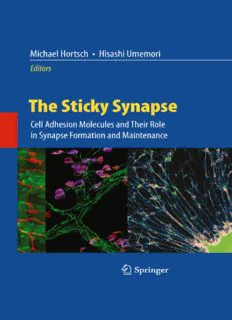
Coverillustrations:DevelopingSynapses-Synapsesareformedatpointsofcontactbetweenaxons
and their targets. From left, Drosophila neuromuscular junctions (motor axons, red; muscles,
green),mouseneuromuscularjunctions(motoraxons,green;neuromuscularjunctions,pink),and
mousecerebellarsynapsesinculture(pontineaxons,blue;cerebellargranulecelldendrites,pink;
synapses,green).
CourtesyofCarrero-MartinezandChiba(Drosophila)andHarrisandUmemori(mouse).
ISBN978-0-387-92707-7 e-ISBN978-0-387-92708-4
DOI10.1007/978-0-387-92708-4
SpringerDordrechtHeidelbergLondonNewYork
LibraryofCongressControlNumber:2009929373
#SpringerScienceþBusinessMedia,LLC2009
Allrightsreserved.Thisworkmaynotbetranslatedorcopiedinwholeorinpartwithoutthewritten
permissionofthepublisher(SpringerScienceþBusinessMedia,LLC,233SpringStreet,NewYork,
NY10013,USA),exceptforbriefexcerptsinconnectionwithreviewsorscholarlyanalysis.Usein
connectionwithanyformofinformationstorageandretrieval,electronicadaptation,computer
software,orbysimilarordissimilarmethodologynowknownorhereafterdevelopedisforbidden.
Theuseinthispublicationoftradenames,trademarks,servicemarks,andsimilarterms,evenifthey
arenotidentifiedassuch,isnottobetakenasanexpressionofopinionastowhetherornottheyare
subjecttoproprietaryrights.
Whiletheadviceandinformationinthisbookarebelievedtobetrueandaccurateatthedateof
going to press, neither the authors nor the editors nor the publisher can accept any legal
responsibilityforanyerrorsoromissionsthatmaybemade.Thepublishermakesnowarranty,
expressorimplied,withrespecttothematerialcontainedherein.
Printedonacid-freepaper
SpringerispartofSpringerScience+BusinessMedia(www.springer.com)
Preface
Themolecularmechanisms,whichareresponsibleforthefunctionaldifferences
betweenthevarioustypesofneuronalsynapses,havebecomeoneofthecentral
themes of modern neurobiology. It is becoming increasingly clear that a
misregulation of synaptogenesis and synaptic remodeling and dysfunctional
neuronalsynapsesareattheheartofseveralhumandiseases,bothneurological
disorders and psychiatric conditions. As synapses present specialized cellular
junctionsbetweenneuronsandtheirtargetcells,itmaynotcomeasasurprise
that neural cell adhesion molecules (CAMs) are of special importance for the
genesisandthemaintenanceofsynapticconnections.Genesencodingadhesive
molecules make up a significant portion of the human genome, and neural
CAMseven havebeenpostulated tobe amajor factor intheevolution ofthe
humanbrain.Thesearejustsomeofthemanyreasonswhywethoughtabook
on neural CAMs and their role in establishing and maintaining neuronal
synapses would be highly appropriate for summarizing our current state of
knowledge. Without question, over the near future, additional adhesive
proteins will join the ranks of synaptic CAMs and our knowledge, and how
thesemoleculesenableneuronsandtheirtargetstocommunicateeffectivelywill
grow.Wehopethatthisbookwillprovideacomprehensiveandtimelysynopsis
of the role of CAMs at synaptic connections and will encourage other
researchers to join this exciting field of neuroscience, which has the promise
notonlytoyieldnewinsightsintothefunctioningofourbrainbutalsotoshed
lightonsomedevastatinghumandiseases.
MichaelHortsch
AnnArbor,MI HisashiUmemori
v
Contents
1 AShortHistoryoftheSynapse–GolgiVersus
Ramo´nyCajal.......................................... 1
MichaelHortsch
2 CellAdhesionMoleculesattheDrosophilaNeuromuscularJunction. 11
FranklinA.Carrero-Martı´nezandAkiraChiba
3 DevelopmentoftheVertebrateNeuromuscularJunction.......... 39
MichaelA.Fox
4 SynapseFormationintheMammalianCentralNervousSystem .... 85
MasahiroYasudaandHisashiUmemori
5 DevelopmentalAxonalPruningandSynapticPlasticity........... 107
BibianaScelfoandMarioRosarioBuffelli
6 CellAdhesionMoleculesinSynaptopathies.................... 141
ThomasBourgeron
7 TheCadherinSuperfamilyinSynapseFormationandFunction..... 159
AndrewM.Garrett,DietmarSchreiner,andJoshuaA.Weiner
8 NectinsandNectin-LikeMoleculesintheNervousSystem ........ 185
HideruTogashi,HisakazuOgita,andYoshimiTakai
9 TheDownSyndromeCellAdhesionMolecule .................. 207
HiteshKathuriaandJamesC.Clemens
10 MolecularBasisofLamina-SpecificSynapticConnectionsinthe
Retina:SidekickImmunoglobulinSuperfamilyMolecules ......... 223
Y.KateHongandMasahitoYamagata
vii
viii Contents
11 SYG/Nephrin/IrreCFamilyofAdhesionProteinsMediate
AsymmetricCell–CellAdhesioninDevelopment ................ 235
KangShen
12 L1-TypeCellAdhesionMolecules:DistinctRolesinSynaptic
Targeting,Organization,andFunction ....................... 247
SmithaBabuUthamanandTanjaAngelaGodenschwege
13 CellAdhesionMoleculesoftheNCAMFamilyandTheirRolesat
Synapses............................................... 265
SylwiaOwczarek,LarsV.Kristiansen,MichaelHortsch,and
PeterS.Walmod
14 MHCClassIFunctionattheNeuronalSynapse................ 301
SebastianThamsandStaffanCullheim
15 PathfindingMoleculesBranchOut:SemaphorinFamilyMembers
RegulateSynapseDevelopment ............................. 321
SuzanneParadis
16 EphrinsandEphReceptorTyrosineKinasesinSynapseFormation.. 333
CatherineE.KrullandDanielJ.Liebl
17 NeurexinsandNeuroligins:ASynapticCodeforNeuronalWiring
ThatIsImplicatedinAutism ............................... 347
AlexanderA.Chubykin
18 SynapticAdhesion-LikeMolecules(SALMs) .................. 367
PhilipY.WangandRobertJ.Wenthold
19 TheRoleofIntegrinsatSynapses ........................... 385
DeviMajumdarandDonnaJ.Webb
20 ExtracellularMatrixMoleculesinNeuromuscularJunctionsand
CentralNervousSystemSynapses........................... 397
LaurentBogdanikandRobertW.Burgess
21 GapJunctionsasElectricalSynapses......................... 423
JuanMauricioGarre´ andMichaelV.L.Bennett
Index..................................................... 441
Contributors
MichaelV.L.Bennett DominickPPurpuraDepartmentofNeuroscience,
AlbertEinsteinCollegeofMedicine,1410PelhamParkwaySouth,Room704,
Bronx,NY10804,USA,[email protected]
LaurentBogdanik TheJacksonLaboratory,600MainSt.,BarHarbor,ME
04609,USA,[email protected]
ThomasBourgeron HumanGeneticsandCognitiveFunctionsUnit,
DepartmentofNeuroscience,InstitutPasteur,25rueduDocteurRoux,75724
ParisCedex15,France,[email protected]
MarioRosarioBuffelli DipartimentodiScienzeNeurologicheedellaVisione,
SezionediFisiologia,Universita’diVerona,StradaLeGrazie8,37134Verona,
Italy,[email protected]
RobertW.Burgess TheJacksonLaboratory,600MainSt.,BarHarbor,ME
04609,USA,[email protected]
FranklinA.Carrero-Martı´nez DepartmentofBiology,UniversityofPuerto
Rico,Mayagu¨ez,Mayagu¨ez,PuertoRico00681-9012,[email protected]
AkiraChiba DepartmentofBiology,UniversityofMiami,234CoxScience
Center,1301MemorialDrive,CoralGables,FL33124,USA,
[email protected]
AlexanderA.Chubykin ThePicowerInstituteforLearningandMemory,
Massachusetts Institute of Technology, 77 Massachusetts Avenue, 46-3301,
Cambridge,MA02139,USA,[email protected]
JamesC.Clemens DepartmentofBiochemistry,PurdueUniversity,175S.
UniversitySt.,WestLafayette,IN47907,USA,[email protected]
StaffanCullheim DepartmentofNeuroscience,KarolinskaInstitutet,SE-171
77Stockholm,Sweden,[email protected]
MichaelA.Fox DepartmentofAnatomyandNeurobiology,Virginia
CommonwealthUniversityMedicalCampus,Box980709,Richmond,VA
23298-0709,USA,[email protected]
ix
x Contributors
JuanMauricioGarre´ DominickPPurpuraDepartmentofNeuroscience,
AlbertEinsteinCollegeofMedicine,1410PelhamParkwaySouth,Room704,
Bronx,NY10804,USA
AndrewM.Garrett DepartmentofBiology,GraduateProgramin
Neuroscience,TheUniversityofIowa,IowaCity,IA52242,USA
TanjaAngelaGodenschwege DepartmentofBiologicalSciences,Florida
AtlanticUniversity,SansonScienceBuilding1/209,777GladesRoad,Boca
Raton,FL33431,USA,[email protected]
Y.KateHong PrograminNeuroscience,HarvardMedicalSchool,Boston
MA,02115,USA;DepartmentofMolecularandCellularBiology,Harvard
University,FairchildBldg,7DivinityAve.,Cambridge,MA02138,USA,
[email protected]
MichaelHortsch DepartmentofCellandDevelopmentalBiology,University
ofMichigan,BSRB,109ZinaPitcherPlace,AnnArbor,MI48109,USA,
[email protected]
HiteshKathuria DepartmentofBiochemistry,PurdueUniversity,175S.
UniversitySt.,WestLafayette,IN47907,USA
LarsV.Kristiansen ResearchLaboratoryforStereologyandNeuroscience,H.
S.BispebjergUniversityHospital,Copenhagen,Denmark,
[email protected]
CatherineE.Krull BiologicandMaterialsSciences,UniversityofMichigan,
5211Dental,1011N.UniversityAve.,AnnArbor,MI48109-1078,USA,
[email protected]
DanielJ.Liebl MillerSchoolofMedicine,UniversityofMiami,MiamiProject
toCureParalysis,P.O.Box016960R-48,Miami,FL33101,USA,
[email protected]
DeviMajumdar DepartmentofBiologicalSciences,VanderbiltKennedy
CenterforResearchonHumanDevelopment,VanderbiltUniversity,46521st
AvenueSouth,Nashville,TN37232,USA
HisakazuOgita DivisionofMolecularandCellularBiology,Departmentof
Biochemistry and Molecular Biology, Kobe University Graduate School of
Medicine,7-5-1Kusunoki-cho,Chuo-ku,Kobe650-0017Japan
SylwiaOwczarek ProteinLaboratory,DepartmentofNeuroscienceand
Pharmacology,UniversityofCopenhagen,FacultyOfHealthSciences,
Blegdamsvej3B,DK-2200Copenhagen,Denmark
SuzanneParadis DepartmentofBiology,BrandeisUniversity,
P.O.Box549110,Waltham,MA02454-9110,USA,
[email protected]
Contributors xi
BibianaScelfo DipartimentodiNeuroscienze–SezionediFisiologia,Istituto
NazionalediNeuroscienze,Universita’diTorino,CorsoRaffaello30,10125
Torino,Italy
DietmarSchreiner DepartmentofBiology,TheUniversityofIowa,IowaCity,
IA52242,USA
KangShen DepartmentofBiologicalSciences,StanfordUniversity,
371SerraMall,Gilbert109,Stanford,CA94305-5020,USA,
[email protected]
YoshimiTakai DivisionofMolecularandCellularBiology,Departmentof
BiochemistryandMolecularBiology,KobeUniversityGraduateSchool
ofMedicine,7-5-1Kusunoki-cho,Chuo-ku,Kobe650-0017Japan,
[email protected]
SebastianThams DepartmentofNeuroscience,KarolinskaInstitutet,SE-171
77Stockholm,Sweden,[email protected]
HideruTogashi DivisionofMolecularandCellularBiology,
DepartmentofBiochemistryandMolecularBiology,KobeUniversity
GraduateSchoolofMedicine,7-5-1Kusunoki-cho,Chuo-ku,
Kobe650-0017Japan
HisashiUmemori MolecularandBehavioralNeuroscienceInstitute,
UniversityofMichigan,BSRB,109ZinaPitcherPlace,AnnArbor,MI48109,
USA,[email protected]
SmithaBabuUthaman DepartmentofBiologicalSciences,FloridaAtlantic
University,SansonScienceBuilding1/209,777GladesRoad,BocaRaton,FL
33431,USA
PhilipY.Wang LaboratoryofNeurochemistry,NationalInstituteon
DeafnessandOtherCommunicationDisorders,NationalInstitutesofHealth,
Bethesda,MD20892,USA;DepartmentofBiology,CollegeofChemicaland
LifeSciencesandNeuroscienceandCognitiveScienceProgram,Universityof
Maryland,CollegePark,MD20742,USA
DonnaJ.Webb DepartmentofBiologicalSciencesandVanderbiltKennedy
CenterforResearchonHumanDevelopment,VanderbiltUniversity,VU
stationB,Box35-1634,Nashville,TN37235,USA,
[email protected]
JoshuaA.Weiner DepartmentofBiology,GraduateProgramin
Neuroscience,TheUniversityofIowa,IowaCity,IA52242,USA,joshua-
[email protected]
RobertJ.Wenthold LaboratoryofNeurochemistry,NationalInstituteon
DeafnessandOtherCommunicationDisorders,NationalInstitutesofHealth,
Bethesda,MD20892,USA,[email protected]
Description:Over the last few years, a considerable number of different cell adhesion molecules (CAMs) have been identified that are imperative for synapse formation and maintenance. Recent research, however, has also revealed that many synaptic connections are highly dynamic and not as stable as initially thou