Table Of ContentTable of Contents
Cover
Copyright
About the Author
Also by Jo Nesbø
Dedication
This eBook is copyright material and must not be copied, reproduced, transferred,
distributed, leased, licensed or publicly performed or used in any way except as specifically
permitted in writing by the publishers, as allowed under the terms and conditions under which it
was purchased or as strictly permitted by applicable copyright law. Any unauthorised distribution or
use of this text may be a direct infringement of the author’s and publisher’s rights and those
responsible may be liable in law accordingly.
Epub ISBN: 9781409089650
Version 1.0
www.randomhouse.co.uk
Published by HARVILL SECKER 2010
2 4 6 8 10 9 7 5 3 1
Copyright © Jo Nesbø 2007
English translation copyright © Don Bartlett 2010
Jo Nesbø has asserted his right under the Copyright, Designs and Patents Act 1988 to be identified
as the author of this work
This book is sold subject to the condition that it shall not, by way of trade or otherwise, be lent,
resold, hired out, or otherwise circulated without the publisher’s prior consent in any form of
binding or cover other than that in which it is published and without a similar condition including
this condition being imposed on the subsequent purchaser
First published with the title Snømannen in 2007
by H. Aschehoug & Co. (W. Nygaard), Oslo
First published in Great Britain in 2010 by
HARVILL SECKER
Random House
20 Vauxhall Bridge Road
London SW1V 2SA
www.rbooks.co.uk
Addresses for companies within The Random House Group Limited can be found at:
www.randomhouse.co.uk/offices.htm
The Random House Group Limited Reg. No. 954009
A CIP catalogue record for this book is available from the British Library
ISBN 9781846553486 (hardback)
ISBN 9781846551406 (trade paperback)
This translation has been published with the financial support of NORLA
The Random House Group Limited supports The Forest Stewardship
Council (FSC), the leading international forest certification organisation. All our titles that are
printed on Greenpeace approved FSC certified paper carry the FSC logo. Our paper procurement
policy can be found at
www.rbooks.co.uk/environment
Typeset in Minion by Palimpsest Book Production Limited,
Grangemouth, Stirlingshire
Printed and bound in Great Britain by
CPI Mackays, Chatham ME5 8TD
About the Author
Jo Nesbø is a musician, songwriter, economist and author. His first crime novel featuring Harry
Hole was published in Norway in 1997 and was an instant hit, winning the Glass Key Award for
best Nordic crime novel (an accolade shared with Peter Høeg, Henning Mankell and Stieg Larsson).
The Snowman is the fifth of Nesbø’s novels to be translated into English.
Don Bartlett lives in Norfolk and works as a freelance translator of Scandinavian literature. He has
translated, or co-translated, Norwegian novels by Lars Saabye Christensen, Roy Jacobsen, Ingvar
Ambjørnsen, Kjell Ola Dahl, Gunnar Staalesen and Pernille Rygg.
ALSO BY JO NESBØ
The Redbreast
Nemesis
The Devil’s Star
The Redeemer
For Kirsten Hammervoll Nesbø
Part One
1
WEDNESDAY, 5 NOVEMBER 1980.
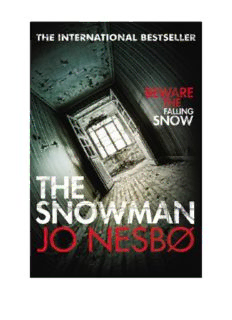
The Snowman.
IT WAS THE DAY THE SNOW CAME. A T ELEVEN O’CLOCK IN the morning, large flakes
appeared from a colourless sky and invaded the fields, gardens and lawns of Romerike like an
armada from outer space. At two, the snowploughs were in action in Lillestrøm, and when, at half
past two, Sara Kvinesland slowly and carefully steered her Toyota Corolla SR5 between the
detached houses in Kolloveien, the November snow was lying like a down duvet over the rolling
countryside.
She was thinking that the houses looked different in daylight. So different that she almost passed his
drive. The car skidded as she applied the brakes, and she heard a groan from the back seat. In the
rear-view mirror she saw her son’s disgruntled face.
‘It won’t take long, my love,’ she said.
In front of the garage there was a large patch of black tarmac amid all the white, and she realised
that the removal van had been there. Her throat constricted. She hoped she wasn’t too late.
‘Who lives here?’ came from the back seat.
‘Just someone I know,’ Sara said, automatically checking her hair in the mirror. ‘Ten minutes, my
love. I’ll leave the key in the ignition so you can listen to the radio.’
She went without waiting for a response, slithered in her slippery shoes up to the door she had been
through so many times, but never like this, not in the middle of the day, in full view of all the
neighbours’ prying eyes. Not that late-night visits would seem any more innocent, but for some
reason acts of this kind felt more appropriate when performed after the fall of darkness.
She heard the buzz of the doorbell inside, like a bumblebee in a jam jar. Feeling her desperation
mount, she glanced at the windows of the neighbouring houses. They gave nothing away, just
returned reflections of bare black apple trees, grey sky and milky-white terrain. Then, at last, she
heard footsteps behind the door and heaved a sigh of relief. The next moment she was inside and in
his arms.
‘Don’t go, darling,’ she said, hearing the sob already straining at her vocal cords.
‘I have to,’ he said in a monotone that suggested a refrain he had tired of long ago. His hands sought
familiar paths, of which they never tired.
‘No, you don’t,’ she whispered into his ear. ‘But you want to. You don’t dare any longer.’
‘This has nothing to do with you and me.’
She could hear the irritation creeping into his voice at the same time as his hand, the strong but
gentle hand, slid down over her spine and inside the waistband of her skirt and tights. They were
like a pair of practised dancers who knew their partner’s every move, step, breath, rhythm. First, the
white lovemaking. The good one. Then the black one. The pain.
His hand caressed her coat, searching for her nipple under the thick material. He was eternally
fascinated by her nipples; he always returned to them. Perhaps it was because he didn’t have any
himself.
‘Did you park in front of the garage?’ he asked with a firm tweak.
She nodded and felt the pain shoot into her head like a dart of pleasure. Her sex had already opened
for the fingers which would soon be there. ‘My son’s waiting in the car.’
His hand came to an abrupt halt.
‘He knows nothing,’ she groaned, sensing his hand falter.
‘And your husband? Where’s he now?’
‘Where do you think? At work of course.’
Now it was she who sounded irritated. Both because he had brought her husband into the
conversation and it was difficult for her to say anything at all about him without getting irritated,
and because her body needed him, quickly. Sara Kvinesland opened his flies.
‘Don’t ’ he began, grabbing her around the wrist. She slapped him hard with her other hand. He
looked at her in amazement as a red flush spread across his cheek. She smiled, grabbed his thick
black hair and pulled his face down to hers.
‘You can go,’ she hissed. ‘But first you have to shag me. Is that understood?’
She felt his breath against her face. It was coming in hefty gasps now. Again she slapped him with
her free hand, and his dick was growing in her other.
He thrust, a bit harder each time, but it was over now. She was numb, the magic was gone, the
tension had dissolved and all that was left was despair. She was losing him. Now, as she lay there,
she had lost him. All the years she had yearned, all the tears she had cried, the desperate things he
had made her do. Without giving anything back. Except for one thing.
He was standing at the foot of the bed and taking her with closed eyes. Sara stared at his chest. To
begin with, she had thought it strange, but after a while she had begun to like the sight of unbroken
white skin over his pectoral muscles. It reminded her of old statues where the nipples had been
omitted out of consideration for public modesty.
His groans were getting louder. She knew that soon he would let out a furious roar. She had loved
that roar. The ever-surprised, ecstatic, almost pained expression as though the orgasm surpassed his
wildest expectation each and every time. Now she was waiting for the final roar, a bellowing
farewell to his freezing box of a bedroom divested of pictures, curtains and carpets. Then he would
get dressed and travel to a different part of the country where he said he had been offered a job he
couldn’t say no to. But he could say no to this. This. And still he would roar with pleasure.
She closed her eyes. But the roar didn’t come. He had stopped.
‘What’s up?’ she asked, opening her eyes. His features were distorted alright. But not with pleasure.
‘A face,’ he whispered.
She flinched. ‘Where?’
‘Outside the window.’
The window was at the other end of the bed, right above her head. She heaved herself round, felt
him slip out, already limp. From where she was lying, the window above her head was set too high
in the wall for her to see out. And too high for anyone to stand outside and peer in. Because of the
already dwindling daylight all she could see was the double-exposed reflection of the ceiling lamp.
‘You saw yourself,’ she said, almost pleading.
‘That was what I thought at first,’ he said, still staring at the window.
Sara pulled herself up onto her knees. Got up and looked into the garden. And there, there was the
face.
She laughed out loud with relief. The face was white, with eyes and a mouth made with black
pebbles, probably from the drive. And arms made from twigs off the apple trees.
‘Heavens,’ she gasped. ‘It’s only a snowman.’
Then her laugh turned into tears; she sobbed helplessly until she felt his arms around her.
‘I have to go now,’ she sobbed.
‘Stay for a little while longer,’ he said.
She stayed for a little while longer.
As Sara approached the garage she saw that almost forty minutes had passed.
He had promised to ring now and then. He had always been a good liar, and for once she was glad.
Even before she got to the car she saw her son’s pale face staring at her from the back seat. She
pulled at the door and found to her astonishment that it was locked. She peered in at him through
steamed-up windows. He only opened it when she knocked on the glass.
She sat in the driver’s seat. The radio was silent and it was ice-cold inside. The key was on the
passenger seat. She turned to him. Her son was pale, and his lower lip was trembling.
‘Is there anything wrong?’ she asked.
‘Yes,’ he said. ‘I saw him.’
There was a thin, shrill tone of horror in his voice that she couldn’t recall hearing since he was a
little boy jammed between them on the sofa in front of the TV with his hands over his eyes. And
now his voice was changing, he had stopped giving her a goodnight hug and had started being
interested in car engines and girls. And one day he would get in a car with one of them and also
leave her.
‘What do you mean?’ she said, inserting the key in the ignition and turning.
‘The snowman ’
There was no response from the engine and panic gripped her without warning. Quite what she was
afraid of, she didn’t know. She stared out of the windscreen and turned the key again. Had the
battery died?
‘And what did the snowman look like?’ she asked, pressing the accelerator to the floor and
desperately turning the key so hard it felt as though she would break it. He answered, but his answer
was drowned by the roar of the engine.
Sara put the car in gear and let go of the clutch as if in a sudden hurry to get away. The wheels spun
in the soft, slushy snow. She accelerated harder, but the rear of the car slid sideways. By then the
tyres had spun their way down to the tarmac and they lurched forward and skidded into the road.
‘Dad’s waiting for us,’ she said. ‘We’ll have to get a move on.’
She switched on the radio and turned up the volume to fill the cold interior with sounds other than
her own voice. A newsreader said for the hundredth time today that last night Ronald Reagan had
beaten Jimmy Carter in the American election.
The boy said something again, and she glanced in the mirror.
‘What did you say?’ she said in a loud voice.
He repeated it, but still she couldn’t hear. She turned down the radio while heading towards the
main road and the river, which ran through the countryside like two mournful black stripes. And
gave a start when she realised he had leaned forward between the two front seats. His voice sounded
like a dry whisper in her ear. As if it was important no one else heard them.
‘We’re going to die.’
2
2 NOVEMBER 2004. DAY 1.
Pebble-Eyes.
HARRY H OLE GAVE A START AND OPENED HIS EYES WIDE. It was freezing cold, and
from the dark came the sound of the voice that had awoken him. It announced that the American
people would decide today whether their President for the next four years would again be George
Walker Bush. November. Harry was thinking they were definitely heading for dark times. He threw
off the duvet and placed his feet on the floor. The lino was so cold it stung. He left the news blaring
from the radio alarm clock and went into the bathroom. Regarded himself in the mirror. November
there, too: drawn, greyish pale and overcast. As usual his eyes were bloodshot, and the pores on his
nose large, black craters. The bags under his eyes with their light blue, alcohol-washed irises would
disappear after his face had been ministered to with hot water, a towel and breakfast. He assumed
they would, that is. Harry was not sure exactly how his face would fare during the day now that he
had turned forty. Whether the wrinkles would be ironed out and peace would fall over the hunted
expression he woke with after nights of being ridden by nightmares. Which was most nights. For he
avoided mirrors after he left his small, spartan flat in Sofies gate to become Inspector Hole of the
Crime Squad at Oslo Police HQ. Then he stared into others’ faces to find their pain, their Achilles
heels, their nightmares, motives and reasons for self-deception, listening to their fatiguing lies and
trying to find a meaning in what he did: imprisoning people who were already imprisoned inside
themselves. Prisons of hatred and self-contempt he recognised all too well. He ran a hand over the
shorn bristles of blond hair that grew precisely 192 centimetres above the frozen soles of his feet.
His collarbone stood out under his skin like a clothes hanger. He had trained a lot since the last
case. In a frenzy, some maintained. As well as cycling he had started to lift weights in the fitness
room in the bowels of Police HQ. He liked the burning pain, and the repressed thoughts.
Nevertheless, he just became leaner. The fat disappeared and his muscles were layered between skin
and bone. And while before he had been broad-shouldered and what Rakel called a natural athlete,
now he had begun to resemble the photograph he had once seen of a skinned polar bear: a muscular,
but shockingly gaunt, predator. Quite simply, he was fading away. Not that it actually mattered.
Harry sighed. November. It was going to get even darker.
He went into the kitchen, drank a glass of water to relieve his headache and peered through the
window in surprise. The roof of the block on the other side of Sofies gate was white and the bright
reflected light made his eyes smart. The first snow had come in the night. He thought of the letter.
He did occasionally get such letters, but this one had been special. It had mentioned Toowoomba.
On the radio a nature programme had started and an enthusiastic voice was waxing lyrical about
seals. ‘Every summer Berhaus seals collect in the Bering Straits to mate. Since the males are in the
majority, the competition for females is so fierce that those males which have managed to procure
themselves a female will stick with her during the whole of the breeding period. The male will take
care of his partner until the young have been born and can cope by themselves. Not out of love for
the female, but out of love for his own genes and hereditary material. Darwinist theory would say
that it is natural selection that makes the Berhaus seal monogamous, not morality.’
I wonder, thought Harry.
The voice on the radio was almost hitting falsetto with excitement. ‘But before the seals leave the
Bering Straits to search for food in the open sea, the male will try to kill the female. Why? Because
a female Berhaus seal will never mate twice with the same male! For her this is about spreading the
biological risk of hereditary material, just like on the stock market. For her it makes biological sense
to be promiscuous, and the male knows this. By taking her life he wants to stop the young of other
seals competing with his own progeny for the same food.’
‘We’re entering Darwinian waters here, so why don’t humans think like the seal?’ another voice
said.
‘But we do, don’t we! Our society is not as monogamous as it appears, and never has been. A
Swedish study showed recently that between fifteen and twenty per cent of all children born have a
different father from the one they – and for that matter the postulated fathers – think. Twenty per
cent! That’s every fifth child! Living a lie. And ensuring biological diversity.’
Harry fiddled with the frequency dial to find some tolerable music. He stopped at an ageing Johnny
Cash’s version of ‘Desperado’.
There was a firm knock on the door.
Harry went into the bedroom, put on his jeans, returned to the hall and opened up.
‘Harry Hole?’ The man outside was wearing a blue boiler suit and looking at Harry through thick
lenses. His eyes were as clear as a child’s.
Harry nodded.
‘Have you got fungus?’ The man asked the question with a straight face. A long wisp of hair
traversed his forehead and was stuck there. Under his arm he was holding a plastic clipboard with a
densely printed sheet.
Harry waited for him to explain further, but nothing was forthcoming. Just this clear, open
expression.
‘That,’ Harry said, ‘strictly speaking, is a private matter.’
The man gave the suggestion of a smile in response to a joke he was heartily sick of hearing.
‘Fungus in your flat. Mould.’
‘I have no reason to believe that I have,’ said Harry.
‘That’s the thing about mould. It seldom gives anyone any reason to believe that it’s there.’ The
man sucked at his teeth and rocked on his heels.
‘But?’ Harry said at length.
‘But it is.’
‘What makes you think that?’
‘Your neighbour’s got it.’
‘Uh-huh? And you think it may have spread?’
‘Mould doesn’t spread. Dry rot does.’
‘So then ?’
‘There’s a construction fault with the ventilation along the walls in this block. It allows dry rot to
flourish. May I take a peep at your kitchen?’
Harry stepped to the side. The man powered into the kitchen where at once he pressed an orange
Description:The next thrilling installment in the Harry Hole series.The night the first snow falls a young boy wakes to find his mother gone. He walks through the silent house, but finds only wet footprints on the stairs. In the garden looms a solitary figure: a snowman bathed in cold moonlight, its black eyes