Table Of ContentTOBRUK
Rommel s plan for tfie
attackonTobrukwhich
was to take place n
November 1941
Reproductionofasketchmap
drawn by Rommel
Inthis left handcorner ofthe original map Rommel
wrote the time schedule for the attack. It reads:
1 StartlineX-Day 03.30
2 AttackonfortificationsX-Day04.00afterartillery
preparation (02.00-04.00)
3 AdvanceonbothsidesofViaBalbiauptojunction
ofthreeroads 06.30-10.00
4 Penetration to coastline 10.00-15.00
5 AttackonharbourandtownofTobruk15 00X* }
andAuda waterworks .<A>- ** **
6 Railing up of the coastal strip asfa, as adi
Sahal
\
MAI MAY 21 19
"u JUN o r
HAY 16
7 Rommels sketch on which he plotted the British
attack of November 20th aimed at the relief of
Tobruk, which forestalled and thwarted his plan,
"""""- with the movements ofhis own forces in
responsetoit.
COPYRIGHT, 1953, BY
B. H. LIDDELL HART
All rights reserved* including
the right to reproduce this book
or portions thereof in any-form.
LIBRARY OF CONGRESS CATALOG CARD NO. 53-5656
PRINTED IN THE UNITED STATES OF AMERICA
CONTENTS
ix
XV. ALAMEIN IN RETROSPECT
page 327
XVI. THE GREAT RETREAT
337
The Evacuation ofCyrenaica 348
XVII. CONSULTATION IN EUROPE 359
XVIII. BACK TO TUNISIA
370
Through the Sirte 273
Buerat Respite 381
The Endin Tripolitania 385
From Alamein to Mareth Retrospect 394
XIX. BETWEEN Two FIRES
397
Army Group " Afrika " 408
The End in Africa 416
PART FOUR
ITALY
XX. ITALY, 1943, by Manfred Rommel 425
PART FIVE
INVASION
XXI. INVASION 1944, by General Fritz Bayerlein 4,51
RommeVs Lettersfrom the West, December 1943 Jwne
1944 460
High CommandPreparationsfor the Invasion 4.65
Invasion Day 471
XXII. THE LAST DAYS, by ManfredRvmmel 495
XXIII. THE SKY HAS GROWN DARK
507
Modern
Military Leadership 516
Africa in Retrospect
Appendix 525
Index 526
LIST OF MAPS
Drawn by J. F. Trotter
1. The advance from the Rhine to Cherbourg page 5
2. The break-through on the Meuse 8
3. Rommels map of his advance, iSth-iyth May, 1940 23
4. Battles round Arras and Lille 31
5. Crossing the Somme 45
6. The Somme-Seine break-through 51
7. The drive into Cherbourg 71
8. The thrust into Cyrenaica, April 1941 108
9. The British Offensive, June 1941 Battleaxe 143
10. The British Offensive, November 1941 Crusader (ist phase) 157
11. Crusader (and phase) 165
12. Rommels attack at Gazala, May 1942 (ist phase) 205
13. Gazala (2nd phase) 215
14. Rommels eastward thrust after Bir Hacheim 219
15. The Battle of Alamein, July 1942 247
16. The Battle of Alam Haifa, September 1942 278
17. The Battle of Alamein, October November 1942 301
18. The Battle of Kasserine ggg
The Battle of Medenine
19. 4x3
20. The lay-out of German defences on D-Day 472
21. Battles round Caen
475
22. Battles in the Cherbourg Peninsula 488
FOLD OUT MAPS
The coast ofNorth Africa fromAlexandriatoTunis
facingpage 418
Northern France
LIST OF PLATES
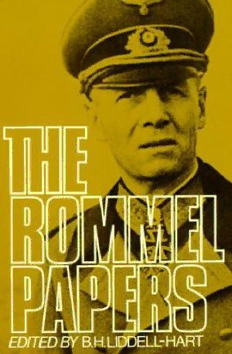
Field Marshal Rommel frontispiece
Crossing the Somme facingpage42
Enemy artillery on the Somme 43
"We had reached the coast of France" 43
British and French prisoners at St. Valdry 58
The surrender at St. Val&y 58
Rammers letter to his wife, June 2ist, 1940 59
Rommel with General Gambier-Parry 98
The Fieseler Storch used by Rommel 98
Tracks south of Tobruk, Summer 1941 99
Another type of desert terrain 99
Rommel on the Via Balbia, April 1941 130
Rommels main headquarters on the Via Balbia 130
Rommels advanced headquarters near Tobruk 131
Rommel outside his tent 131
The Mammoth 2226
Digging a way through the sand hills 226
Rommel working in his caravan 227
Field Marshal Kesselring, General Froehlich, General Cause,
Field Marshal Rommel, General Cruewell 227
Plans for the attack on Cairo 258
Obstacles on the shores of France, Spring 1944 259
Rommel with Field Marshal Rundstedt 498
Rommel with General Speidel 498
RommeFs coffin being borne from his home 499
Hitlers wreath 499
INTRODUCTION
THE IMPACT that Rommel made on the world with the sword will be
deepened by his power with the pen. No commander in history has
written an account of his campaigns to match the vividness and value
ofRommel s which, for the most part, has now been retrieved from its
various hiding places and put together in this volume.
No other commander has provided such a graphic picture of his
operations and method of command. No one else has so strikingly
conveyed in writing the dynamism of Blitzkrieg and the pace ofpanzer
forces. The sense of fast movement and quick decision is electrifyingly
communicated in many of the passages Rommel carries the reader
along with him in his command vehicle.
Great commanders have mostly been dull writers. Besides lacking
literary skill in describing their actions, they have tended to be cloudy
about the way their minds worked. In relating what they did, they have
told posterity little about how and why. Napoleon was an exception,
but the value of his account is impaired by a more than usual un-
scrupulousness in treating facts, and by his intentness to falsify the
balance-sheet. Like Caesars, his writing was not merely coloured but
dominated by a propaganda purpose.
Rommels narrative is remarkably objective, as well as graphic.
In drafting it he certainly had, like most men who have made history,
a concern for his place in history. But while he shows a natural desire
for justification in his explanation of events, it is subordinate to his
burning interest in the military lessons of the campaigns. His evidence
stands up uncommonly well to critical examination, and checking by
other sources, A number oferrors offact can be found in it, but fewer
than in many of the official and personal narratives compiled with the
advantage ofpost-warknowledge. There are some disputable interpreta
tions, but not the purposeful distortions, for national or personal credit,
which are all too often found in such accounts.
The clarity and high degree ofaccuracy which distinguish Rommel s
picture of the operations are the more notable because of the confused
impressions that are apt to be produced by fast-moving tank battles,
in the desert. The clearness ofRommels picture owes much
especially
to his way ofcommand his habit ofgetting right forward and seeking
Xlll
INTRODUCTION
to be near the crucial spot at the crucial time. It also owes much to his
prolonged self-training in observation, highly developed eye for spotting
what was significant in a scene, and knack of registering it. His passion
for taking photographs at every step ofadvance was a symptom of this
characteristic as it was with Lawrence, in the Arabian theatre of
World War L
There were marked resemblances between these two masters ofdesert
warfare, whatever their differences in temperament, range of interest
and philosophy. They were strikingly akin in their sense of time and
space, instinct for surprise, eye for ground and opportunity, combination
offlexibilitywith vision, and ideasofdirectpersonal leadership. Another
military link was in the application of mechanised mobility to desert
warfare. Lawrence, who is popularly associated with camel-rides, was
among the first to see how the new means of mobility could transform
desertwarfare,andhaddemonstratedthisembryonicallyandinminiature,
with a few armoured cars and aircraft. RommeFs exploitation of these
potentialities on thegrand scale would have delighted the Lawrencewho
was a connoisseur ofmilitary art and had a revolutionary bent.
Rommel, also, had an urge to express himselfon paper as well as in
action. That became evident long before he became famous as a
commander from his extraordinarily vivid treatise on infantry tactics,
inspired by his experiences as a young officer in World War I and by
his reflections upon them. Most text-books on tactics are deadly dull,
but he brought life into the subject. The more mobile operations ofthe
next war, and his own greater role, gave him bigger scope ofwhich he
took full advantage. He was a born writer as well as a born fighter.
The same expressive gift and urge can be seen in the way he sketched on
paper, with pencil or coloured chalks, the operations he planned or even
imagined.
Throughout his activities in World War II he kept constantly in
mind the project of a book to match the performance, and continually
made notes for the purpose notes that he developed into a narrative
whenever he had a
breathing space.
Death, under Hitlers decree, prevented him from completing the
project, but what he had already drafted makes a book that has no peer
among narratives ofits kind. It may lack polish, but its literary power
is very striking. Along with descriptive clarity it has dramatic intensity,
while its value is much increased by the comments that accompany and
illuminate its story. His section on " The Rules ofDesert Warfare " is a
masterly piece ofmilitary thinking, while the whole narrative is sprinkled
with sage reflections, often with a fresh turn about concentration in
time rather than in space; about the effect of speed in outweighing
numbers; about flexibility as a means to surprise; about the security
provided by audacity; about thestultifying conventions ofthe " quarter
master " mind; about creating new standards and not submitting to