
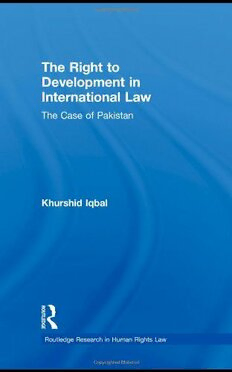
Download The Right to Development in International Law: The Case of Pakistan PDF Free - Full Version
Download The Right to Development in International Law: The Case of Pakistan by Khurshid Iqbal in PDF format completely FREE. No registration required, no payment needed. Get instant access to this valuable resource on PDFdrive.to!
About The Right to Development in International Law: The Case of Pakistan
The Right to Development in International Law rigorously explores the right to development (RTD) from the perspectives of international law as well as the constitutionally guaranteed fundamental rights and the Islamic concept of social justice in Pakistan. The volume draws on a wide range of relevant sources to analyse the legal status of international cooperation in contemporary international law, before exploring the domestic application of the right to development looking at the example of Pakistan, a country that is undergoing radical transformation in terms of its internal governance structures and the challenges it faces for enforcing the rule of law. Of particular importance is the examination of the RTD and Shari‘ah law in Pakistan which adds a new perspective to the RTD debate and enriches the discussion about human rights and Shari‘ah across the world. Through focusing on Pakistan the book links international perspectives and the international human rights framework with the domestic constitutional apparatus for enforcing the RTD within that jurisdiction. In doing so, Khurshid Iqbal argues that the RTD may be promoted through existing constitutional mechanisms if fundamental rights are widely interpreted by the superior courts, effectively implemented by the lower courts and if Shari‘ah law is progressively interpreted in public interest. Iqbal’s work will appeal to researchers, professionals and students in the fields of law, human rights, development, international law, South Asian Studies, Islamic law and international development studies.
Detailed Information
| Author: | Khurshid Iqbal |
|---|---|
| Publication Year: | 2009 |
| ISBN: | 9780415479417 |
| Pages: | 289 |
| Language: | English |
| File Size: | 42.527 |
| Format: | |
| Price: | FREE |
Safe & Secure Download - No registration required
Why Choose PDFdrive for Your Free The Right to Development in International Law: The Case of Pakistan Download?
- 100% Free: No hidden fees or subscriptions required for one book every day.
- No Registration: Immediate access is available without creating accounts for one book every day.
- Safe and Secure: Clean downloads without malware or viruses
- Multiple Formats: PDF, MOBI, Mpub,... optimized for all devices
- Educational Resource: Supporting knowledge sharing and learning
Frequently Asked Questions
Is it really free to download The Right to Development in International Law: The Case of Pakistan PDF?
Yes, on https://PDFdrive.to you can download The Right to Development in International Law: The Case of Pakistan by Khurshid Iqbal completely free. We don't require any payment, subscription, or registration to access this PDF file. For 3 books every day.
How can I read The Right to Development in International Law: The Case of Pakistan on my mobile device?
After downloading The Right to Development in International Law: The Case of Pakistan PDF, you can open it with any PDF reader app on your phone or tablet. We recommend using Adobe Acrobat Reader, Apple Books, or Google Play Books for the best reading experience.
Is this the full version of The Right to Development in International Law: The Case of Pakistan?
Yes, this is the complete PDF version of The Right to Development in International Law: The Case of Pakistan by Khurshid Iqbal. You will be able to read the entire content as in the printed version without missing any pages.
Is it legal to download The Right to Development in International Law: The Case of Pakistan PDF for free?
https://PDFdrive.to provides links to free educational resources available online. We do not store any files on our servers. Please be aware of copyright laws in your country before downloading.
The materials shared are intended for research, educational, and personal use in accordance with fair use principles.

