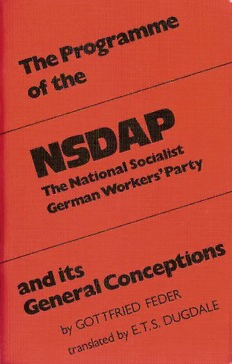
Table Of ContentTHE PROGRAMME OF THE
NSDAP
THE NATIONAL SOCIALIST
GERMAN WORKERS' PARTY
AND ITS
GENERAL CONCEPTIONS
by GOTTFRIED FEDER
translated by E. T. S. DUGDALE
FirstpublishedMunich 1932
by Fritz Eher Verlag.
1980Editionby B.P.Publications,
95a Chester Road East,Shotton,ClwydCH5 2AA
ISBN 0862460018
Historical Account of the Rise of the
N.S.DAP. with a Biographical Survey of the
Career of Adolf Hitler
Adolf Hitler was born on April 20th, 1889, at Braunau on the Inn,
a village of the old Bavaria.
His father was the orphaned child ofa poor peasant and worked his
way up to being a Customs Official. His mother came from a German
ypeeaarssanltatfearmihlyis. Wmohtehner.heAdwoalfs H13itleyreawrsasoldthehnealosscthhoilsarfaatthetrh,eanRdefaolu-r
schu1e at Linz on the Danube, after leaving the National School. It had
been his father’s wish that he should become an official, but his own desire
was to be an artist. His mother’s death obliged him without further delay
to earn his own living.
At 17 years old Hitler went to Vienna, where he aimed to become an
architect. He earned a living by his own efforts, first as a builder’s la-
bourer, mixing the mortar, then as an architect’s draughtsman. At 18years
old he was already taking an interest in politics; he became anti-Marxist,
but so far took no leading part. From his earliest youth Hitler had been
-
passionately Nationalist, and his hope was to combine the social ex
periences of his working period with his nationalist convictions.For several
years he lived in Vienna in extreme poverty.
In 1912 he migrated to Munich, where he was a student. He had
never known youthful enjoyments, but ever since the day when he left
home with 50 kronen in his pocket, labour and privation had been his lot.
In February, 1914, he succeeded in getting free from the obligation
to serve in the Austrian Army. Six months later war broke out. He
immediately volunteered for service in the German Army, and obtained,
by a direct appeal to King Ludwig of Bavaria, permission to enter a
Bavarian regiment as a volunteer for the war. On October 10th, 1914,
the new regiment marched forth.
-
On December 2nd, 1914, the 25 years old volunteer was awarded
the Iron Cross, 2nd Class.
In recognition of his bravery in the ataack on the ‘Bayernwald’ and
in the other engag-ements near Wytschaete, he was ordered to take on-
duty asa despatch carrier, which demanded especial courage and reliabi
lity, for reports had often to be carried across open ground under heavy
fire. This quickly made his name known throughout the regiment beyond
the narrow circle of his comrades.
On October 7th, 1916, he was wounded by a shell splinter. In March,
1917, he returned to his regiment. He received several other distinctions,
3
-
including a Regim ents Diplom for special bravery in the fights
near Fontaines, and finally the Iron Cross, Class I.
On October 14th, 1918 he was severely injured along with many
comrades in his regiment by the Mustard Gas which the British were
then using for the first time, and he was temporarily blinded. Whilst he
was in hospital the Revolution broke out.
On this Hitler resolved to become a politician. In 1919 he joined with
a small party consisting of 6men and on it he founded the National
Socialist German Workers’ Party. He drew up in outline the Programme
of the new movement, and settled its character and aims.
The Nucleus: Seven Men.
In September, 1919, Adolf Hitler made his first speech to seven men;
he then addressed audiences of 11, 25, 47; in December 111; in January,
1920, 270, and shortly afterwards 400. On November 14th, 1920, he spoke
at a mass-meeting of 1700. He now organised the propaganda of the
young—Party,—which after a year’s work numbered 64 members. A year
later 1920 it had already reached 3000. Hitler’s propagandist activity
-
in Munich was such that he was finally addressing mass meetings three
times a week, and on Mondays he carried on a course of instruction. He
attacked first and foremost the folly of Versailles, and denied the
assertions of the Marxists, the Centre Party, etc. that it was—possible to
fulfil that Treaty. He pilloried the slogan of these Parties “Give up
your arms, and the others will also disarm”. He spoke on the assumption
that a—fter arms had been given up by us the rest would continue to
arm, if not with their own money, then with the millions wrung from
the completely disarmed German nation. Whilst opposing the propaganda
od the S.P.D. and Centre in favour of signing the Treaty, he prophecied
that the Ruhr would be occupied, whatever we signed.
1921.
This year was marked by the foundation of the first local groups
at Rosenheim and Landshut. Hitler organised the first body of men to
protect the Party, and began his fight against the Separatist movement
.
in Bavaria Our leader also addressed a meeting of over 5000 in the
Circus in Munich.
He declared at his meetings that fulfilment of the Treaty would not
help, as the S.P.D., Centre and Volkspartei asserted, to build up German
prosperity in peace and quiet, but that the result of that foolish policy was
bound to be inflation on a large scale, involvin-g immense injury to
German industry-. Hitler’s assertion that the black red Government was
planning to de nationalise the State Railways was declared to be a
‘bare-faced lie’. An attempt at a revolt within the Parly was defeated.
Hitler drafted the new Constitution of the Party, which gave him dictatorial
powers.
Social Democracy, which was unable lo continue to ignore the name
of Hitler, now attempted to get rid of its buy bear by methods of
terrorism. There were sanguinary collisions at the meetings, in whi-ch our
leader’s iron nerves maintained the upper hand. An invincible body guard
4
was formed in the course of them, which thenceforward was named the
’Storm Detachment’.
1922.
Whilst the conquest of Munich was proceeding, the movement was
beginning to spread throughout the rest of Bavaria. Hitler rejected all
overtures, by way of compromise, to join up with other Parlies. He
gradually destroyed all similar ‘nationalist’ party formations, and made
the National Socialist movement supreme over them.
In October, 1922, Hitler marched at the head of 800 men to Coburg,
and in twice 24 hours for the first time utterly crushed the Red Terror
in that town.
Adolf Hitler declared then publicly that we were rushing headlong
ipnolitchyeodfirtehcetiobnlacokf-riendflactoioanli,tiownh.icHhe hbeecahmade fkonroewsenenasasthethmeorsetsudlatngoferothues
and best hated enemy of the system. Social Democracy and the Centre
Party ceased defending themselves by argument, and adopted a policy of
defamation.
1923.
In January, 1923, the first great Party Conference was held, and the
first banners of the Party were consecrated. The Storm Detachment was
formally incorporated.
The Party propaganda was exhaustively studied and improved, and
the permanent principles of the organisation were settled and established.
Adherents gathered round Hitler in large numbers, the majority of whom
-
are to day his stedfast partners in the struggle. The attacks on him were
meanwhile pursued with increasing determination; he found himself in
prison for the first time on the charge of disturbing the meetings of his
adversaries; he was constantly fined. Nevertheless he never for one moment
ceased fighting against the system.
During the summer of 1923 Adolf Hitler proceeded to break down the
RedTerror in the majority af the towns in Bavaria; R—atisbon,Hof,Bayreuth,
Nurenberg,Fiirth,Ingolstadt,Wurzburg,Schweinfurt, ofte-n at the cost of
bloodshed in street fights, in which he defeated the Social democratic and
Communist terrorist bands.
His struggle against the incompetent Government of the Reich was
-
accompanied by bitter accusations. He prophecied the ill success o-f
the Government’s feeble resistance in the matter of the Ruhr, and con
stantly attacked the stupid policy of an understanding with France, and-
that of fulfilment. He never failed to point out the necessity of an under
standing with England and Italy.
In November, 1923, Adolf Hitler made his attempt to overthrow the
system. The rising failed, and Hitler was arrested.
1924.
.
The great Trial took place in Munich in March, 1924 Though found
guilty on the facts, our leader achieved overwhelming moral justification.
Hitler’s defence influenced the Court to such an extent, and his assumption
of sole and exclusive responsibility was so convincing, that the speech
of the counsel indicting him turned into a remarkable testimony’ to his
5
honourable motives. The Judge however condemned him to a period of
detention.
The National Socialist Party suffered by the loss of its leader. Its
adversaries were convinced that the movement was done for, and took
courage to sign the infamous Dawes Pact, thus deliberately starting the
system of the plundering of Germany which was brought to a head in the
Young Plan. What a triumph for the Social Democrats and the Centre!
The objective of the enslavement of Germany was apparently achieved!
In vain Hitler tried through his asso.ciates, who were at liberty, to
put up a fight against the Dawes Pact. Ii vain he made them declare in
public that the assurances of the Centre Party, the S.P.D. and the
Volkspartei, that the foreign loans under the Plan would increase national
prosperity, that unemployment would cease, that wages would be raise-d
and taxes reduced, that agriculture would be saved, were merely a de
ception of the nation. In vain he made them point out that the Dawes Pact
was bound to increase poverty, since the interest on the loans would
cripple industry, whilst the loans themselves merely served the purpose
of fulfilling the financial obligations under the Plan; bankruptcy and
unemployment would increase, wages would sink, prices and taxation
.
would rise still further, and the farmers would be faced with utter
ruin and be forced to part with all they possessed.
On December 20th Hitler quitted the fortress.
1925.
By February 27th, 1925, Adolf Hitler’s call for the re-birth of the
Party went forth, and he made his first speech after his imprisonment be-
fore an audience of 4000 persons.
The National Socialist movement had been broken up after the events
of November 9th, and all its property and money had been confiscated;
so that Adolf Hitler now started with nothing in hand to rebuild the Party
from its foundations. Vor warts and Germania in Berlin made fun of
his efforts and mocked at the “fool whom imprisonment had made mad”.
Nevertheless the reconstruction of the Party proceeded with great rapidity
under Hitler’s leadership. The old leaders gathered faithfully round him once
more. Hitler stimulated the Party press into fresh activity.
By December, 1925, the Party numbered 27,000 members.
The Centre and the Social Democrats in alarm decreed that the leader
should not speak in public for two years.
.
1926
June of this year saw the first Conference of the Party since Hitler’s
imprisonment.
The bourgeois world were still convinced that the policy of fulfilment
would save Germany and that the Dawes Pact would revive industry. The
Marxists were convinced that their domination was unshakable.
President von Hindenburg separated from his supporters and marched
off with the Centre and S.P.D.
The Party carried on the struggle; by the end of the year it
numbered 49,000 members.
6
1927.
The order forbidding Hitler to speak in public was withdrawn, since
it was found impossible to enforce it. He addressed numbers of mass meet-
ings. Each month saw the Party more and more firmly consolidated.
Developments all round proved with greater and greater force that
Hitler had been right. The Dawes Pact was unmasked, and its con-
sequences were terrific. The Social Democrats and Centre Party attempt-
ed to save what might be saved by means of lies and abuse.
In August Hitler summoned a Party Conference at Nurenberg, which
proved a great success. By the end of the year the Party numbered
72,000 members.
1928.
Adolf Hitler led his Party in an intensified assault on the existing
-
system. National Socialism was now the inexorable enemy of the de
-
stroyers of Germany within and without. Hitler directed his attack espe
cially against the senseless ruining of the farmers and middle classes. He
prophecied the catastrophe which would fall upon the home markets.
He declared at hundreds of meetings again and again that the policy
of fulfilment was lunacy, and that its consequences would mean death and
ruin to German industry. The Social Democrats and Centre mocked and
jeered in their attempt to get their revenge. Their lies and abuse were
directed at Hitler personally.
By the end of the year the membership numbered 108,000, and 12
members of the Party sat in the Reichstag.
1929.
Adolf Hitler continued his fight with the existing system with-
untiring energy. The Press of the Party was perfected, the Storm De
-
tachment increased, the SS formations strengthened, and the propa
ganda intensified. The doctrines of National Socialism began to penetrate
deeply into the national consciousness.
on aOtnreAmuegnudsotus4tshcatlhee. HseictloenrdatPtaacrktyedCtohnefebrelanccke-rteodoksypstleamce watithNuerveenrbeinrg-
creasing energy and stood forth without a- rival as the most powerful
leader against all that was meant by ‘Democraty’. All attempts to oust
him from the leadership of the Party were crushed.
By the end of the year the Party numbered 178,000 members.
1930.
The struggle against the Young Plan was in full swing. Hindenburg
defended it with energy, asserting that by it Germany would be saved,
that German industry would revive, that unemployment would be stemmed,
that the farmers would breathe again, and that it would be possible to
lighten taxation.
Adolf Hitler described such views as unreal and fatal; he prophecied
the contrary. His Party proceeded to enlighten the nation amidst severe
fighting. The opponents replied with a stream of lies.
7
The Elections to-the Reichstag took place on September 14th, 1930.
The Party polled 61 million votes, and 107 members were elected. Its
internal organisation was stronger than ever. A few minor attempts at
revolt, promoted from outside, were promptly crushed by Hitler, and
those who would not submit unconditionally were expelled.
The Centre Party, which had now delivered itself into the hands of
the S.P.D. for good or ill, began to excite the Church against Hitler.
Bishops and Priests, belonging to the Centre Party, started a fanatical
attack against the National Socialist movement, excommunicated its
adherents, and even refused them Christian burial. Hitler held unshakably
to his conviction that the Centre spelt ruin for Germany, and continued
his fight against it with even greater determination than before. He
sternly rejected any attempt to extort some modification of his opinions
from him.
By the end of the year the Party numbered 389,000 members.
1931.
The fight against the Young Plan continued. The consequences fore-
seen by Hitler became a reality.
The Government began to administrate by means of emergency mea-
sures, thinking thus to save industry. Sharp disputes followed, in which
Adolf Hitler ag—ain pointed out the fatal consequences of that policy. In
a few months a few weeks even — he was proved right.
Meanwhile numbers of National Socialist newspapers had starded into
life, and the central publishing office of the Party had gradually grown
to be a vast enterprise. The organisation had become highly efficient, and
the Storm Detachment had in course of time reached a high stage of
development.
Our opponents wallowed in lies, and were allowing orders for goods to
be placed in France.
By the end of the year 1931 the membership of the Hitler Party
attained to 806,000, a month later to 862,000, and again a month later to
920,000. On the day of the Election there were something like a million
members, and untold millions of supporters at the Polls.
The man who was once a poor worker and later a soldier at the
front has thus in barely thirteen years built op the greatest political
organisation which Germany has ever seen. The sole resources against
this man which his oppenents can employ are lies and defamation. And he
has always won so far in spite of all the lies, and this time he has come
near to being elected President of the Reich.
Has anyone in the whole history of Germany ever accomplished a
similar achievement in twelve years, in face of opposition from Party,
high finance, Capital, Press, public opinion, bureaucracy, lies, terrorism, and
persecution?
This was no sheltered child; from his earliest years he has been a
man in the highest sense of the word, relying solely on his own strength.
8
Preface
At Weimar in 1926 the Council of the Party decided to publish a series
of pamphlets, dealing in a concise form with the fundamental questions
affecting every aspect of political life in Germany. Our intention was, and
is, to present a consistent and complete picture of the attitude of National
Socialism towards the various tasks of our public life, and of the means by
which it hopes to remove its errors and defects.
Our task is therefore to examine exhaustively how it stands, then
to enquire scientifically whence it originated, and finally, with
creative inspiration, to answer the fateful question, what then? The
high aim of these pamphlets is to indicate new methods for the life of the
State, for finance and economics; to set on high a ‘rocher de bronze’
in the midst of the chaos, to form a stock of clear knowledge by close
study, so that out of it all may emerge a united political will.
At the great Meeting on August 31st, 1927, Adolf Hitler declared
emphatically: “Questions of Programme do not affect the Council
of Administration; the Programme is fixed, and I shall never suffer
changes in the principles of the movement, as laid down in its Programme.”
With this decisive pronouncement on the part of our Leader I associate
myself whole-heartedly, for nothing is more dangerous to the life and
striking force of a movement such as ours, than that, as time goes on, its
fixed Programme should be subjected to negative criticism.
No man who feels that he cannot go the whole way with us in the
Jewish question, in our fight against high finance, the Dawes Pact and the
pauperising policy, or in any other questions contained in our Programme,
or is inclined to barter the liberty of the German nation through the League
of Nations, the Locarno Pact, by compromise and cowardice, need apply to
us; his place is outside the N.S.D.A.P. We utterly reject the ‘superior pri-
vate knowledge’ which such as he are so ready to air in platform oratory
and journalistic out-pourings.
A man who agrees fundamentally with our principles may perhaps
havescruplesaboutafewminordetails,forwecannotexpectovergonetoagree
absolutely on all questions, especially in an aggressive political movement.
It is, however, a different matter when political enemies make mince
meat of some one Point by odious misrepresentation quite beside the point,
as has indeed happened. In such a case an official commentary is necessary.
(See p. 19: Point 17.)
We refuse to vary our Programme for reasons of expediency, as other
Parties do, to suit so-called altered conditions. We intend to.make condi-
tions suit our Programme, by mastering them.
I have been commissioned by Adolf Hitler to issue this series of
pamphlets, which are to form the official literature of the Party.
I have included the official A\anifesto of the Party of March 6th, 1930;
also my reply to ten questions (p. 14 et seq.) set us by the Deutsch-e
Tageszeitung, the leading organ of the Reichslandbund. That news
paper accepted my replies.
This is the best and most effective way to dispose of all the lies about
our ill-disposition towards ownership and inheritance of landed property
in Germany.
9
1. Official Party Manifesto on the Position of
the N.S.D.A.P. with regard to the farming
population and Agriculture
Munich, March 6, 1930.
1. Importance of the Farming Class and of Agriculture
for Germany.
The German nation der-ive a considerable portion of their food from
importation of foreign food stuffs. Before the world War we managed to
pay for these imports with our industrial exports, our trade, and our
deposits of capital abroad. The outcome of the war put an end to this
possibility.
-
To day we are paying for our imported food mostly with the help of
foreign loans, which drive the German nation deeper and deeper in debt
to the international financiers who provide credits. If things go on as they
are, the German poeple will become more and more impoverished.
The only possibility of escaping from this thraldom lies in the ability
of Germany to produce essential food stuffs at home. Increased production
by German agriculture is therefore a question of life and death for the
German nation.
-
Moreover a country population, economically sound and highly pro
ductive, is essential for our industry, which will in future have more and
more to look for openings in the home market.
We also regard the country population as the bearer of the inheritance
of health, the source of the nation’s youth, and as the back-bone of its
armed strength.
Maintenance of an efficient agricultural class, increasing in numbers
as the general population increases, is an essential plank in die National
Socialist platform, because our movement considers the welfare of all our
people in the generations to come.
2. The present-day St a t c’s neglect of the Farming class
and of Agriculture.
Agricultural production, which in itself is capable of being augmented,
is being handicapped, because the increasing indebtedness of the farmers
prevents their purchasing the necessities of cultivation, and because the
fact that farming does not pay removes the inducement to increase pro-
.
duction
The reasons why farming fails to give a sufficient return for the labour
are to be sought:
10