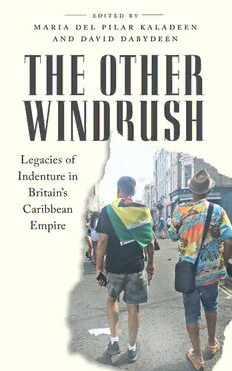
Table Of ContentThe Other Windrush
‘This illuminating, vivid volume is a fitting tribute to the experiences
of migration, struggle and celebration that shaped those communities
born out of the system of Caribbean indenture.’
—Hanif Kureishi, author of The Buddha of Suburbia
‘Through moving and insightful stories and testimonies, the legacies
of indenture are powerfully inscribed.’
—Hannah Lowe, author of Long Time No See
‘This kaleidoscopic survey illuminates corners of modern Britain that
have been overlooked. Filed with vivid stories about the Chinese and
Indian contribution to Caribbean culture, it is also a vibrant history of
immigration to the UK: a colourful work in every sense.’
—Sibghat Kadri QC
‘I cried when I read this beautifully furious book on the life, loves and
heroic struggles of my brave ancestors, the unfree indentured Indian
and Chinese men and women who have been consciously and cruelly
written out of British and Caribbean history.’
—Heidi Safia Mirza, Professor of Race, Faith and Culture
at Goldsmiths, University of London
The Other Windrush
Legacies of Indenture in
Britain’s Caribbean Empire
Edited by
Maria del Pilar Kaladeen
and David Dabydeen
First published 2021 by Pluto Press
345 Archway Road, London N6 5AA
www.plutobooks.com
Copyright © Maria del Pilar Kaladeen and David Dabydeen 2021
The right of the individual contributors to be identified as the authors of
this work has been asserted in accordance with the Copyright, Designs and
Patents Act 1988.
The editors are grateful to the Ameena Gafoor Institute for the Study of
Indentureship and Its Legacies for supporting the publication of this book.
British Library Cataloguing in Publication Data
A catalogue record for this book is available from the British Library
ISBN 978 0 7453 4355 6 Hardback
ISBN 978 0 7453 4354 9 Paperback
ISBN 978 0 7453 4358 7 PDF
ISBN 978 0 7453 4356 3 EPUB
ISBN 978 0 7453 4357 0 Kindle
Typeset by Stanford DTP Services, Northampton, England
Contents
List of figures vii
Introduction: ‘My Father’s Journey Made Me Who I Am’ 1
Maria del Pilar Kaladeen and David Dabydeen
1. What’s in a Face? 9
Jonathan Phang
2. Black Turkey 26
David Dabydeen
3. From BG to GB 36
Elly Niland
4. Made through Movement 46
Nalini Mohabir
5. Interview: ‘Trinidad Implants in you this Wonderful
Sense of Carnival’ 59
Bob Ramdhanie
6. A Tribute to the Life of Rudy Narayan (1938–1998) 72
Lainy Malkani
7. Pepperpot 82
Gordon Warnecke
8. Scratching the Surface: A Speculative Feminist Visual
History of other Windrush Itineraries 93
Tao Leigh Goffe
9. Everything of Us 112
Maria del Pilar Kaladeen
v
The Other Windrush
10. Three Rivers 120
Mr Gee
11. Interview: ‘Invited then Unwelcomed’ 134
Charlotte Bailey
Contributor Biographies 140
Index 144
vi
List of figures
1.1 My mother Maureen 11
1.2 Cyril Bollers, my maternal grandfather 13
1.3 My maternal grandmother Maude and her eldest son,
John 15
1.4 William Adrian Lee, my paternal great-grandfather 18
1.5 Amy Phang, my paternal grandmother 20
1.6 My parents on their wedding day 23
3.1 Elly Niland’s passport photo at age 13 37
3.2 Elly Niland aged 16, taken in London 41
4.1 Myrtle with Nalini Mohabir’s mother Amiran 49
7.1 Mum, Dad and me, 1962, before we moved from
Highgate to Greenford 87
8.1 Hyacinth Lee, studio portrait, 1950s 102
8.2 Hyacinth Lee posing outside a house, 1958 103
8.3 Scanned assorted photographs of Hyacinth Lee, 1950s 104
8.4 Still from Nang by Nang (Dir. Richard Fung, 2019) 108
8.5 ‘Aunt Winnie’s Story’ (1996) by Albert Chong 109
8.6 ‘Aunt Winnie’ (1996) by Albert Chong 110
9.1 Maria del Pilar Kaladeen’s South Indian
great-grandfather, Swantimala 118
Dedicated to the memory of Krishna Prasad (born 1932,
British Guiana; died 2019, London)
And with love to Surujpaul Kaladeen, dreamer and Windrusher
(born 1938, British Guiana)
Introduction: ‘My Father’s Journey
Made Me Who I Am’
Maria del Pilar Kaladeen and David Dabydeen
Despite the strong sense of Caribbean identity that connects
the contributors to this book, many of us have experienced,
throughout our lives, the blank looks of those who have struggled
to place us when we respond to that most loaded of questions,
‘Where are you from?’ Far too few people in the United Kingdom
know about the system of indenture in the Caribbean and the
people of Chinese and Indian descent that it left in the region.
Fewer still are aware that alongside African-Caribbean people,
the descendants of these indentured labourers formed part of
the Windrush generation of migrants from the region to Britain
during 1948–1971.1 While this book reflects on the challenges
experienced by a community who have effectively lived their lives
as a minority within a minority, it is also a celebration of what
has been made possible in spite of our invisibility to the general
population and through the creative ways we have resisted the
silence that surrounds our cultural history.
1 It is important to note that ships carrying Caribbean migrants arrived before
this date. However, the 1948 Commonwealth Act, which reaffirmed the right to
British nationality of citizens of the Commonwealth, was an attempt to foster an
environment that would enable men and women from across the British Empire to
live and work in the UK, fulfilling the nation’s urgent need for labour and helping
to rebuild cities devastated by the Second World War. The establishment of the
National Health Service in the same year created a significant part of the need for
a workforce who largely came from the Caribbean, India and Pakistan. Contri-
butions in this book show how people from the Caribbean responded to this call
for labour; coming to train as nurses, work in the army or study for a number of
other professions.
1