
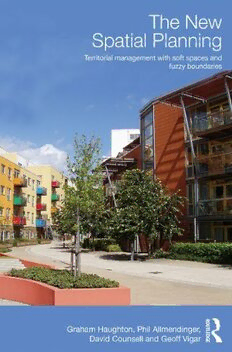
Download The New Spatial Planning: Territorial Management with Soft Spaces and Fuzzy Boundaries (RTPI Library Series) PDF Free - Full Version
Download The New Spatial Planning: Territorial Management with Soft Spaces and Fuzzy Boundaries (RTPI Library Series) by Graham Haughton, Philip Allmendinger, David Counsell, Geoff Vigar in PDF format completely FREE. No registration required, no payment needed. Get instant access to this valuable resource on PDFdrive.to!
About The New Spatial Planning: Territorial Management with Soft Spaces and Fuzzy Boundaries (RTPI Library Series)
Spatial planning, strongly advocated by government and the profession, is intended to be more holistic, more strategic, more inclusive, more integrative and more attuned to sustainable development than previous approaches. In what the authors refer to as the New Spatial Planning, there is a fairly rapidly evolving maturity and sophistication in how strategies are developed and produced. Crucially, the authors argue that the reworked boundaries of spatial planning means that to understand it we need to look as much outside the formal system of practices of ‘planning’ as within it. Using a rich empirical resource base, this book takes a critical look at recent practices to see whether the new spatial planning is having the kinds of impacts its advocates would wish. Contributing to theoretical debates in planning, state restructuring and governance, it also outlines and critiques the contemporary practice of spatial planning. This book will have a place on the shelves of researchers and students interested in urban/regional studies, politics and planning studies.
Detailed Information
| Author: | Graham Haughton, Philip Allmendinger, David Counsell, Geoff Vigar |
|---|---|
| Publication Year: | 2010 |
| ISBN: | 9780415483353 |
| Pages: | 289 |
| Language: | English |
| File Size: | 1.482 |
| Format: | |
| Price: | FREE |
Safe & Secure Download - No registration required
Why Choose PDFdrive for Your Free The New Spatial Planning: Territorial Management with Soft Spaces and Fuzzy Boundaries (RTPI Library Series) Download?
- 100% Free: No hidden fees or subscriptions required for one book every day.
- No Registration: Immediate access is available without creating accounts for one book every day.
- Safe and Secure: Clean downloads without malware or viruses
- Multiple Formats: PDF, MOBI, Mpub,... optimized for all devices
- Educational Resource: Supporting knowledge sharing and learning
Frequently Asked Questions
Is it really free to download The New Spatial Planning: Territorial Management with Soft Spaces and Fuzzy Boundaries (RTPI Library Series) PDF?
Yes, on https://PDFdrive.to you can download The New Spatial Planning: Territorial Management with Soft Spaces and Fuzzy Boundaries (RTPI Library Series) by Graham Haughton, Philip Allmendinger, David Counsell, Geoff Vigar completely free. We don't require any payment, subscription, or registration to access this PDF file. For 3 books every day.
How can I read The New Spatial Planning: Territorial Management with Soft Spaces and Fuzzy Boundaries (RTPI Library Series) on my mobile device?
After downloading The New Spatial Planning: Territorial Management with Soft Spaces and Fuzzy Boundaries (RTPI Library Series) PDF, you can open it with any PDF reader app on your phone or tablet. We recommend using Adobe Acrobat Reader, Apple Books, or Google Play Books for the best reading experience.
Is this the full version of The New Spatial Planning: Territorial Management with Soft Spaces and Fuzzy Boundaries (RTPI Library Series)?
Yes, this is the complete PDF version of The New Spatial Planning: Territorial Management with Soft Spaces and Fuzzy Boundaries (RTPI Library Series) by Graham Haughton, Philip Allmendinger, David Counsell, Geoff Vigar. You will be able to read the entire content as in the printed version without missing any pages.
Is it legal to download The New Spatial Planning: Territorial Management with Soft Spaces and Fuzzy Boundaries (RTPI Library Series) PDF for free?
https://PDFdrive.to provides links to free educational resources available online. We do not store any files on our servers. Please be aware of copyright laws in your country before downloading.
The materials shared are intended for research, educational, and personal use in accordance with fair use principles.

