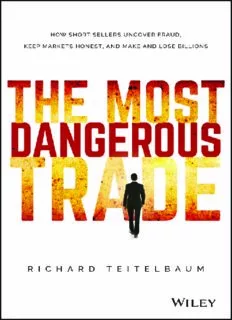
Table Of ContentThe Most
Dangerous Trade
How Short Sellers Uncover
Fraud, Keep Markets
Honest, and Make
and Lose Billions
Richard Teitelbaum
Copyright©2015byRichardTeitelbaum.Allrightsreserved.
PublishedbyJohnWiley&Sons,Inc.,Hoboken,NewJersey.
PublishedsimultaneouslyinCanada.
Nopartofthispublicationmaybereproduced,storedinaretrievalsystem,ortransmittedinanyformorby
anymeans,electronic,mechanical,photocopying,recording,scanning,orotherwise,exceptaspermitted
underSection107or108ofthe1976UnitedStatesCopyrightAct,withouteitherthepriorwritten
permissionofthePublisher,orauthorizationthroughpaymentoftheappropriateper-copyfeetothe
CopyrightClearanceCenter,Inc.,222RosewoodDrive,Danvers,MA01923,(978)750-8400,fax(978)
646-8600,orontheWebatwww.copyright.com.RequeststothePublisherforpermissionshouldbe
addressedtothePermissionsDepartment,JohnWiley&Sons,Inc.,111RiverStreet,Hoboken,NJ07030,
(201)748-6011,fax(201)748-6008,oronlineathttp://www.wiley.com/go/permissions.
LimitofLiability/DisclaimerofWarranty:Whilethepublisherandauthorhaveusedtheirbesteffortsin
preparingthisbook,theymakenorepresentationsorwarrantieswithrespecttotheaccuracyorcompleteness
ofthecontentsofthisbookandspecificallydisclaimanyimpliedwarrantiesofmerchantabilityorfitnessfora
particularpurpose.Nowarrantymaybecreatedorextendedbysalesrepresentativesorwrittensalesmaterials.
Theadviceandstrategiescontainedhereinmaynotbesuitableforyoursituation.Youshouldconsultwitha
professionalwhereappropriate.Neitherthepublishernorauthorshallbeliableforanylossofprofitorany
othercommercialdamages,includingbutnotlimitedtospecial,incidental,consequential,orotherdamages.
Forgeneralinformationonourotherproductsandservicesorfortechnicalsupport,pleasecontactour
CustomerCareDepartmentwithintheUnitedStatesat(800)762-2974,outsidetheUnitedStatesat(317)
572-3993orfax(317)572-4002.
Wileypublishesinavarietyofprintandelectronicformatsandbyprint-on-demand.Somematerialincluded
withstandardprintversionsofthisbookmaynotbeincludedine-booksorinprint-on-demand.Ifthisbook
referstomediasuchasaCDorDVDthatisnotincludedintheversionyoupurchased,youmaydownload
thismaterialathttp://booksupport.wiley.com.FormoreinformationaboutWileyproducts,visit
www.wiley.com.
LibraryofCongressCataloging-in-PublicationData:
Teitelbaum,Richard,1961–
Themostdangeroustrade:howshortsellersuncoverfraud,keepmarketshonest,andmakeandlose
billions/RichardTeitelbaum.
pagescm
Includesindex.
ISBN978-1-118-50521-2(cloth)–ISBN978-1-118-77424-3(epdf)–ISBN978-1-118-61614-7(epub)
1.Shortselling(Securities)2.Fraud.3.Investments.4.Speculation.I.Title.
HG6041.T432015
332.64′5–dc23
2015017857
CoverDesign:Wiley
CoverImages:businessmanwalking©iStock.com/4×6;
background©iStock.com/delirium
PrintedintheUnitedStatesofAmerica
10 9 8 7 6 5 4 3 2 1
Dedicated to former mayor of New York City, Michael Bloomberg,
without whom this book would not have been possible.
Contents
Preface vii
Chapter 1 Ackman: The Activist Grandstander 1
Chapter 2 Asensio: Exile on Third Avenue 27
Chapter 3 Chanos: Connoisseur of Chaos 51
Chapter 4 Einhorn: Contrarian at the Gates 87
Chapter 5 Block: Playing the China Hand 125
Chapter 6 Fleckenstein: Strategies and Tactics 153
Chapter 7 Kass: Nader’s Raider Hits the Street 177
Chapter 8 Tice: Truth Squad Leader 203
Chapter 9 Pellegrini: Behind the Great Subprime Bet 227
Chapter 10 Cohodes: Force of Nature, Market Casualty 257
About the Author 297
Index 299
v
Preface
At its crux, short selling is about failure. Things break down.
Whereasmostofmankindbasksinanaturaloptimism,thereare
those who navigate the darker side of events—the miscalcula-
tions,fraud,andfolliesthatspurusonwardtowarddisaster.Catastrophe’s
natural handmaidens are greed and, yes, plain evil.
The natural state of a collapsing universe is the breaking down of
order. Short sellers understand this and seek to profit from it.
I knew these dynamics before starting this project in 2012. After
all, I quoted the pessimist philosopher Arthur Schopenhauer in college
and still enthuse over Samuel Beckett plays. In hindsight, I’m embar-
rassed to say, my effort was more about careerism than anything else.
Colleagues and rivals were churning out acclaimed books in the wake
of the 2008–2009 financial crisis. I was toiling for Bloomberg News, at a
sparselyreadmonthlymagazineundertheyokeofapetulanteditor.Yes,
Iwasproudofagoodportionofmywork—rackinguparecord23cover
stories.Someofitexploredtheundersideofthefinancialcrisis.Butmy
peers were on Charlie Rose or, worse, had even penned movie deals.
John Wiley & Sons approached me, suggesting I write a book pro-
filingshortsellers—somethingIsuspecttheysooncametoregret.Short
sellers,amisfitbreedofinvestortiltingagainsttherelentlessonslaughtof
vii
viii PREFACE
hypeemanatingfromWallStreet’spowerfulmarketingmachinary,make
acolorfulcastofcharacters—anassortmentofloners,firebrands,cynics,
liars, and losers. What could go wrong?
My paranoid suspicion—evidence for which is utterly
circumstantial—is that the wheels began to fall off the project
before it began, with an investigative story I wrote for the January
2012 issue of the magazine. In July 2008, U.S. Treasury Secretary
Henry Paulson met at the offices of Eton Park Capital Management
with a group of hedge fund managers and other Wall Street types,
many of them alumni of Goldman Sachs, where he was CEO from
1999 to 2006. According to a source at the meeting, the secretary
disclosed material nonpublic information—that the government was
planning to put mortgage guarantors Fannie Mae and FreddieMac into
conservatorship—wiping out equity holders in those state-sponsored
companies. Disclosing this was not illegal, as I reported, citing legal
experts. Yet Paulson had recently said such a move was unlikely.
Nothing much came of that story until September 2012, when the
Wall Street Journal reported that the U.S. Securities & Exchange Com-
mission (SEC) had launched an investigation into the matter. I was on
book leave, and Bloomberg News did not, according to standard prac-
tice, match the story. Nothing much seems to have come of the SEC
investigation.
Except perhaps this: A month or so after the Journal story, while
still on book leave, I was summoned to Bloomberg headquarters and
informed that I was being demoted to essentially a data entry position.
They somehow neglected to change my senior writer title. Of course
plentyofpeoplearedemotedallthetime.Later,BloombergLPrevealed
that then-mayor Michael Bloomberg had a business relationship with
Paulson. Indeed, they are co-chairs of an environmental organization
called the Risky Business Project, along with ex-hedge fund manager
and Goldman Sachs alumnus Thomas Steyer.
Butifthisbookwastochroniclebreakdowns—financial,regulatory,
ethical, structural—my star-crossed efforts to bring the project together
seemedtoeerilyreflectthat.Subjectsdeclinedtobeinterviewed.Others
did so only off the record. I was given bogus information, including a
falseaddressbyonesubject,andothersclaimedtohavenorecordofpast
returns.Aretiredwomanshortsellerrelayedtomethatshehadbecome
Description:How short sellers profit from disasters that afflict individuals, markets, and nations The Most Dangerous Trade serves up tales from the dark side of the world marketplace to reveal how traders profit from the failure and, often, the financial ruin of others. In this book Richard Teitelbaum profiles