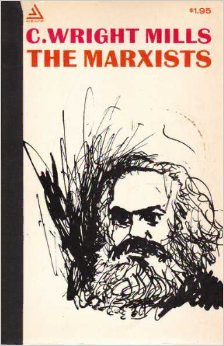
Table Of ContentThe Marxists
— For the past hundred years
the marxists have posed the chief political alternative
for capitalistic societies. They have been the successful
revolutionaries of Russia, China, and Yugoslavia. They
are now the technicians and philosophers whose appeals
to the underdeveloped nations of Asia, Africa, and Latin
America may be decisive.
Here they speak for themselves— in documents by the
leading theorists from young Marx to Mao Tse-tung and
Khrushchev.
As a guide through these theories, C. Wright Mills, author
of such classic and best-selling studies as THE POWER
ELITE, maps out the essential ideas of marxism, which he
then examines critically. He sketches their historical de
velopment— the divisions and revisions, the successes
and failures— and points to their implications for the
present, and the future.
other books by C. WRIGHT MILLS
LISTEN, YANKEE: The Revolution in Cuba (1960)
IMAGES OF MAN (1960)— Edited with an Introduction
THE SOCIOLOGICAL IMAGINATION (1959)
THE CAUSES OF WORLD WAR THREE (1958)
THE POWER ELITE (1956)
CHARACTER AND SOCIAL STRUCTURE (1953)— with H. Gerth
WHITE COLLAR: The American Middle Classes (1951)
THE PUERTO RICAN JOURNEY (1950)— with C. Senior and R. Goldsen
THE NEW MEN OF POWER (1948)
FROM MAX WEBER: Essays in Sociology (1946)— Ed. and Tr. with H. Gerth
The Marxists
C. Wright Mills
A LAUREL EDITION
239
Jrt . *
Published by DELL PUBLISHING C0.f INC.
750 Third Avenue, New York 17, N.Y.
© Copyright 1962, by C. Wright Mills
Laurel ® TM 674623, Dell Publishing Co., Inc. .
On the first pages of selections in this book,
which are used by special permission,
appear copyright notices which constitute
an extension of this copyright page.
This is an original Laurel book.
All rights reserved
First printing— March, 1962
Second printing— December, 1963
Third printing— March, 1966
Printed in U.S.A.
ACKNOWLEDGMENTS: I wish to thank Pablo Gonzales Casanova, Carlos
Fuentes, Enrique Gonzales Pedero, and other friends at the University
of Mexico for their criticisms and aid. Earlier drafts have been read, in
whole or in part, by friends and colleagues to whom I am most grateful
for their generous help. They are, of course, absolved from any errors
or nonsense which may remain: Igor Alexandrov, Tom Bottomore, Isaac
Deutscher, Hans Gerth, Andrew Hacker, I. L. Horowitz, Saul Landau, Sid
Lens, Herbert Marcuse, Ralph Miliband, William Miller, George Mosse,
George Novack, L. A. Costa Pinto, Edward Thompson, William A. Williams.
V ■■ ! ■
<r
contypts
1. IDEALS AND IDEOLOGIES
... in which it is explained why neither “liberalism” nor “social sci
ence” provide adequate grounds for the examination of marxism; four
criteria to use in examining any political philosophy are suggested;
what often happens to a political philosophy— when a success and
when a failure— is considered, and it is explained that marxism and
liberalism have each become ideology, but also that each bears the secu
lar and humanistic tradition of western civilization; conservatism is
characterized and dismissed; the inadequacies of liberalism to meet
the problems of modern society are noted. 9
2. A CELEBRATION OF MARX
... in which the ideological message and the intellectual power of
marxism is indicated: Karl Marx’s place in intellectual history and his
relevance to present-day social reflection are stated. 30
3. THE CLASSIC THINKERS
... in which the intellectual scope and variety of Karl Marx and Fried
rich Engels are illustrated by selected readings, ranging from the
young Marx as critical philosopher to the image-maker of a commu
nist future. 41
4. INVENTORY OF IDEAS
... in which the leading ideas of Marx are systematically stated; his
model of society, theory of history, as well as specific conceptions and
expectations, are set forth without criticism. 81
5. RULES FOR CRITICS
...in which some correct and some irrelevant grounds of criticism
are sorted out, and the terms of criticism to be used in this book are
stated. 96
6. CRITICAL OBSERVATIONS
... in which the major theories of Marx are examined critically and in
light of relevant trends of contemporary societies; errors, ambiguities,
and inadequacies of the intellectual structure are suggested. 105
7. ROADS TO SOCIALISM
... in which the major phases of marxism are each briefly characterized,
politically and intellectually: the classic thinkers, the social demo
crats, the bolshevik pivot, the stalinist consolidation, critics of Stalin
ism, soviet marxism and the new revisionists, marxism outside the bloc
— and the over-all lines of marxist development are briefly summed
up. 132
8. THE SOCIAL DEMOCRATS
... in which Karl Kautsky, Eduard Bernstein, and Rosa Luxemburg— rep
resenting the leading tendencies in the most important party of The
Second International— discuss revolution and reform. 159
9. THE BOLSHEVIK PIVOT
...in which Nikolai Lenin is writing about an imperialist world, the
party, the state, and the co-operation of workers with peasants; Leon
Trotsky is developing the theory of the permanent revolution; how
Lenin and Trotsky coincide in the bolshevism of October 1917 is ex
plained. 203
10. THE STALINIST CONSOLIDATION
... in which Joseph Stalin is in 1924 defining what he is going to mean
by “Leninism" and, near the end of his life, making a brief comment
on base and superstructure and on the inevitability of war. 290
11. CRITICS OF STALINISM
... in which Rosa Luxemburg is giving an early warning; Trotsky is de
veloping his theory of the nature of stalinist society; Rudolf Hilferding
writing on “state capitalism"; Franz Borkenau is characterizing the
communist parties of The Third International; and Isaac Deutscher is
reviewing “The God That Failed." 306
12. SOVIET MARXISM AND THE NEW REVISIONISTS
. . . in which after the death of Stalin Nikita Khrushchev is making a
speech— against Stalin, but not yet against stalinism; Mao Tse-tung is
discussing contradictions and other matters; 81 marxists-leninists are
appealing to the peoples of the world; Palmiro Togliatti is answering
nine questions about stalinism; and we listen in on the VIII Plenum of
the Polish party. 364
13. MARXISM OUTSIDE THE BLOC
... in which the Yugoslav road is being surveyed by Edvard Kardelj;
G. D. H. Cole is again considering the appropriate attitudes of so
cialists toward communists, and other post-Stalin questions; and Er
nesto “Che" Guevara is reflecting upon ideology, revolution, and re
lated matters. 416
14. NEW BEGINNINGS?
... in which the annoying variety of marxism yesterday and today is
indicated; the historical contours of the marxists are briefly presented;
some new beginnings inside and outside the soviet bloc are suggested,
and some questions about the future posed. 468
INDEX 475
1 . Ideals and Ideologies
This book is “a primer,” a primer on marxisms, written
mainly for those who do not really know these philoso
phies, and who do not pretend to know them. It is also
written (hopefully, I suppose) for those who are already
familiar with marxism but who believe that marxism as a
whole has been “gobbled up by the communists” and
accordingly is not for them; for those who hold to the
notion that after all it is “merely ideology,” and that,
nowadays especially, ideology is at an end—or ought to
be. It is also for those who are bored with politics and po
litical philosophy, who have withdrawn to or never emerged
from a strictly private life. If this book does no more than
push such people a bit closer to the experience of being full
citizens, it will have fulfilled its central purpose.
1
In reconsidering several varieties of marxism in terms
appropriate to our own immediate times, I plan in the fol
lowing pages to make a systematic inventory of what I
take to be the essential ideas of classic marxism and then
to criticize them. I shall follow this with some brief his
torical profiles of its main lines of development and uses.
Rather than interrupt this presentation by lengthy quota
tions, I have arranged a selection of the most important
marxist writings as independent chapters. In my criticisms
I shall of course draw upon relevant work now available
in those social sciences with which I am familiar. In order
to keep this book to manageable length, I have not dealt
here in any explicit and systematic way with interpreta
tions and criticisms of marxism provided by other com
mentators. But I have tried to take other interpretations
and criticisms into account, and I hope that I have re
mained aware of the most important of them.
10 The Marxists
Throughout I have tried to be objective, but I do not
claim to be detached. No political philosopher can be de
tached; he can only pretend to be. And I do write this
book in some part as a political philosopher, which only
means: as one who is seeking, with his readers, political
orientation. Accordingly, I shall try to be explicit about
my own political and moral judgments.
As we read the marxists, a political comparison is in
the minds of most of us, whether we are aware of it or
not: the standards we generally tend to use are the stand
ards we think of as “democratic” or “liberal” or those
of “The Free World.” We must state, and examine, these
standards in order to examine marxism effectively. We must
examine both “political liberalism”—the major alternative
in political philosophy and in world reality, and the source
of our values, assumptions and theories—and “social sci
ence” whose terms provide conventional grounds for criti
cism of marxism. My comments on liberalism will neces
sarily be brief, for my main concern in this book is with
marxism.1 But I hope to write in such ways that the as
sumptions of the liberal reader will rise to the surface,
making him freer to clarify his political position.
Many of those who reject (or more accurately, ignore)
marxist ways of thinking about human affairs are actually
rejecting the classic traditions of their own disciplines.
The “Social Science” in the name of which marxism is
ignored or rejected is more often than not a social science
having little or no concern with the pivotal events and the
historic acceleration characteristic of our immediate times.
It is a social science of the narrow focus, the trivial detail,
the abstracted almighty unimportant fact.* A few differences
between Marx’s style of work and some leading types of
contemporary social science will suffice to suggest their
character. When marxists speak of “bourgeois social sci
ence,” these are the sorts of things they mean (or ought to
mean):
The social scientists study the details of small-scale
1. I have already made extended critiques of various liberal views which
I am willing to let stand. For example, see The New Men of Power (1948),
vhite Collar (1951), and The Power Elite (1956).
2. For an elaboration of this point of view, see The Sociological Imagi-
tion (1959); for a sampling of “the classic tradition in sociological
inking,” see Images of Man (1960).