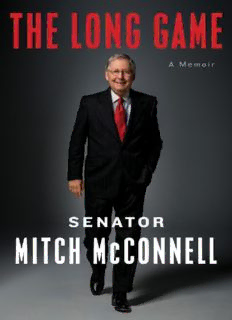
Table Of ContentSENTINEL
An imprint of Penguin Random House LLC
375 Hudson Street
New York, New York 10014
penguin.com
Copyright © 2016 by Mitch McConnell Penguin supports copyright. Copyright fuels creativity, encourages
diverse voices, promotes free speech, and creates a vibrant culture. Thank you for buying an authorized
edition of this book and for complying with copyright laws by not reproducing, scanning, or distributing
any part of it in any form without permission. You are supporting writers and allowing Penguin to continue
to publish books for every reader.
PHOTOGRAPH CREDITS
Insert here: From The Courier-Journal, November 7, 1999, © 1999 Gannett-Community Publishing; here:
From The Courier-Journal, June 23, 1996, © 1996 Gannett-Community Publishing. All rights reserved.
Used by permission and protected by the copyright laws of the United States. The printing, copying,
redistribution, or retransmission of this content without express written permission is prohibited.
Credits for other photographs appear adjacent to the respective images.
ISBN 9780399564109 (hardcover)
ISBN 9780399564123 (ebook)
Penguin is committed to publishing works of quality and integrity. In that spirit, we are proud to offer this
book to our readers; however, the story, the experiences, and the words are the author’s alone.
Version_1
To my mom and dad
Contents
Title Page
Copyright
Dedication
Introduction
CHAPTER ONE
A Fighting Spirit
CHAPTER TWO
From Baseball to Politics
CHAPTER THREE
Seeing Greatness
CHAPTER FOUR
“You Can Start Too Late, but Never Too Soon”
CHAPTER FIVE
“Mitch Who?”
CHAPTER SIX
Giving It All I’ve Got
CHAPTER SEVEN
Slow and Steady
CHAPTER EIGHT
Love
CHAPTER NINE
Standing My Ground
CHAPTER TEN
The Value of the Team
CHAPTER ELEVEN
Resilience
CHAPTER TWELVE
Practicing Patience
CHAPTER THIRTEEN
Frogs in a Wheelbarrow
CHAPTER FOURTEEN
A Thick Hide
CHAPTER FIFTEEN
Bad News
CHAPTER SIXTEEN
Professor Obama
CHAPTER SEVENTEEN
You Can’t Make Policy If You Don’t Win the Election
CHAPTER EIGHTEEN
Courage
CHAPTER NINETEEN
“Making a Point or a Difference?”
CHAPTER TWENTY
Victory
Epilogue
Photographs
Acknowledgments
Index
Introduction
O
ver the three decades I have been a US senator, I’ve been the subject of
many profiles. I usually play the villain, according to the standard good
guy/bad guy accounts favored by most Washington reporters. The more positive
ones tend to focus on my ability to broker deals with supposed adversaries, keep
my head when others don’t, and win elections I’m not supposed to. Until now,
though, no one has ever tried to write the story as I see it, which is really my
doing. I only talk to the press if it’s to my advantage, and I always discourage
my staff from revealing details of my meetings with presidents and other public
figures. It’s rare that I attend the kind of social events where people tend to
engage in the gossip and intrigue for which Washington is famous. I’ve only
been to Nantucket a few times, and I didn’t like it. My idea of a good time is a
quiet evening at home with my wife, Elaine Chao, or—although I may hardly
strike people as the tailgating type—gathered with friends in the parking lot of
the University of Louisville’s Papa John’s stadium, before a Cardinals football
game, a tradition I’ve enjoyed for decades.
Beyond that, the place I feel most at ease is the Senate, an institution that
rewards patience and confounds those who lack it. Every serious student of the
institution, from Tocqueville to my late colleague Robert Byrd, has viewed the
Senate as uniquely important to America’s stability and flourishing. In their
view, as well as in mine, it has made all the difference. Why? Because during the
most contentious and important battles throughout our nation’s history—from
the fierce early fights over the shape and scope of the federal government, to
those that preceded and followed a nation-rending Civil War, to those
surrounding the great wars of the twentieth century, or a decades-long Cold War,
or the war on terror—the Senate is the tool that has enabled us to find our
footing almost every time.
At its best, the Senate exists to keep the government from swinging between
extremes as one party loses power and another gains it. The Senate is the only
legislative body on earth where a majority is not enough—most things require
sixty votes to pass. Without this moderating effect, today’s majority passes
something and tomorrow’s majority repeals it; today’s majority proposes
something, tomorrow’s majority opposes it. We see that in the House of
Representatives all the time. But when the Senate is allowed to work the way it
was designed to—meaning a place where nothing is decided without a good dose
of deliberation and debate, as well as input from both the majority and minority
parties—it arrives at a result that is acceptable to people all along the political
spectrum.
In recent years, however, we’ve lost our sense for the value of slow and
steady deliberation, for the type of work that depends more on patient diplomacy
than on power plays and media manipulation. Under Democratic leader Harry
Reid, the Senate Chamber frequently became little more than a Democratic
campaign studio. Many of the bills that Reid allowed for consideration were bills
his party did not intend to pass. And none of us—no senator, no American—
should be at peace with that. Because if America is to face up to the challenges
we face in the decades ahead, she’ll need the Senate the Founders in their
wisdom intended, not the hollow shell of the Senate created in recent years under
Reid.
No better example exists of this than the story behind the passage of
Obamacare. When Democrats in the Senate couldn’t convince even one
Republican that this bill was worth supporting as written, they decided to do it
on their own and pass it on a party line vote. And now we’re seeing the result.
The chaos this law has visited on our country isn’t just deeply tragic, it was
entirely predictable. That will always be the case if you approach legislation
without regard for the views of the other side. Without some meaningful buy-in,
you guarantee a food fight. You guarantee instability and strife. It may very well
have been the case that on Obamacare, the will of the country was not to pass the
bill at all. That’s what I would have concluded if Republicans couldn’t get a
single Democratic vote for legislation of this magnitude. But Democrats plowed
forward anyway. They didn’t want to hear it and the results are clear. It’s a mess.
The problem, admittedly, originates not solely from the Left alone, but also,
disappointingly, from a very few on the Right. Just as the Democrats have used
every gimmick to push through radically liberal policies, some on the Right have
demanded that if they don’t get every single thing they want, we may as well
burn the place down, even if it means scorching the reputation and future success
of our own party. People are not elected to the Senate to get everything they
want. This is not an all-or-nothing place. And these are not the type of people we
want to be the leaders in the Senate, or of anything else.
A big part of the problem with the Senate today is the way many politicians
on both sides of the aisle style themselves as saviors. It’s not only self-serving
nonsense in most cases, it’s exploitative of the voters. And it reflects a
fundamentally un-American view of how our political institutions were meant to
function. The proper basis of government, James Madison believed, was human
frailty. That’s why it was just as important to Madison, in devising the
government we have, not only to protect the people from their own worst
impulses, but also to protect them from the worst impulses of those they put in
office. And that’s also why the moment we conclude that our political
institutions are no longer up to the task of resolving the challenges we face is the
moment we give up on the American project altogether. Why? Because in the
end it’s the institutions, not the flawed men and women who pass through them,
that will save us from ourselves and from the politicians we’re all so fond of
criticizing.
All these things have always seemed obvious to me, to the point that I never
felt the need to unburden myself of any of it in a book, let alone tell my own
story. But I’ve come to realize that those ideas—and many other constitutional
principles—are anything but obvious to most people today. And when I was
reelected in 2014, winning by a fifteen-point landslide against all odds and
attracting a level of attention I could only find amusing, I realized it was time for
me to write this book.
From the moment I made that decision, I was determined to make it true to
who I am. So much of politics today is about artifice and obfuscation, and that
extends to the standard political memoir, many of which seem artificial to me.
They’re either cloyingly grandiose, or dishonest about what usually motivates
people in my business. I didn’t want my book to be either. The truth is that very
few of us expect to be at the center of world-changing events when we first file
for office, and personal ambition usually has a lot more to do with it than most
of us are willing to admit. That was certainly true for me, and I never saw the
point in pretending otherwise. It doesn’t mean we don’t bring deep and abiding
concerns to the job. It does mean that the standard story of the humble idealist
who unexpectedly finds him-or herself in Washington, carried by a wave of
encouraging friends in a selfless pursuit of justice and truth, is largely a fable.
We’re all the flawed politicians Madison worried about, and the hero pose isn’t a
good look for anyone.
I’m free to say all this because, unlike so many other senators, I’ve never had
an interest in running for president. And since trashing the Senate seems to be a
prerequisite for a presidential run these days, it falls on people like me to write
books like this, defending this precious institution and telling the true story of
what politics in America is actually like.
Anybody can enter politics, but I believe that being good at it—meaning
winning elections so that you can impact policy—comes only as a result of an
extraordinary amount of preparation. My ascension as leader of a new
Republican majority was years in the making. Depending on how you look at it,
preparation like the kind I’ve practiced seems either admirable or overly
calculating. But it happens to be the new reality of politics in America. Unless
you are blessed with extraordinary gifts of charisma or step into the national
spotlight at a particularly opportune moment, making it in the world of politics
today frequently involves incredible feats of preparation and endurance.
Fortunately for me, that’s the only way I have ever approached life. Maybe
that’s because I learned at an early age that nothing worthwhile comes easy.
Maybe it’s because I’ve had to work hard to overcome obstacles of birth and
circumstance. Whatever the reason, I have never had to quarrel with the realities
of life as a senator. Success in politics is a lot of work, and pretending otherwise
isn’t just pointless, it never seemed right to me.
This is a big, boisterous, complex country. Getting to the top in any field
should be tough. The reward for that effort is the knowledge that you have truly
earned your place at the table, and that, in politics at least, the privilege of
serving your fellow citizens is something that’s been hard-won, and for that
reason, worth the effort, before and after the votes are counted. This book is the
story not of one particular campaign, but a lifetime of campaigns. It is the story
of how patience and perseverance have been the keystone of my four decades in
public life, and why I think both qualities are needed now more than ever if we
are to meet our greatest challenges as a nation. It is the story of how a little kid
from Alabama found his purpose in life and pursued it with everything he had.
It’s the story of the long game, and it begins in a small hospital room in
Warm Springs, Georgia.
Description:In October 1984, a hard-charging Kentucky politician waited excitedly for President Ronald Reagan to arrive at a presidential rally in Louisville. In the midst of a tough Senate campaign against an incumbent Democrat, the young Republican hoped Reagan’s endorsement would give a much-needed boost t