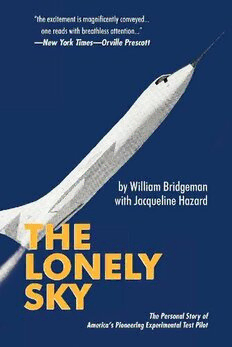
Table Of ContentT H E L O N E L Y S K Y
by WILLIAM BRIDGEMAN
and JACQUELINE HAZARD
Illustrated with Photographs
HENRY HOLT AND COMPANY • NEW YORK
Copyright, 1955, by Henry Holt and Company, Inc.
All rights reserved, including the right to reproduce this
book or portions thereof in any form.
In Canada, George J. McLeod, Ltd.
First Edition
Library of Congress Catalog Card Number: 54-10518
THE LONELY SKY has been given security clearance by the U. S. Navy and
the U. S. Department of Defense.
The publisher wishes to thank the Douglas Aircraft Company, Inc., for
permission to use the photographs reproduced in this book.
81979-0115
Printed in the United States of America
Dedicated to the memory of
CAPTAIN NORMAN “BUZZ” MILLER, USN;
Commanding Officer of Bombing Squadron 109,
“The Reluctant Raiders”
William Bridgeman. Photo courtesy of Douglas Aircraft Company, Inc.
CONTENTS
Prologue 7
Chapter I 12
Chapter II 16
Chapter III 23
Chapter IV 30
Chapter V 39
Chapter VI 52
Chapter VII 63
Chapter VIII 76
Chapter IX 86
Chapter X 101
Chapter XI 112
Chapter XII 120
Chapter XIII 141
Chapter XIV 161
Chapter XV 179
Chapter XVI 187
Chapter XVII 195
Chapter XVIII 214
Chapter XIX 234
Chapter XX 249
Chapter XXI 261
Chapter XXII 270
Chapter XXIII 282
P R O L O G U E
T
his is the story of an experimental high-speed airplane and the test pilot who
flew it.
The story of America’s experimental airplanes, the supersonic
pioneers, could begin in the dawn of a summer day above a German
countryside. The year is 1942.
Out of the brightening sky an unarmed, stripped-down Mosquito,
cameras whining, shot in low over the remote Nazi airstrip. The RAF
officer again noticed the many peculiar-looking black streaks at the end
of the runway; some as even as railroad tracks. Seconds later the little
bomber disappeared into the west.
At Medmenham the developing laboratory of the RAF Photo
Interpretation Unit verified the news once more. The Germans were
busily experimenting with something radically different from anything
the Allies had in the air—probably rockets and rocket-propelled
aircraft. And there was little doubt, the even, parallel streaks were
burned by the flames from a twin-jet fighter.
The United States had no such weapons. Upon our entry into the
war a high-level decision was made. Only a fraction of our resources
would be devoted to jet and rocket research. Time and men and
money would be used to pour out and perfect more of what we had
going already. The huge production machine would be uninterrupted
while the conflict lasted.
But with the news from Medmenham, added to the top of the pile
of intelligence reports from other sources, General Hap Arnold, chief
of the Army Air Forces, appointed a special committee of scientists and
engineers in the allied fields of aerodynamics to advise him on the
future of aircraft and aircraft weapons. He particularly asked the
committee to think about the aircraft not only of tomorrow but of 20
years from then. To head his advisory committee he chose, on the
advice of his close friend Robert Millikan of the California Institute of
Technology, a member of Millikan’s staff, Dr. Theodore von Karman.
As head of Arnold’s Scientific Advisory Board, von Karman, a long-
time prober of supersonics and a strong advocate of applying its
principles to the design of aircraft, began to explore the possibilities of
a truly supersonic airplane.
At the same time the military services were demanding that
manufacturers produce tactical aircraft capable of reaching speeds of
400 mph. The designers were handed the sizable task of molding a
shell sleek and strong enough to reach this speed with the available,
puny reciprocating engine.
It was true we had access to a jet engine. But it wasn’t much more
powerful than the engines we had already and it ate up twice the fuel.
General Electric had put it together, at General Arnold’s request, from
plans of the British Whittle engine brought secretly into the country by
Arnold in 1941. Arnold gave the job of wrapping a frame around the
G.E. turbo-jet attempt to the young and enterprising Bell Company.
The result was America’s first jet, the P-59. It flew valiantly enough
late in 1942, but according to Arnold’s own account of the
experimental ship, its “legs weren’t long enough” to successfully reach
a target. The model never got into combat.
Arnold turned back to the “right-now” aircraft. He listened to the
problems of the manufacturers who were successfully turning out the
faster ships he had demanded. He talked to the combat pilots who flew
the high-performing planes that were now coining off the line by the
thousands.
“What can we do to improve performance?” he asked his fighter
pilots.
“They’re pretty hot right now, sir. If you make them any faster we
won’t be able to fly them. I dove my Mustang on an ME-109 last week …
the controls froze up on me and she shook like a rivet handle. I
couldn’t pull her out of it. I was a fast thousand feet from the bottom
before I could get the nose up.”
A new problem. In the airplanes that reached the 400-mile-an-hour
mark demanded by the military, pilots, diving in combat, were
running into the raw edge of the speed of sound. (Mach 1), into the air-
monster, “compressibility,” a phenomenon that eventually became
more romantically known as the sound barrier.
The Germans and the Japs were not the only enemy that the fighter
pilots had to face. There was the reef of the sound barrier, the dark
area of speed where compressibility lurked to shake a plane to pieces
or suck it out of control straight down into a hole in the ground.
An effect of high speed, compressibility was a phenomenon known
to the aerodynamicists in theory for many years. Because of this
phenomenon, it was generally agreed that flight at and beyond the
speed of sound was impossible.
However, as a result of combat demands, aircraft had flown right
into the monster and the scientists were caught with no answers. In
order to get the answers, investigations into high speed were urgently
needed. This need for all-out research into the unexplored area where
compressibility lay was apparent to the aircraft industry, the Air Force,
the Navy Bureau of Aeronautics, and the nation’s aeronautical research
establishment, the National Advisory Committee on Aeronautics.
It also became apparent that new tools to investigate the area were
needed. Methods of reaching speeds where compressibility could be
studied just didn’t exist. Wind tunnels “choked” as speeds reached that
of sound. Test pilots could dive into such transonic speeds, but it was
too dangerous. There was only one answer: full-scale, high-speed
experimental models, fitted with instrumentation recording devices, to
fly in nature’s big laboratory, the sky; airplanes that would do in level
flight what had only been done in dives.
When things began to look pretty good in Europe, General Arnold
became a champion of the “research-airplane” idea. By the end of 1943
the Navy, the Air Force, and NACA held conferences at NACA
headquarters in Washington to discuss the feasibility of such research
airplanes.
Pursuing a slightly different course, Dr. von Karman’s Scientific
Advisory Board had already stimulated the Air Force’s interest in the
long-range research approach to a supersonic airplane. General F.O.
Carroll, in informal sessions with manufacturers, had brought up the
idea of such an aircraft, not so much as an exploratory tool as an
attempt toward a conventional-operating ship capable of supersonic
speed in actual flight. Douglas Aircraft Company picked up the
challenge and with their own resources assigned their then-small
research-design group to come up with something. The project
became known as X-3.
A year later, toward the last days of the war, Germany got her V-1
rockets and her jet-powered ME-262 and rocket-propelled ME-163B
into the air. But they were too late. They were a futile attempt, a final
bid; and their appearance caused more wonder than destruction.
The war in Europe was over. It was then that the final decision was
made to go ahead with the hurry-up research-airplane program. Two
projects were ordered: the Bell X-1, sponsored by the Air Force, and the
Douglas D-558, sponsored by the Navy. Both projects were eventually
to be tools that would enable NACA to find out all about high-speed
flight.
The X-1, fitted with a rocket engine, was to fly briefly at transonic
speed; while the D-558, using a turbo-jet engine, was designed to
explore, for a longer period, in the high subsonic range.
On V-J Day a group of Navy, NACA, and Douglas engineers met in a
conference room of the nearly deserted El Segundo plant to work out
the details of the D-558. A year had passed since Ed Heineman’s El
Segundo staff had been offered the idea of the original experimental
research plane. In that time advantages of the swept-back wing in
cutting down compressibility were picked up from Germany after V-E
Day.
The Navy project became two airplanes: the Phase I straight-winged
D-558 and the Phase II D-558. The D-558-II utilized the swept wing
and, in addition to the turbojet engine, it was equipped with a rocket
engine similar to that in the Bell X-1. She was named Skyrocket.
Sometime later the Air Force signed a contract with Douglas to go
on investigating with their X-3 project the possibilities of a true
supersonic airplane. The X-3 was eventually ordered in 1949, to be
added to the small stable of weird-shaped Navy- and Air Force-