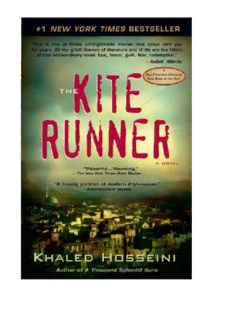
Table Of ContentTHE KITE RUNNER
by
KHALED HOSSEINI
Riverhead Books - New York
Copyright © 2003 by Khaled Hosseini
Riverhead trade paperback
ISBN: 1-59488-000-1
This book is dedicated to
Haris and Farah, both the
_noor_ of my eyes, and to
the children of Afghanistan.
ACKNOWLEDGMENTS
I am indebted to the following colleagues for their advice, assistance, or support: Dr. Alfred Lerner, Don
Vakis, Robin Heck, Dr. Todd Dray, Dr. Robert Tull, and Dr. Sandy Chun. Thanks also to Lynette Parker of
East San Jose Community Law Center for her advice about adoption procedures, and to Mr. Daoud
Wahab for sharing his experiences in Afghanistan with me. I am grateful to my dear friend Tamim
Ansary for his guidance and support and to the gang at the San Francisco Writers Workshop for their
feed back and encouragement. I want to thank my father, my oldest friend and the inspiration for all that
is noble in Baba; my mother who prayed for me and did nazr at every stage of this book’s writing; my
aunt for buying me books when I was young. Thanks go out to Ali, Sandy, Daoud, Walid, Raya, Shalla,
Zahra, Rob, and Kader for reading my stories. I want to thank Dr. and Mrs. Kayoumy--my other parents--
for their warmth and unwavering support.
I must thank my agent and friend, Elaine Koster, for her wisdom, patience, and gracious ways, as well as
Cindy Spiegel, my keen-eyed and judicious editor who helped me unlock so many doors in this tale. And
I would like to thank Susan Petersen Kennedy for taking a chance on this book and the hardworking
staff at Riverhead for laboring over it.
Last, I don’t know how to thank my lovely wife, Roya--to whose opinion I am addicted--for her kindness
and grace, and for reading, re-reading, and helping me edit every single draft of this novel. For your
patience and understanding, I will always love you, Roya jan.
ONE
_December 2001_
I became what I am today at the age of twelve, on a frigid overcast day in the winter of 1975. I remember
the precise moment, crouching behind a crumbling mud wall, peeking into the alley near the frozen
creek. That was a long time ago, but it’s wrong what they say about the past, I’ve learned, about how
you can bury it. Because the past claws its way out. Looking back now, I realize I have been peeking
into that deserted alley for the last twenty-six years.
One day last summer, my friend Rahim Khan called from Pakistan. He asked me to come see him.
Standing in the kitchen with the receiver to my ear, I knew it wasn’t just Rahim Khan on the line. It was
my past of unatoned sins. After I hung up, I went for a walk along Spreckels Lake on the northern edge
of Golden Gate Park. The early-afternoon sun sparkled on the water where dozens of miniature boats
sailed, propelled by a crisp breeze. Then I glanced up and saw a pair of kites, red with long blue tails,
soaring in the sky. They danced high above the trees on the west end of the park, over the windmills,
floating side by side like a pair of eyes looking down on San Francisco, the city I now call home. And
suddenly Hassan’s voice whispered in my head: _For you, a thousand times over_. Hassan the
harelipped kite runner.
I sat on a park bench near a willow tree. I thought about something Rahim Khan said just before he
hung up, almost as an after thought. _There is a way to be good again_. I looked up at those twin kites.
I thought about Hassan. Thought about Baba. Ali. Kabul. I thought of the life I had lived until the winter
of 1975 came and changed everything. And made me what I am today.
TWO
When we were children, Hassan and I used to climb the poplar trees in the driveway of my father’s
house and annoy our neighbors by reflecting sunlight into their homes with a shard of mirror. We would
sit across from each other on a pair of high branches, our naked feet dangling, our trouser pockets filled
with dried mulberries and walnuts. We took turns with the mirror as we ate mulberries, pelted each other
with them, giggling, laughing; I can still see Hassan up on that tree, sunlight flickering through the
leaves on his almost perfectly round face, a face like a Chinese doll chiseled from hardwood: his flat,
broad nose and slanting, narrow eyes like bamboo leaves, eyes that looked, depending on the light,
gold, green, even sapphire I can still see his tiny low-set ears and that pointed stub of a chin, a meaty
appendage that looked like it was added as a mere afterthought. And the cleft lip, just left of midline,
where the Chinese doll maker’s instrument may have slipped; or perhaps he had simply grown tired and
careless.
Sometimes, up in those trees, I talked Hassan into firing walnuts with his slingshot at the neighbor’s
one-eyed German shepherd. Hassan never wanted to, but if I asked, _really_ asked, he wouldn’t deny
me. Hassan never denied me anything. And he was deadly with his slingshot. Hassan’s father, Ali, used
to catch us and get mad, or as mad as someone as gentle as Ali could ever get. He would wag his finger
and wave us down from the tree. He would take the mirror and tell us what his mother had told him, that
the devil shone mirrors too, shone them to distract Muslims during prayer. “And he laughs while he
does it,” he always added, scowling at his son.
“Yes, Father,” Hassan would mumble, looking down at his feet. But he never told on me. Never told
that the mirror, like shooting walnuts at the neighbor’s dog, was always my idea.
The poplar trees lined the redbrick driveway, which led to a pair of wrought-iron gates. They in turn
opened into an extension of the driveway into my father’s estate. The house sat on the left side of the
brick path, the backyard at the end of it.
Everyone agreed that my father, my Baba, had built the most beautiful house in the Wazir Akbar Khan
district, a new and affluent neighborhood in the northern part of Kabul. Some thought it was the
prettiest house in all of Kabul. A broad entryway flanked by rosebushes led to the sprawling house of
marble floors and wide windows. Intricate mosaic tiles, handpicked by Baba in Isfahan, covered the
floors of the four bathrooms. Gold-stitched tapestries, which Baba had bought in Calcutta, lined the
walls; a crystal chandelier hung from the vaulted ceiling.
Upstairs was my bedroom, Baba’s room, and his study, also known as “the smoking room,” which
perpetually smelled of tobacco and cinnamon. Baba and his friends reclined on black leather chairs
there after Ali had served dinner. They stuffed their pipes--except Baba always called it “fattening the
pipe”--and discussed their favorite three topics: politics, business, soccer. Sometimes I asked Baba if I
could sit with them, but Baba would stand in the doorway. “Go on, now,” he’d say. “This is grown-ups’
time. Why don’t you go read one of those books of yours?” He’d close the door, leave me to wonder
why it was always grown-ups’ time with him. I’d sit by the door, knees drawn to my chest. Sometimes I
sat there for an hour, sometimes two, listening to their laughter, their chatter.
The living room downstairs had a curved wall with custombuilt cabinets. Inside sat framed family
pictures: an old, grainy photo of my grandfather and King Nadir Shah taken in 1931, two years before
the king’s assassination; they are standing over a dead deer, dressed in knee-high boots, rifles slung
over their shoulders. There was a picture of my parents’ wedding night, Baba dashing in his black suit
and my mother a smiling young princess in white. Here was Baba and his best friend and business
partner, Rahim Khan, standing outside our house, neither one smiling--I am a baby in that photograph
and Baba is holding me, looking tired and grim. I’m in his arms, but it’s Rahim Khan’s pinky my fingers
are curled around.
The curved wall led into the dining room, at the center of which was a mahogany table that could
easily sit thirty guests-- and, given my father’s taste for extravagant parties, it did just that almost
every week. On the other end of the dining room was a tall marble fireplace, always lit by the orange
glow of a fire in the wintertime.
A large sliding glass door opened into a semicircular terrace that overlooked two acres of backyard
and rows of cherry trees. Baba and Ali had planted a small vegetable garden along the eastern wall:
tomatoes, mint, peppers, and a row of corn that never really took. Hassan and I used to call it “the Wall
of Ailing Corn.”
On the south end of the garden, in the shadows of a loquat tree, was the servants’ home, a modest
little mud hut where Hassan lived with his father.
It was there, in that little shack, that Hassan was born in the winter of 1964, just one year after my
mother died giving birth to me.
In the eighteen years that I lived in that house, I stepped into Hassan and Ali’s quarters only a handful of
times. When the sun dropped low behind the hills and we were done playing for the day, Hassan and I
parted ways. I went past the rosebushes to Baba’s mansion, Hassan to the mud shack where he had
been born, where he’d lived his entire life. I remember it was spare, clean, dimly lit by a pair of kerosene
lamps. There were two mattresses on opposite sides of the room, a worn Herati rug with frayed edges in
between, a three-legged stool, and a wooden table in the corner where Hassan did his drawings. The
walls stood bare, save for a single tapestry with sewn-in beads forming the words _Allah-u-akbar_. Baba
had bought it for Ali on one of his trips to Mashad.
It was in that small shack that Hassan’s mother, Sanaubar, gave birth to him one cold winter day in
1964. While my mother hemorrhaged to death during childbirth, Hassan lost his less than a week after
he was born. Lost her to a fate most Afghans considered far worse than death: She ran off with a clan
of traveling singers and dancers.
Hassan never talked about his mother, as if she’d never existed. I always wondered if he dreamed
about her, about what she looked like, where she was. I wondered if he longed to meet her. Did he
ache for her, the way I ached for the mother I had never met? One day, we were walking from my
father’s house to Cinema Zainab for a new Iranian movie, taking the shortcut through the military
barracks near Istiqlal Middle School--Baba had forbidden us to take that shortcut, but he was in
Pakistan with Rahim Khan at the time. We hopped the fence that surrounded the barracks, skipped
over a little creek, and broke into the open dirt field where old, abandoned tanks collected dust. A
group of soldiers huddled in the shade of one of those tanks, smoking cigarettes and playing cards.
One of them saw us, elbowed the guy next to him, and called Hassan.
“Hey, you!” he said. “I know you.”
We had never seen him before. He was a squatly man with a shaved head and black stubble on his
face. The way he grinned at us, leered, scared me. “Just keep walking,” I muttered to Hassan.
“You! The Hazara! Look at me when I’m talking to you!” the soldier barked. He handed his cigarette to
the guy next to him, made a circle with the thumb and index finger of one hand. Poked the middle
finger of his other hand through the circle. Poked it in and out. In and out. “I knew your mother, did
you know that? I knew her real good. I took her from behind by that creek over there.”
The soldiers laughed. One of them made a squealing sound. I told Hassan to keep walking, keep
walking.
“What a tight little sugary cunt she had!” the soldier was saying, shaking hands with the others,
grinning. Later, in the dark, after the movie had started, I heard Hassan next to me, croaking. Tears were
sliding down his cheeks. I reached across my seat, slung my arm around him, pulled him close. He
rested his head on my shoulder. “He took you for someone else,” I whispered. “He took you for
someone else.”
I’m told no one was really surprised when Sanaubar eloped. People _had_ raised their eyebrows when
Ali, a man who had memorized the Koran, married Sanaubar, a woman nineteen years younger, a
beautiful but notoriously unscrupulous woman who lived up to her dishonorable reputation. Like Ali,
she was a Shi’a Muslim and an ethnic Hazara. She was also his first cousin and therefore a natural
choice for a spouse. But beyond those similarities, Ali and Sanaubar had little in common, least of all
their respective appearances. While Sanaubar’s brilliant green eyes and impish face had, rumor has it,
tempted countless men into sin, Ali had a congenital paralysis of his lower facial muscles, a condition
that rendered him unable to smile and left him perpetually grimfaced. It was an odd thing to see the
stone-faced Ali happy, or sad, because only his slanted brown eyes glinted with a smile or welled with
sorrow. People say that eyes are windows to the soul. Never was that more true than with Ali, who could
only reveal himself through his eyes.
I have heard that Sanaubar’s suggestive stride and oscillating hips sent men to reveries of infidelity. But
polio had left Ali with a twisted, atrophied right leg that was sallow skin over bone with little in between
except a paper-thin layer of muscle. I remember one day, when I was eight, Ali was taking me to the
bazaar to buy some _naan_. I was walking behind him, humming, trying to imitate his walk. I watched
him swing his scraggy leg in a sweeping arc, watched his whole body tilt impossibly to the right every
time he planted that foot. It seemed a minor miracle he didn’t tip over with each step. When I tried it, I
almost fell into the gutter. That got me giggling. Ali turned around, caught me aping him. He didn’t say
anything. Not then, not ever. He just kept walking.
Ali’s face and his walk frightened some of the younger children in the neighborhood. But the real
trouble was with the older kids. They chased him on the street, and mocked him when he hobbled by.
Some had taken to calling him _Babalu_, or Boogeyman.
“Hey, Babalu, who did you eat today?” they barked to a chorus of laughter. “Who did you eat, you
flat-nosed Babalu?”
They called him “flat-nosed” because of Ali and Hassan’s characteristic Hazara Mongoloid features. For
years, that was all I knew about the Hazaras, that they were Mogul descendants, and that they looked a
little like Chinese people. School text books barely mentioned them and referred to their ancestry only
in passing. Then one day, I was in Baba’s study, looking through his stuff, when I found one of my
mother’s old history books. It was written by an Iranian named Khorami. I blew the dust off it, sneaked it
into bed with me that night, and was stunned to find an entire chapter on Hazara history. An entire
chapter dedicated to Hassan’s people! In it, I read that my people, the Pashtuns, had persecuted and
oppressed the Hazaras. It said the Hazaras had tried to rise against the Pashtuns in the nineteenth
century, but the Pashtuns had “quelled them with unspeakable violence.” The book said that my people
had killed the Hazaras, driven them from their lands, burned their homes, and sold their women. The
book said part of the reason Pashtuns had oppressed the Hazaras was that Pashtuns were Sunni
Muslims, while Hazaras were Shi’a. The book said a lot of things I didn’t know, things my teachers
hadn’t mentioned. Things Baba hadn’t mentioned either. It also said some things I did know, like that
people called Hazaras _mice-eating, flat-nosed, load-carrying donkeys_. I had heard some of the kids in
the neighborhood yell those names to Hassan.
The following week, after class, I showed the book to my teacher and pointed to the chapter on the
Hazaras. He skimmed through a couple of pages, snickered, handed the book back. “That’s the one
thing Shi’a people do well,” he said, picking up his papers, “passing themselves as martyrs.” He
wrinkled his nose when he said the word Shi’a, like it was some kind of disease.
But despite sharing ethnic heritage and family blood, Sanaubar joined the neighborhood kids in
taunting Ali. I have heard that she made no secret of her disdain for his appearance.
“This is a husband?” she would sneer. “I have seen old donkeys better suited to be a husband.”
In the end, most people suspected the marriage had been an arrangement of sorts between Ali and his
uncle, Sanaubar’s father. They said Ali had married his cousin to help restore some honor to his
uncle’s blemished name, even though Ali, who had been orphaned at the age of five, had no worldly
possessions or inheritance to speak of.
Ali never retaliated against any of his tormentors, I suppose partly because he could never catch them
with that twisted leg dragging behind him. But mostly because Ali was immune to the insults of his
assailants; he had found his joy, his antidote, the moment Sanaubar had given birth to Hassan. It had
been a simple enough affair. No obstetricians, no anesthesiologists, no fancy monitoring devices. Just
Sanaubar lying on a stained, naked mattress with Ali and a midwife helping her. She hadn’t needed
much help at all, because, even in birth, Hassan was true to his nature:
He was incapable of hurting anyone. A few grunts, a couple of pushes, and out came Hassan. Out he
came smiling.
As confided to a neighbor’s servant by the garrulous midwife, who had then in turn told anyone
who would listen, Sanaubar had taken one glance at the baby in Ali’s arms, seen the cleft lip, and
barked a bitter laughter.
“There,” she had said. “Now you have your own idiot child to do all your smiling for you!” She had
refused to even hold Hassan, and just five days later, she was gone.
Baba hired the same nursing woman who had fed me to nurse Hassan. Ali told us she was a blue-eyed
Hazara woman from Bamiyan, the city of the giant Buddha statues. “What a sweet singing voice she
had,” he used to say to us.
What did she sing, Hassan and I always asked, though we already knew--Ali had told us countless
times. We just wanted to hear Ali sing.
He’d clear his throat and begin:
_On a high mountain I stood,
And cried the name of Ali, Lion of God.
O Ali, Lion of God, King of Men,
Bring joy to our sorrowful hearts._
Then he would remind us that there was a brotherhood between people who had fed from the same
breast, a kinship that not even time could break.
Hassan and I fed from the same breasts. We took our first steps on the same lawn in the same yard.
And, under the same roof, we spoke our first words.
Mine was _Baba_.
Description:The timely and critically acclaimed debut novel that's becoming a word-of-mouth phenomenon. An epic tale of fathers and sons, of friendship and betrayal, that takes us from Afghanistan in the final days of the monarchy to the atrocities of the present. The unforgettable, heartbreaking story of the u