
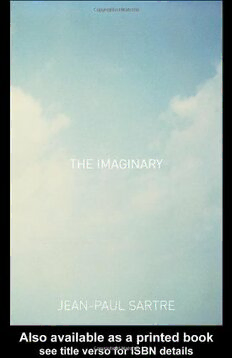
Download The Imaginary: A Phenomenological Psychology of the Imagination PDF Free - Full Version
Download The Imaginary: A Phenomenological Psychology of the Imagination by Jean-Paul Sartre, Arlette Elkaim-Sartre in PDF format completely FREE. No registration required, no payment needed. Get instant access to this valuable resource on PDFdrive.to!
About The Imaginary: A Phenomenological Psychology of the Imagination
'We may therefore conclude that imagination is not an empirical power added to consciousness, but it is the whole of consciousness as it realizes its freedom.' - Jean-Paul Sartre . Sartre's L'Imaginaire was first published in French in 1940 and in English in 1948. This new translation, the first for over fifty years, is of the recent French edition revised by Arlette Elkaim-Sartre. It corrects many important mistakes in the earlier English translation and includes a new introduction by Jonathan Webber, placing the book in a contemporary context. The Imaginary is one of Sartre's most important works and an ideal introduction to his thought. It is a brilliant and lucid examination of one supposedly simple human act: the act of imagining something. Sartre's genius is to show that between this act and the world that imagination creates, lies nothing less than a new theory of of human consciousness. The book contains Sartre's devastating criticisms of scientific psychology and he presents, for the first time, the radical theories of consciousness and human freedom that were to appear a few years later in his magnum opus, Being and Nothingness. Considering the role of the imagination and the emotions, such as disgust, Sartre argues that it is because human beings can imagine or think of things as they are not , that they are ultimately free. The Imaginary is essential reading for anyone interested in Sartre, exitentialism, phenomenology, twentieth century philosophy and philosophy of mind.
Detailed Information
| Author: | Jean-Paul Sartre, Arlette Elkaim-Sartre |
|---|---|
| Publication Year: | 2004 |
| ISBN: | 9780203687673 |
| Pages: | 241 |
| Language: | English |
| File Size: | 0.848 |
| Format: | |
| Price: | FREE |
Safe & Secure Download - No registration required
Why Choose PDFdrive for Your Free The Imaginary: A Phenomenological Psychology of the Imagination Download?
- 100% Free: No hidden fees or subscriptions required for one book every day.
- No Registration: Immediate access is available without creating accounts for one book every day.
- Safe and Secure: Clean downloads without malware or viruses
- Multiple Formats: PDF, MOBI, Mpub,... optimized for all devices
- Educational Resource: Supporting knowledge sharing and learning
Frequently Asked Questions
Is it really free to download The Imaginary: A Phenomenological Psychology of the Imagination PDF?
Yes, on https://PDFdrive.to you can download The Imaginary: A Phenomenological Psychology of the Imagination by Jean-Paul Sartre, Arlette Elkaim-Sartre completely free. We don't require any payment, subscription, or registration to access this PDF file. For 3 books every day.
How can I read The Imaginary: A Phenomenological Psychology of the Imagination on my mobile device?
After downloading The Imaginary: A Phenomenological Psychology of the Imagination PDF, you can open it with any PDF reader app on your phone or tablet. We recommend using Adobe Acrobat Reader, Apple Books, or Google Play Books for the best reading experience.
Is this the full version of The Imaginary: A Phenomenological Psychology of the Imagination?
Yes, this is the complete PDF version of The Imaginary: A Phenomenological Psychology of the Imagination by Jean-Paul Sartre, Arlette Elkaim-Sartre. You will be able to read the entire content as in the printed version without missing any pages.
Is it legal to download The Imaginary: A Phenomenological Psychology of the Imagination PDF for free?
https://PDFdrive.to provides links to free educational resources available online. We do not store any files on our servers. Please be aware of copyright laws in your country before downloading.
The materials shared are intended for research, educational, and personal use in accordance with fair use principles.

