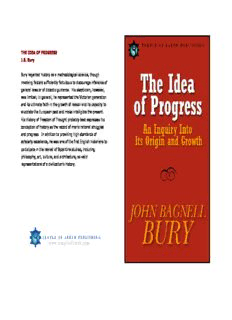
Table Of ContentTHE IDEA OF PROGRESS
J.B. Bury
Bury regarded history as a methodological science, though
involving factors sufficiently fortuitous to discourage inference of
general laws or of didactic guidance. His skepticism, however,
was limited; in general, he represented the Victorian generation
and its ultimate faith in the growth of reason and its capacity to
elucidate the European past and make intelligible the present.
His History of Freedom of Thought probably best expresses his
conception of history as the record of man's rational struggles
and progress. In addition to providing high standards of
scholarly excellence, he was one of the first English historians to
participate in the revival of Byzantine studies, including
philosophy, art, culture, and architecture, as valid
representations of a civilization's history.
THE IDEA OF PROGRESS · J.B. Bury p. 2a THE IDEA OF PROGRESS · J.B. Bury p. 2b
Dedicated to the memories of Charles Francois Castel de Saint-
Pierre, Marie Jean Antoine Nicolas Caritat de Condorcet, Auguste
Comte, Herbert Spencer, and other optimists mentioned in this
THE IDEA OF PROGRESS
volume.
AN INQUIRY INTO
Tantane uos generis tenuit fiducia uestri?
ITS ORIGIN AND GROWTH
BY
J. B. BURY
REGIUS PROFESSOR OF MODERN HISTORY,
AND FELLOW OF KING'S COLLEGE, IN THE
UNIVERSITY OF CAMBRIDGE
THE IDEA OF PROGRESS · J.B. Bury p. 3a THE IDEA OF PROGRESS · J.B. Bury p. 3b
institutions was judged. Monasticism, for instance, throve under
its aegis, while liberty of conscience had no chance. With a new
idea in control, this has been reversed. Religious freedom has
PREFACE thriven under the aegis of Progress; monasticism can make no
appeal to it.
We may believe in the doctrine of Progress or we may not, but in
either case it is a matter of interest to examine the origins and trace For the hope of an ultimate happy state on this planet to be
the history of what is now, even should it ultimately prove to be no enjoyed by future generations--or of some state, at least, that may
more than an idolum saeculi, the animating and controlling idea of relatively be considered happy--has replaced, as a social power, the
western civilisation. For the earthly Progress of humanity is the hope of felicity in another world. Belief in personal immortality is
general test to which social aims and theories are submitted as a still very widely entertained, but may we not fairly say that it has
matter of course. The phrase CIVILISATION AND PROGRESS has ceased to be a central and guiding idea of collective life, a criterion
become stereotyped, and illustrates how we have come to judge a by which social values are measured? Many people do not believe
civilisation good or bad according as it is or is not progressive. The in it; many more regard it as so uncertain that they could not
ideals of liberty and democracy, which have their own ancient and reasonably permit it to affect their lives or opinions. Those who
independent justifications, have sought a new strength by believe in it are doubtless the majority, but belief has many
attaching themselves to Progress. The conjunctions of "liberty and degrees; and one can hardly be wrong in saying that, as a general
progress," "democracy and progress," meet us at every turn. rule, this belief does not possess the imaginations of those who
Socialism, at an early stage of its modern development, sought the hold it, that their emotions react to it feebly, that it is felt to be
same aid. The friends of Mars, who cannot bear the prospect of remote and unreal, and has comparatively seldom a more direct
perpetual peace, maintain that war is an indispensable instrument influence on conduct than the abstract arguments to be found in
of Progress. It is in the name of Progress that the doctrinaires who treatises on morals.
established the present reign of terror in Russia profess to act. All
this shows the prevalent feeling that a social or political theory or Under the control of the idea of Progress the ethical code
programme is hardly tenable if it cannot claim that it harmonises recognised in the Western world has been reformed in modern
with this controlling idea. times by a new principle of far-reaching importance which has
emanated from that idea. When Isocrates formulated the rule of
In the Middle Ages Europeans followed a different guiding star. life, "Do unto others," he probably did not mean to include among
The idea of a life beyond the grave was in control, and the great "others" slaves or savages. The Stoics and the Christians extended
things of this life were conducted with reference to the next. When its application to the whole of living humanity. But in late years
men's deepest feelings reacted more steadily and powerfully to the the rule has received a vastly greater extension by the inclusion of
idea of saving their souls than to any other, harmony with this idea the unborn generations of the future. This principle of duty to
was the test by which the opportuneness of social theories and posterity is a direct corollary of the idea of Progress. In the recent
THE IDEA OF PROGRESS · J.B. Bury p. 4a THE IDEA OF PROGRESS · J.B. Bury p. 4b
war that idea, involving the moral obligation of making sacrifices
for the sake of future ages, was constantly appealed to; just as in
the Crusades, the most characteristic wars of our medieval CONTENTS
ancestors, the idea of human destinies then in the ascendant lured
thousands to hardship and death. INTRODUCTION
The present attempt to trace the genesis and growth of the idea in CHAPTER I SOME INTERPRETATIONS OF UNIVERSAL
broad outline is a purely historical inquiry, and any discussion of HISTORY: BODIN AND LE ROY
the great issue which is involved lies outside its modest scope.
Occasional criticisms on particular forms which the creed of CHAPTER II UTILITY THE END OF KNOWLEDGE: BACON
Progress assumed, or on arguments which were used to support it,
are not intended as a judgment on its general validity. I may, CHAPTER III CARTESIANISM
however, make two observations here. The doubts which Mr.
Balfour expressed nearly thirty years ago, in an Address delivered CHAPTER IV THE DOCTRINE OF DEGENERATION: THE
at Glasgow, have not, so far as I know, been answered. And it is ANCIENTS AND MODERNS
probable that many people, to whom six years ago the notion of a
sudden decline or break-up of our western civilisation, as a result CHAPTER V THE PROGRESS OF KNOWLEDGE: FONTENELLE
not of cosmic forces but of its own development, would have
appeared almost fantastic, will feel much less confident to-day, CHAPTER VI THE GENERAL PROGRESS OF MAN: ABBE DE
notwithstanding the fact that the leading nations of the world have SAINT-PIERRE
instituted a league of peoples for the prevention of war, the
measure to which so many high priests of Progress have looked CHAPTER VII NEW CONCEPTIONS OF HISTORY:
forward as meaning a long stride forward on the road to Utopia. MONTESQUIEU, VOLTAIRE, TURGOT
The preponderance of France's part in developing the idea is an CHAPTER VIII THE ENCYCLOPAEDISTS AND ECONOMISTS
outstanding feature of its history. France, who, like ancient
Greece, has always been a nursing-mother of ideas, bears the CHAPTER IX WAS CIVILISATION A MISTAKE? ROUSSEAU,
principal responsibility for its growth; and if it is French thought CHASTELLUX
that will persistently claim our attention, this is not due to an
arbitrary preference on my part or to neglect of speculation in CHAPTER X THE YEAR 2440
other countries.
CHAPTER XI THE FRENCH REVOLUTION: CONDORCET
J. B. BURY. January, 1920.
THE IDEA OF PROGRESS · J.B. Bury p. 5a THE IDEA OF PROGRESS · J.B. Bury p. 5b
CHAPTER XII THE THEORY OF PROGRESS IN ENGLAND
INTRODUCTION
CHAPTER XIII GERMAN SPECULATIONS ON PROGRESS
When we say that ideas rule the world, or exercise a decisive power
CHAPTER XIV CURRENTS OF THOUGHT IN FRANCE AFTER in history, we are generally thinking of those ideas which express
THE REVOLUTION human aims and depend for their realisation on the human will,
such as liberty, toleration, equality of opportunity, socialism. Some
CHAPTER XV THE SEARCH FOR A LAW OF PROGRESS: I. of these have been partly realised, and there is no reason why any
SAINT-SIMON of them should not be fully realised, in a society or in the world, if
it were the united purpose of a society or of the world to realise it.
CHAPTER XVI SEARCH FOR A LAW OF PROGRESS: II. COMTE They are approved or condemned because they are held to be good
or bad, not because they are true or false. But there is another
CHAPTER XVII "PROGRESS" IN THE FRENCH order of ideas that play a great part in determining and directing
REVOLUTIONARY MOVEMENT (1830-1851) the course of man's conduct but do not depend on his will--ideas
which bear upon the mystery of life, such as Fate, Providence, or
CHAPTER XVIII MATERIAL PROGRESS: THE EXHIBITION OF personal immortality. Such ideas may operate in important ways
1851 on the forms of social action, but they involve a question of fact and
they are accepted or rejected not because they are believed to be
CHAPTER XIX PROGRESS IN THE LIGHT OF EVOLUTION useful or injurious, but because they are believed to be true or
false.
EPILOGUE
The idea of the progress of humanity is an idea of this kind, and it
APPENDIX: NOTES TO THE TEXT [Proofreaders note: these is important to be quite clear on the point. We now take it so much
notes have been interspersed in the main text as Footnotes] for granted, we are so conscious of constantly progressing in
knowledge, arts, organising capacity, utilities of all sorts, that it is
easy to look upon Progress as an aim, like liberty or a world-
federation, which it only depends on our own efforts and good-will
to achieve. But though all increases of power and knowledge
depend on human effort, the idea of the Progress of humanity,
from which all these particular progresses derive their value, raises
a definite question of fact, which man's wishes or labours cannot
affect any more than his wishes or labours can prolong life beyond
the grave.
THE IDEA OF PROGRESS · J.B. Bury p. 6a THE IDEA OF PROGRESS · J.B. Bury p. 6b
up new fields for exploration. Hitherto men of science have not
This idea means that civilisation has moved, is moving, and will been compelled to halt, they have always found means to advance
move in a desirable direction. But in order to judge that we are further. But what assurance have we that they will not one day
moving in a desirable direction we should have to know precisely come up against impassable barriers? The experience of four
what the destination is. To the minds of most people the desirable hundred years, in which the surface of nature has been successfully
outcome of human development would be a condition of society in tapped, can hardly be said to warrant conclusions as to the
which all the inhabitants of the planet would enjoy a perfectly prospect of operations extending over four hundred or four
happy existence. But it is impossible to be sure that civilisation is thousand centuries. Take biology or astronomy. How can we be
moving in the right direction to realise this aim. Certain features of sure that some day progress may not come to a dead pause, not
our "progress" may be urged as presumptions in its favour, but because knowledge is exhausted, but because our resources for
there are always offsets, and it has always been easy to make out a investigation are exhausted--because, for instance, scientific
case that, from the point of view of increasing happiness, the instruments have reached the limit of perfection beyond which it is
tendencies of our progressive civilisation are far from desirable. In demonstrably impossible to improve them, or because (in the case
short, it cannot be proved that the unknown destination towards of astronomy) we come into the presence of forces of which, unlike
which man is advancing is desirable. The movement may be gravitation, we have no terrestrial experience? It is an assumption,
Progress, or it may be in an undesirable direction and therefore not which cannot be verified, that we shall not soon reach a point in
Progress. This is a question of fact, and one which is at present as our knowledge of nature beyond which the human intellect is
insoluble as the question of personal immortality. It is a problem unqualified to pass.
which bears on the mystery of life.
But it is just this assumption which is the light and inspiration of
Moreover, even if it is admitted to be probable that the course of man's scientific research. For if the assumption is not true, it
civilisation has so far been in a desirable direction, and such as means that he can never come within sight of the goal which is, in
would lead to general felicity if the direction were followed far the case of physical science, if not a complete knowledge of the
enough, it cannot be proved that ultimate attainment depends cosmos and the processes of nature, at least an immeasurably
entirely on the human will. For the advance might at some point larger and deeper knowledge than we at present possess.
be arrested by an insuperable wall. Take the particular case of
knowledge, as to which it is generally taken for granted that the Thus continuous progress in man's knowledge of his environment,
continuity of progress in the future depends altogether on the which is one of the chief conditions of general Progress, is a
continuity of human effort (assuming that human brains do not hypothesis which may or may not be true. And if it is true, there
degenerate). This assumption is based on a strictly limited remains the further hypothesis of man's moral and social
experience. Science has been advancing without interruption "perfectibility," which rests on much less impressive evidence.
during the last three or four hundred years; every new discovery There is nothing to show that he may not reach, in his psychical
has led to new problems and new methods of solution, and opened and social development, a stage at which the conditions of his life
THE IDEA OF PROGRESS · J.B. Bury p. 7a THE IDEA OF PROGRESS · J.B. Bury p. 7b
will be still far from satisfactory, and beyond which he will find it 2100 the doctrine of Progress would lose its meaning and would
impossible to progress. This is a question of fact which no willing automatically disappear. It would be a delicate question to decide
on man's part can alter. It is a question bearing on the mystery of what is the minimum period of time which must be assured to man
life. for his future development, in order that Progress should possess
value and appeal to the emotions. The recorded history of
Enough has been said to show that the Progress of humanity civilisation covers 6000 years or so, and if we take this as a
belongs to the same order of ideas as Providence or personal measure of our conceptions of time-distances, we might assume
immortality. It is true or it is false, and like them it cannot be that if we were sure of a period ten times as long ahead of us the
proved either true or false. Belief in it is an act of faith. idea of Progress would not lose its power of appeal. Sixty thousand
years of HISTORICAL time, when we survey the changes which
The idea of human Progress then is a theory which involves a have come to pass in six thousand, opens to the imagination a
synthesis of the past and a prophecy of the future. It is based on an range vast enough to seem almost endless.
interpretation of history which regards men as slowly advancing--
pedetemtim progredientes--in a definite and desirable direction, This psychological question, however, need not be decided. For
and infers that this progress will continue indefinitely. And it science assures us that the stability of the present conditions of the
implies that, as solar system is certified for many myriads of years to come.
Whatever gradual modifications of climate there may be, the planet
The issue of the earth's great business, will not cease to support life for a period which transcends and
flouts all efforts of imagination. In short, the POSSIBILITY of
a condition of general happiness will ultimately be enjoyed, which Progress is guaranteed by the high probability, based on astro-
will justify the whole process of civilisation; for otherwise the physical science, of an immense time to progress in.
direction would not be desirable. There is also a further
implication. The process must be the necessary outcome of the It may surprise many to be told that the notion of Progress, which
psychical and social nature of man; it must not be at the mercy of now seems so easy to apprehend, is of comparatively recent origin.
any external will; otherwise there would be no guarantee of its It has indeed been claimed that various thinkers, both ancient (for
continuance and its issue, and the idea of Progress would lapse into instance, Seneca) and medieval (for instance, Friar Bacon), had
the idea of Providence. long ago conceived it. But sporadic observations--such as man's
gradual rise from primitive and savage conditions to a certain level
As time is the very condition of the possibility of Progress, it is of civilisation by a series of inventions, or the possibility of some
obvious that the idea would be valueless if there were any cogent future additions to his knowledge of nature--which were inevitable
reasons for supposing that the time at the disposal of humanity is at a certain stage of human reflection, do not amount to an
likely to reach a limit in the near future. If there were good cause anticipation of the idea. The value of such observations was
for believing that the earth would be uninhabitable in A.D. 2000 or determined, and must be estimated, by the whole context of ideas
THE IDEA OF PROGRESS · J.B. Bury p. 8a THE IDEA OF PROGRESS · J.B. Bury p. 8b
in which they occurred. It is from its bearings on the future that thinking about, the doctrine of Progress. Leonardo da Vinci and
Progress derives its value, its interest, and its power. You may Berkeley are examples. In my Ancient Greek Historians (1909) I
conceive civilisation as having gradually advanced in the past, but dwelt on the modern origin of the idea (p. 253 sqq.). Recently Mr.
you have not got the idea of Progress until you go on to conceive R. H. Murray, in a learned appendix to his Erasmus and Luther,
that it is destined to advance indefinitely in the future. Ideas have has developed the thesis that Progress was not grasped in antiquity
their intellectual climates, and I propose to show briefly in this (though he makes an exception of Seneca),--a welcome
Introduction that the intellectual climates of classical antiquity and confirmation.]
the ensuing ages were not propitious to the birth of the doctrine of
Progress. It is not till the sixteenth century that the obstacles to its I
appearance definitely begin to be transcended and a favourable
atmosphere to be gradually prepared. It may, in particular, seem surprising that the Greeks, who were so
fertile in their speculations on human life, did not hit upon an idea
[Footnote: The history of the idea of Progress has been treated which seems so simple and obvious to us as the idea of Progress.
briefly and partially by various French writers; e.g. Comte, Cours But if we try to realise their experience and the general character of
de philosophie positive, vi. 321 sqq.; Buchez, Introduction a la their thought we shall cease to wonder. Their recorded history did
science de l'histoire, i. 99 sqq. (ed. 2, 1842); Javary, De l'idee de not go back far, and so far as it did go there had been no impressive
progres (1850); Rigault, Histoire de la querelle des Anciens et des series of new discoveries suggesting either an indefinite increase of
Modernes (1856); Bouillier, Histoire de la philosophie cartesienne knowledge or a growing mastery of the forces of nature. In the
(1854); Caro, Problemes de la morale sociale (1876); Brunetiere, La period in which their most brilliant minds were busied with the
Formation de l'idee de progres, in Etudes critiques, 5e serie. More problems of the universe men might improve the building of ships,
recently M. Jules Delvaille has attempted to trace its history fully, or invent new geometrical demonstrations, but their science did
down to the end of the eighteenth century. His Histoire de l'idee little or nothing to transform the conditions of life or to open any
de progres (1910) is planned on a large scale; he is erudite and has vista into the future. They were in the presence of no facts strong
read extensively. But his treatment is lacking in the power of enough to counteract that profound veneration of antiquity which
discrimination. He strikes one as anxious to bring within his net, seems natural to mankind, and the Athenians of the age of Pericles
as theoriciens du progres, as many distinguished thinkers as or of Plato, though they were thoroughly, obviously "modern"
possible; and so, along with a great deal that is useful and relevant, compared with the Homeric Greeks, were never self- consciously
we also find in his book much that is irrelevant. He has not clearly "modern" as we are.
seen that the distinctive idea of Progress was not conceived in
antiquity or in the Middle Ages, or even in the Renaissance period; 1.
and when he comes to modern times he fails to bring out clearly
the decisive steps of its growth. And he does not seem to realise The indications that human civilisation was a gradual growth, and
that a man might be "progressive" without believing in, or even that man had painfully worked his way forward from a low and
THE IDEA OF PROGRESS · J.B. Bury p. 9a THE IDEA OF PROGRESS · J.B. Bury p. 9b
savage state, could not, indeed, escape the sharp vision of the ploughing or navigation or law-giving did not suggest the guess
Greeks. For instance, Aeschylus represents men as originally living that new inventions might lead ultimately to conditions in which
at hazard in sunless caves, and raised from that condition by life would be more complex but as happy as the simple life of the
Prometheus, who taught them the arts of life. In Euripides we find primitive world.
a similar recognition of the ascent of mankind to a civilised state,
from primitive barbarism, some god or other playing the part of But, if some relative progress might be admitted, the general view
Prometheus. In such passages as these we have, it may be said, the of Greek philosophers was that they were living in a period of
idea that man has progressed; and it may fairly be suggested that inevitable degeneration and decay--inevitable because it was
belief in a natural progress lay, for Aeschylus as well as for prescribed by the nature of the universe. We have only an
Euripides, behind the poetical fiction of supernatural intervention. imperfect knowledge of the influential speculations of Heraclitus,
But these recognitions of a progress were not incompatible with Pythagoras, and Empedocles, but we may take Plato's tentative
the widely-spread belief in an initial degeneration of the human philosophy of history to illustrate the trend and the prejudices of
race; nor did it usually appear as a rival doctrine. The old legend of Greek thought on this subject. The world was created and set
a "golden age" of simplicity, from which man had fallen away, was going by the Deity, and, as his work, it was perfect; but it was not
generally accepted as truth; and leading thinkers combined it with immortal and had in it the seeds of decay. The period of its
the doctrine of a gradual sequence of social and material duration is 72,000 solar years. During the first half of this period
improvements [Footnote: In the masterly survey of early Greek the original uniformity and order, which were impressed upon it by
history which Thucydides prefixed to his work, he traces the social the Creator, are maintained under his guidance; but then it reaches
progress of the Greeks in historical times, and finds the key to it in a point from which it begins, as it were, to roll back; the Deity has
the increase of wealth.] during the subsequent period of decline. loosened his grip of the machine, the order is disturbed, and the
We find the two views thus combined, for instance, in Plato's Laws, second 36,000 years are a period of gradual decay and
and in the earliest reasoned history of civilisation written by degeneration. At the end of this time, the world left to itself would
Dicaearchus, a pupil of Aristotle. [Footnote: Aristotle's own view is dissolve into chaos, but the Deity again seizes the helm and
not very clear. He thinks that all arts, sciences, and institutions restores the original conditions, and the whole process begins
have been repeatedly, or rather an infinite number of times (word anew. The first half of such a world-cycle corresponds to the
in Greek) discovered in the past and again lost. Metaphysics, xi. 8 Golden Age of legend in which men lived happily and simply; we
ad fin.; Politics, iv. 10, cp. Ii. 2. An infinite number of times have now unfortunately reached some point in the period of
seems to imply the doctrine of cycles.] But the simple life of the decadence.
first age, in which men were not worn with toil, and war and
disease were unknown, was regarded as the ideal State to which Plato applies the theory of degradation in his study of political
man would lie only too fortunate if he could return. He had indeed communities. [Footnote: Plato's philosophy of history. In the
at a remote time ill the past succeeded in ameliorating some of the myth of the Statesman and the last Books of the Republic. The best
conditions of his lot, but such ancient discoveries as fire or elucidation of these difficult passages will be found in the notes
THE IDEA OF PROGRESS · J.B. Bury p. 10a THE IDEA OF PROGRESS · J.B. Bury p. 10b
and appendix to Book viii. In J. Adam's edition of the Republic possible, the institutions imposed by the enlightened lawgiver,
(1902).] He conceives his own Utopian aristocracy as having since change meant corruption and disaster. These a priori
existed somewhere towards the beginning of the period of the principles account for the admiration of the Spartan state
world's relapse, when things were not so bad, [Footnote: Similarly entertained by many Greek philosophers, because it was supposed
he places the ideal society which he describes in the Critias 9000 to have preserved unchanged for an unusually long period a system
years before Solon. The state which he plans in the Laws is indeed established by an inspired legislator.
imagined as a practicable project in his own day, but then it is only
a second-best. The ideal state of which Aristotle sketched an 2.
outline (Politics, iv. V.) is not set either in time or in place.] and
exhibits its gradual deterioration, through the successive stages of Thus time was regarded as the enemy of humanity. Horace's verse,
timocracy, oligarchy, democracy, and despotism. He explains this
deterioration as primarily caused by a degeneration of the race, Damnosa quid non imminuit dies?
due to laxity and errors in the State regulation of marriages, and
the consequent birth of biologically inferior individuals. "time depreciates the value of the world," expresses the pessimistic
axiom accepted in most systems of ancient thought.
The theories of Plato are only the most illustrious example of the
tendency characteristic of Greek philosophical thinkers to idealise The theory of world-cycles was so widely current that it may almost
the immutable as possessing a higher value than that which varies. be described as the orthodox theory of cosmic time among the
This affected all their social speculations. They believed in the Greeks, and it passed from them to the Romans.
ideal of an absolute order in society, from which, when it is once
established, any deviation must be for the worse. Aristotle, [Footnote: Plato's world-cycle. I have omitted details not essential;
considering the subject from a practical point of view, laid down e.g. that in the first period men were born from the earth and only
that changes in an established social order are undesirable, and in the second propagated themselves. The period of 36,000 years,
should be as few and slight as possible. [Footnote: Politics, ii. known as the Great Platonic Year, was probably a Babylonian
astronomical period, and was in any case based on the Babylonian
5. ] This prejudice against change excluded the apprehension of sexagesimal system and connected with the solar year conceived as
civilisation as a progressive movement. It did not occur to Plato or consisting of 360 days. Heraclitus seems to have accepted it as the
any one else that a perfect order might be attainable by a long duration of the world between his periodic universal
series of changes and adaptations. Such an order, being an conflagrations. Plato derived the number from predecessors, but
embodiment of reason, could be created only by a deliberate and based it on operations with the numbers 3, 4, 5, the length of the
immediate act of a planning mind. It might be devised by the sides of the Pythagorean right-angled triangle. The Great Year of
wisdom of a philosopher or revealed by the Deity. Hence the the Pythagorean Philolaus seems to have been different, and that of
salvation of a community must lie in preserving intact, so far as the Stoics was much longer (6,570,000 years).
Description:treatises on morals. Under the control of the idea of Progress the ethical code .. belief in a natural progress lay, for Aeschylus as well as for. Euripides