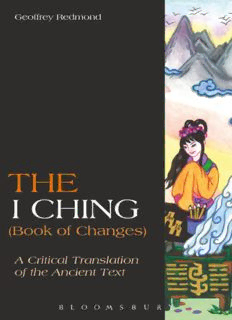
Table Of ContentThe I Ching
(Book of
Changes)
ALSO AVAILABLE FROM BLOOMSBURY
Doing Philosophy Comparatively, Tim Connolly
The Bloomsbury Research Handbook of Chinese Philosophy and
Gender, edited by Ann A. Pang-White
The Bloomsbury Research Handbook of Chinese Philosophy
Methodologies, edited by Sor-hoon Tan
The Bloomsbury Research Handbook of Early Chinese Ethics and
Political Philosophy, edited by Alexus McLeod
Understanding Asian Philosophy, Alexus McLeod
The I Ching
(Book of
Changes)
A Critical Translation
of the Ancient Text
Geoffrey Redmond
Bloomsbury Academic
An imprint of Bloomsbury Publishing Plc
Bloomsbury Academic
An imprint of Bloomsbury Publishing Plc
50 Bedford Square 1385 Broadway
London New York
WC1B 3DP NY 10018
UK USA
www.bloomsbury.com
BLOOMSBURY and the Diana logo are trademarks of Bloomsbury
Publishing Plc
First published 2017
© Geoffrey Redmond, 2017
Geoffrey Redmond has asserted his right under the Copyright, Designs and
Patents Act, 1988, to be identified as the Author of this work.
All rights reserved. No part of this publication may be reproduced or transmitted
in any form or by any means, electronic or mechanical, including photocopying,
recording, or any information storage or retrieval system, without prior
permission in writing from the publishers.
No responsibility for loss caused to any individual or organization acting on
or refraining from action as a result of the material in this publication can be
accepted by Bloomsbury or the author.
British Library Cataloguing-in-Publication Data
A catalogue record for this book is available from the British Library.
ISBN: HB: 978-1-4725-0524-8
PB: 978-1-4725-1413-4
ePDF: 978-1-4725-1271-0
ePub: 978-1-4725-0594-1
Library of Congress Cataloging-in-Publication Data
Names: Redmond, Geoffrey, translator, editor.
Title: The I ching (Book of changes) : a critical translation of the ancient
text / Geoffrey Redmond.
Other titles: Yi jing. English.
Description: New York : Bloomsbury Academic, [2017] | Includes
bibliographical references and index.
Identifiers: LCCN 2016052129| ISBN 9781472505248 (hardback) | ISBN
9781472512710 (epdf)
Subjects: | BISAC: PHILOSOPHY / General.
Classification: LCC PL2478 .D675 2017 | DDC 299.5/1282--dc23 LC record
available at https://lccn.loc.gov/2016052129
Cover design: Catherine Wood
Cover image © Illustrations and calligraphy by Mingmei Yip
Typeset by Fakenham Prepress Solutions, Fakenham, Norfolk NR21 8NN
To find out more about our authors and books visit www.bloomsbury.com. Here
you will find extracts, author interviews, details of forthcoming events and the
option to sign up for our newsletters.
Most of all, for Mingmei, who has always been
there for me during my seemingly endless journey
to the Far Side, to translate one of the world’s most
enigmatic books in the world, and also for her
profound knowledge of Chinese culture, both literary
and popular.
And especially for twenty-five years of love and
companionship.
An excerpt from the oldest (c. 300 bce) existing Zhouyi manuscript; the
original is on bamboo strips. For the anecdote upon which it is based, see
page 368. (All calligraphy and illustrations by Mingmei Yip)
CONTENTS
Preface ix
Foreword xiii
Acknowledgments xxi
Quick Start Guide for the Ancient Book of Changes xxv
Part 1 Approaching one of the world’s oldest books
1 Why another translation? 3
2 Making sense of divination 15
3 History and the intellectual context 23
4 The unique structure of the Book of Changes 43
5 Before the birth of the author: How the Zhouyi was
composed 55
Part 2 The translation and commentaries
Part 3 The quest for philosophy in the Zhouyi
6 What kind of book is the Book of Changes? 329
7 Philosophy in the Zhouyi 353
viii CONTENTS
Part 4 Practical and theoretical aspects
8 Reading by topic 383
9 How to consult the I Ching 385
10 The challenges of translating the Zhouyi 393
Bibliography 411
Index 417
PREFACE
Coming of age in the sixties, I was fascinated by what was
still referred to as the “mysterious Orient,” as well as Western
occultism, itself somewhat beholden to Asian religious and philo-
sophical ideas. At the same time I became attracted to Chinese art,
particularly Song landscape and Shang and Zhou bronzes. Western
interest in China and Japan began far earlier than the sixties. It
started with the early Jesuit missionaries and European philoso-
phers, notably Gottfried Leibniz and Voltaire, who knew about
China only through the accounts of others.
The sudden rise of interest in Asian religion and philosophy in
the sixties was partly due to media popularization, but also because
the times were hungry for new ideas, particularly for philoso-
phies that might offer something life-changing. Through my own
engagement with Chinese culture this came true for me, though
not entirely in ways I expected. I had limited opportunity to pursue
this interest during the long years I was engaged in the ordeal
of medical training, though I did find time to acquaint myself
with the Dao De Jing in the translation of Gia-fu Feng and Jane
English, a work that helped me through this difficult time. While
my approach to science has always been strictly empirical, I found
that Asian thought offered me something that Western science did
not. It is not that I thought these philosophical traditions were
somehow superior to science, rather, they addressed deep human
concerns that the hard sciences by their nature cannot. For this
reason I have always been impatient with the notion that science
and spirituality are incompatible––humanity needs both.
I was particularly fascinated by divination, not as a means of
predicting for myself but as an alternative mode of knowledge, one
that many still find of value in their lives. Scientism rejects such as
not empirically verifiable, but neither is the beauty of a painting
verifiable, despite its enhancing life.
Description:The I Ching has influenced thinkers and artists throughout the history of Chinese philosophy. This new, accessible translation of the entire early text brings to life the hidden meanings and importance of China's oldest classical texts.Complemented throughout by insightful commentaries, The I Ching: