Table Of ContentTHE HISTORY
OF
The Knights Templars,
THE
TEMPLE CHURCH, AND THE TEMPLE.
BY CHARLES G. ADDISON, ESQ.
OF THE INNER TEMPLE.
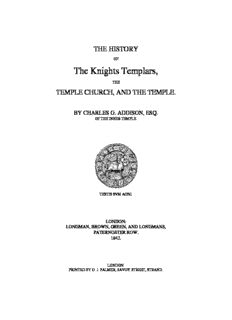
TESTIS SVM AGNI.
LONDON:
LONGMAN, BROWN, GREEN, AND LONGMANS,
PATERNOSTER ROW.
1842.
LONDON:
PRINTED BY G. J. PALMER, SAVOY STREET, STRAND.
TO THE
MASTERS OF THE BENCH OF THE HONOURABLE SOCIETIES
OF THE
Inner and Middle Temple,
THE RESTORERS
OF
The Antient Church of the Knights Templars,
THIS WORK
IS
RESPECTFULLY DEDICATED
BY
THE AUTHOR.
[Pg vii]
PREFACE.
The extraordinary and romantic career of the Knights Templars, their exploits and their
misfortunes, render their history a subject of peculiar interest.
Born during the first fervour of the Crusades, they were flattered and aggrandized as long as
their great military power and religious fanaticism could be made available for the support of the
Eastern church and the retention of the Holy Land, but when the crescent had ultimately
triumphed over the cross, and the religio-military enthusiasm of Christendom had died away,
they encountered the basest ingratitude in return for the services they had rendered to the
christian faith, and were plundered, persecuted, and condemned to a cruel death, by those who
ought in justice to have been their defenders and supporters. The memory of these holy warriors
is embalmed in all our recollections of the wars of the cross; they were the bulwarks of the Latin
kingdom of Jerusalem during the short period of its existence, and were the last band of
Europe’ s host that contended for the possession of Palestine.
To the vows of the monk and the austere life of the convent,[Pg viii] the Templars added the
discipline of the camp, and the stern duties of the military life, joining
“ The fine vocation of the sword and lance,
With the gross aims, and body-bending toil
Of a poor brotherhood, who walk the earth
Pitied.”
The vulgar notion that the Templars were as wicked as they were fearless and brave, has not yet
been entirely exploded; but it is hoped that the copious account of the proceedings against the
order in this country, given in the ninth and tenth chapters of the ensuing volume, will tend to
dispel many unfounded prejudices still entertained against the fraternity, and excite emotions of
admiration for their constancy and courage, and of pity for their unmerited and cruel fate.
Matthew Paris, who wrote at St. Albans, concerning events in Palestine, tells us that the
emulation between the Templars and Hospitallers frequently broke out into open warfare to the
great scandal and prejudice of Christendom, and that, in a pitched battle fought between them,
the Templars were slain to a man. The solitary testimony of Matthew Paris, who was no friend to
the two orders, is invalidated by the silence of contemporary historians, who wrote on the spot;
and it is quite evident from the letters of the pope, addressed to the Hospitallers, the year after
the date of the alleged battle, that such an occurrence never could have taken place.
The accounts, even of the best of the antient writers, should not be adopted without examination,
and a careful comparison with other sources of information. William of Tyre, for instance, tells
us that Nassr-ed-deen, son of sultan Abbas, was taken prisoner by the Templars, and whilst in
their hands became a convert to the Christian religion; that he had learned the rudiments[Pg ix] of
the Latin language, and earnestly sought to be baptized, but that the Templars were bribed with
sixty thousand pieces of gold to surrender him to his enemies in Egypt, where certain death
awaited him; and that they stood by to see him bound hand and foot with chains, and placed in
an iron cage, to be conducted across the desert to Cairo. Now the Arabian historians of that
period tell us that Nassr-ed-deen and his father murdered the caliph and threw his body into a
well, and then fled with their retainers and treasure into Palestine; that the sister of the murdered
caliph wrote immediately to the commandant at Gaza, which place was garrisoned by the
Knights Templars, offering a handsome reward for the capture of the fugitives; that they were
accordingly intercepted, and Nassr-ed-deen was sent to Cairo, where the female relations of the
caliph caused his body to be cut into small pieces in the seraglio. The above act has constantly
been made a matter of grave accusation against the Templars; but what a different complexion
does the case assume on the testimony of the Arabian authorities!
It must be remembered that William archbishop of Tyre was hostile to the order on account of its
vast powers and privileges, and carried his complaints to a general council of the church at
Rome. He is abandoned, in everything that he says to the prejudice of the fraternity, by James of
Vitry, bishop of Acre, a learned and most talented prelate, who wrote in Palestine subsequently
to William of Tyre, and has copied largely from the history of the latter. The bishop of Acre
speaks of the Templars in the highest terms, and declares that they were universally loved by all
men for their piety and humility. “ Nulli molesti erant!” says he, “ sed ab omnibus propter
humilitatem et religionem amabantur.”
The celebrated orientalist Von Hammer has recently brought forward various extraordinary and
unfounded charges, [Pg x]destitute of all authority, against the Templars; and Wilcke, who has
written a German history of the order, seems to have imbibed all the vulgar prejudices against
the fraternity. I might have added to the interest of the ensuing work, by making the Templars
horrible and atrocious villains; but I have endeavoured to write a fair and impartial account of
the order, not slavishly adopting everything I find detailed in antient writers, but such matters
only as I believe, after a careful examination of the best authorities, to be true.
It is a subject of congratulation to us that we possess, in the Temple Church at London, the most
beautiful and perfect memorial of the order of the Knights Templars now in existence. No one
who has seen that building in its late dress of plaster and whitewash will recognize it when
restored to its antient magnificence. This venerable structure was one of the chief ecclesiastical
edifices of the Knights Templars in Europe, and stood next in rank to the Temple at Jerusalem.
As I have performed the pilgrimage to the Holy City, and wandered amid the courts of the
antient Temple of the Knights Templars on Mount Moriah, I could not but regard with more than
ordinary interest the restoration by the societies of the Inner and the Middle Temple of their
beautiful Temple Church.
The greatest zeal and energy have been displayed by them in that praiseworthy undertaking, and
no expense has been spared to repair the ravages of time, and to bring back the structure to what
it was in the time of the Templars.
In the summer I had the pleasure of accompanying one of the chief and most enthusiastic
promoters of the restoration of the church (Mr. Burge, Q.C.) over the interesting fabric, and at
his suggestion the present work was commenced. I am afraid that it will hardly answer his
expectations, and am sorry that the interesting task has not been undertaken by an abler hand.
Temple, Nov. 17, 1841.
[Pg xi]P.S. Mr. Willement, who is preparing some exquisitely stained glass windows for the
Temple Church, has just drawn my attention to the nineteenth volume of the “ MÉMOIRES DE LA
SOCIÉTÉ ROYALE DES ANTIQUAIRES DE FRANCE,” published last year. It contains a most curious
and interesting account of the church of Brelevennez, in the department des Cotes-du-Nord,
supposed to have formerly belonged to the order of the Temple, written by the Chevalier du
FREMANVILLE. Amongst various curious devices, crosses, and symbols found upon the windows
and the tombs of the church, is a copper medallion, which appears to have been suspended from
the neck by a chain. This decoration consists of a small circle, within which are inscribed two
equilateral triangles placed one upon the other, so as to form a six-pointed star. In the midst of
the star is a second circle, containing within it the LAMB of the order of the Temple holding the
banner in its fore-paw, similar to what we see on the antient seal of the order delineated in the
title-page of this work. Mr. Willement has informed me that he has received an offer from a
gentleman in Brittany to send over casts of the decorations and devices lately discovered in that
church. He has kindly referred the letter to me for consideration, but I have not thought it
advisable to delay the publication of the present work for the purpose of procuring them.
Mr. Willement has also drawn my attention to a very distinct impression of the reverse of the
seal of the Temple described in page 106, whereon I read very plainly the interesting motto,
“ TESTIS SVM AGNI.”
[Pg xii]
[Pg xiii]
CONTENTS.
CHAPTER I.
Origin of the Templars—The pilgrimages to
Jerusalem—The dangers to which pilgrims were
exposed—The formation of the brotherhood of the poor
fellow-soldiers of Jesus Christ to protect them—Their
location in the Temple—A description of the
Temple—Origin of the name Templars—Hugh de Payens
chosen Master of the Temple—Is sent to Europe by King
Baldwin—Is introduced to the Pope—The assembling of the
Council of Troyes—The formation of a rule for the
government of the Templars Page 1
CHAPTER II.
Regula Pauperum Commilitonum Christi et Templi
Salomonis.
The most curious parts of the rule displayed—The
confirmation of the rule by the Pope—The visit of Hugh de
Payens, the Master of the Temple, to England—His cordial
reception—The foundation of the Order in this
country—Lands and money granted to the Templars—Their
popularity in Europe—The rapid increase of their
fraternity—St. Bernard takes up the pen in their behalf—He
displays their valour and piety 15
[Pg xiv]
CHAPTER III.
de Payens returns to Palestine—His death—Robert de Craon
made Master—Success of the Infidels—The second
Crusade—The Templars assume the Red Cross—Their
gallant actions and high discipline—Lands, manors, and
churches granted them in England—Bernard de Tremelay
made Master—He is slain by the Infidels—Bertrand de
Blanquefort made Master—He is taken prisoner, and sent in
chains to Aleppo—The Pope writes letters in praise of the
Templars—Their religious and military enthusiasm—Their
war banner called Beauseant—The rise of the rival religio-
military order of the Hospital of St. John 36
CHAPTER IV.
The contests between Saladin and the Templars—The vast
privileges of the Templars—The publication of the bull,
omne datum optimum—The Pope declares himself the 60
immediate Bishop of the entire Order—The different
classes of Templars—The knights—Priests—Serving
brethren—The hired soldiers—The great officers of the
Temple—Punishment of cowardice—The Master of the
Temple is taken prisoner, and dies in a
dungeon—Saladin’ s great successes—The Christians
purchase a truce—The Master of the Temple and the
Patriarch Heraclius proceed to England for succour—The
consecration of the TEMPLE CHURCH at LONDON
CHAPTER V.
The Temple at London—The vast possessions of the
Templars in England—The territorial divisions of the
order—The different preceptories in this country—The
privileges conferred on the Templars by the kings of
England—The Masters of the Temple at London—Their
power and importance 81
CHAPTER VI.
The Patriarch Heraclius quarrels with the king of
England—He returns to Palestine without succour—The
disappointments and gloomy forebodings of [Pg xv]the
Templars—They prepare to resist Saladin—Their defeat and
slaughter—The valiant deeds of the Marshal of the
Temple—The fatal battle of Tiberias—The captivity of the
Grand Master and the true Cross—The captive Templars are
offered the Koran or death—They choose the latter, and are
beheaded—The fall of Jerusalem—The Moslems take
possession of the Temple—They purify it with rose-water,
say prayers, and hear a sermon—The Templars retire to
Antioch—Their letters to the king of England and the
Master of the Temple at London—Their exploits at the
siege of Acre 114
CHAPTER VII.
Richard Cœur de Lion joins the Templars before
Acre—The city surrenders, and the Templars establish the
chief house of their order within it—Cœur de Lion takes up
his abode with them—He sells to them the island of
Cyprus—The Templars form the van of his army—Their
foraging expeditions and great exploits—Cœur de Lion
quits the Holy Land in the disguise of a Knight
Templar—The Templars build the Pilgrim’ s Castle in
Palestine—The state of the order in England—King John 141
resides in the Temple at London—The barons come to him
at that place, and demand MAGNA CHARTA—The exploits
of the Templars in Egypt—The letters of the Grand Master
to the Master of the Temple at London—The Templars
reconquer Jerusalem
CHAPTER VIII.
The conquest of Jerusalem by the Carizmians—The
slaughter of the Templars, and the death of the Grand
Master—The exploits of the Templars in Egypt—King
Louis of France visits the Templars in Palestine—He assists
them in putting the country into a defensible state—Henry
II., king of England, visits the Temple at Paris—The
magnificent hospitality of the Templars in England and
France—Benocdar, sultan of Egypt, invades Palestine—He
defeats the Templars, takes their strong fortresses, and
decapitates six hundred of their brethren—The Grand
Master comes to England for succour—The renewal of the
war—The fall of Acre, and the final extinction of the
Templars in Palestine 165
[Pg xvi]
CHAPTER IX.
The downfall of the Templars—The cause thereof—The
Grand Master comes to Europe at the request of the
Pope—He is imprisoned, with all the Templars in France,
by command of king Philip—They are put to the torture,
and confessions of the guilt of heresy and idolatry are
extracted from them—Edward II. king of England stands up
in defence of the Templars, but afterwards persecutes them
at the instance of the Pope—The imprisonment of the
Master of the Temple and all his brethren in
England—Their examination upon eighty-seven horrible
and ridiculous articles of accusation before foreign
inquisitors appointed by the Pope—A council of the church
assembles at London to pass sentence upon them—The
curious evidence adduced as to the mode of admission into
the order, and of the customs and observances of the
fraternity 193
CHAPTER X.
The Templars in France revoke their rack-extorted
confessions—They are tried as relapsed heretics, and burnt
at the stake—The progress of the inquiry in England—The
curious evidence adduced as to the mode of holding the 239
chapters of the order—As to the penance enjoined therein,
and the absolution pronounced by the Master—The
Templars draw up a written defence, which they present to
the ecclesiastical council—They are placed in separate
dungeons, and put to the torture—Two serving brethren and
a chaplain of the order then make confessions—Many other
Templars acknowledge themselves guilty of heresy in
respect of their belief in the religious authority of their
Master—They make their recantations, and are reconciled
to the church before the south door of Saint Paul’ s
cathedral—The order of the Temple is abolished by the
Pope—The last of the Masters of the Temple in England
dies in the Tower—The disposal of the property of the
order—Observations on the downfall of the Templars
CHAPTER XI.
THE TEMPLE CHURCH.
The restoration of the Temple Church—The beauty and
magnificence of the venerable building—The various styles
of architecture displayed in it—The [Pg xvii]discoveries
made during the recent restoration—The sacrarium—The
marble piscina—The sacramental niches—The penitential
cell—The ancient Chapel of St. Anne—Historical matters
connected with the Temple Church—The holy relics
anciently preserved therein—The interesting monumental
remains 289
CHAPTER XII.
THE TEMPLE CHURCH.
THE MONUMENTS OF THE CRUSADERS—The tomb and effigy
of Sir Geoffrey de Magnaville, earl of Essex, and constable
of the Tower—His life and death, and famous exploits—Of
William Marshall, earl of Pembroke, Protector of
England—Of the Lord de Ross—Of William and Gilbert
Marshall, earls of Pembroke—Of William Plantagenet, fifth
son of Henry the Third—The anxious desire manifested by
king Henry the Third, queen Eleanor, and various persons
of rank, to be buried in the Temple Church 309
CHAPTER XIII.
THE TEMPLE.
Antiquities in the Temple—The history of the place
subsequent to the dissolution of the order of the Knights 342
Templars—The establishment of a society of lawyers in the
Temple—The antiquity of this society—Its connexion with
the antient society of the Knights Templars—An order of
knights and serving brethren established in the law—The
degree of frere serjen, or frater serviens, borrowed from
the antient Templars—The modern Templars divide
themselves into the two societies of the Inner and Middle
Temple
CHAPTER XIV.
THE TEMPLE.
The Temple Garden—The erection of new buildings in the
Temple—The dissolution of the order of the Hospital of
Saint John—The law societies become lessees of the
crown—The erection of the magnificent Middle Temple
Hall—The conversion of the old hall into chambers—The
grant of the inheritance [Pg xviii]of the Temple to the two
law societies—Their magnificent present to his
Majesty—Their antient orders and customs, and antient
hospitality—Their grand entertainments—Reader’ s
feasts—Grand Christmasses and Revels—The fox-hunt in
the hall—The dispute with the Lord Mayor—The quarrel
with the custos of the Temple Church 373
ERRATA.
In note, page 6, for infinitus, read infinitis.
29, for carrissime, read carissime.
42, for Angli, read Anglia.
79, for promptia, read promptior.
79, for principos, read principes.
80, for Patriarcha, read patriarcham.
[Pg 1]
THE KNIGHTS TEMPLARS.
CHAPTER I.
Origin of the Templars—The pilgrimages to Jerusalem—The dangers to which pilgrims were
exposed—The formation of the brotherhood of the poor fellow-soldiers of Jesus Christ to
protect them—Their location in the Temple—A description of the Temple—Origin of the
name Templars—Hugh de Payens chosen Master of the Temple—Is sent to Europe by King
Baldwin—Is introduced to the Pope—The assembling of the Council of Troyes—The
formation of a rule for the government of the Templars.
“ Yet ’ midst her towering fanes in ruin laid,
The pilgrim saint his murmuring vespers paid;
’ Twas his to mount the tufted rocks, and rove
The chequer’ d twilight of the olive-grove:
’ Twas his to bend beneath the sacred gloom,
And wear with many a kiss Messiah’ s tomb.”
The extraordinary and romantic institution of the Knights Templars, those military friars who so
strangely blended the character of the monk with that of the soldier, took its origin in the
following manner:—
On the miraculous discovery of the Holy sepulchre by the Empress Helena, the mother of
Constantine, about 298 years after the death of Christ, and the consequent erection, by [Pg
2]command of the first christian emperor, of the magnificent church of the Resurrection, or, as it
is now called, the Church of the Holy Sepulchre, over the sacred monument, the tide of
pilgrimage set in towards Jerusalem, and went on increasing in strength as Christianity gradually
spread throughout Europe. On the surrender of the Holy City to the victorious Arabians, (A. D.
637,) the privileges and the security of the christian population were provided for in the
following guarantee, given under the hand and seal of the Caliph Omar to Sophronius the
Patriarch.
“ From OMAR EBNO ’ L ALCHITAB to the inhabitants of ÆLIA.”
“ They shall be protected and secured both in their lives and fortunes, and their churches shall
neither be pulled down nor made use of by any but themselves.” [1]
Under the government of the Arabians, the pilgrimages continued steadily to increase; the old
and the young, women and children, flocked in crowds to Jerusalem, and in the year 1064 the
Description:The extraordinary and romantic career of the Knights Templars, their pure diligence, and a steady perseverance in the exercise of their sacred