Table Of ContentTh e Haitian Declaration
of Independence
Jeff ersonian America
JAN ELLEN LEWIS, PETER S. ONUF,
AND ANDREW O’SHAUGHNESSY, EDITORS
Th e Haitian Declaration
of Independence
Creation, Context, and Legacy
EDITED BY JULIA GAFFIELD
University of Virginia Press
CHARLOTTESVILLE AND LONDON
University of Virginia Press
© 2016 by the Rector and Visitors of the University of Virginia
All rights reserved
Printed in the United States of America on acid-free paper
First published 2016
9 8 7 6 5 4 3 2 1
Library of Congress Cataloging-in-Publication Data
The Haitian Declaration of Independence : creation, context, and legacy / edited by
Julia Gaffi eld.
pages cm.—(Jeff ersonian America)
Includes bibliographical references and index.
isbn 978-0-8139-3787-8 (cloth : acid-free paper)—isbn 978-0-8139-3788-5 (e-book)
1. Haiti—History—Autonomy and independence movements. 2. Proclamations—
Haiti—History and criticism. 3. Liberty—Political aspects—Haiti—History—19th
century. 4. Dessalines, Jean-Jacques, 1758–1806. 5. Haiti—History—Revolution,
1791–1804. 6. Haiti—History—1804–1844. I. Gaffi eld, Julia.
f1924.h22 2015
972.94(cid:2)04—dc23
2015008544
Publication of this volume has been supported by the Thomas
Jeff erson Foundation.
Contents
Preface vii
Acknowledgments xi
Introduction: The Haitian Declaration of Independence
in an Atlantic Context 1
DAVID ARMITAGE AND JULIA GAFFIELD
PART I(cid:2)Writing the Declaration
Haiti’s Declaration of Independence 25
DAVID GEGGUS
“Victims of Our Own Credulity and Indulgence”: The Life of
Louis Félix Boisrond- Tonnerre 42
JOHN GARRIGUS
The Debate Surrounding the Printing of the Haitian Declaration
of Independence: A Review of the Literature 58
PATRICK TARDIEU
Living by Metaphor in the Haitian Declaration of Independence:
Tigers and Cognitive Theory 72
DEBORAH JENSON
PART II(cid:2)Haitian Independence and the Atlantic
Law, Atlantic Revolutionary Exceptionalism, and the Haitian
Declaration of Independence 95
MALICK W. GHACHEM
vi(cid:2)CONTENTS
Jean-Jacques Dessalines, Norbert Thoret, and the Violent Aftermath
of the Haitian Declaration of Independence 115
JEREMY D. POPKIN
Did Dessalines Plan to Export the Haitian Revolution? 136
PHILIPPE GIRARD
PART III(cid:2)Th e Legacy of the Haitian Declaration of Independence
“Outrages on the Laws of Nations”: American Merchants and Diplomacy
after the Haitian Declaration of Independence 161
JULIA GAFFIELD
The Sovereign People of Haiti during the Eighteenth
and Nineteenth Centuries 181
JEAN CASIMIR
Thinking Haitian Independence in Haitian Vodou 201
LAURENT DUBOIS
Revolutionary Commemorations: Jean-Jacques Dessalines and Haitian
Independence Day, 1804–1904 219
ERIN ZAVITZ
Appendix: The Haitian Declaration of Independence 239
Bibliography 249
Notes on Contributors 267
Index 269
Preface
Index and middle fi nger crossed, the American political commentator Rachel
Maddow informed viewers of her April 1, 2010, MSNBC primetime show,
“us and Haiti, we’re like this. We always have been.” At fi rst glance, this
may seem like a throwaway comment worthy of a raised eyebrow; in fact,
Maddow’s reference to the interconnected histories of Haiti and the United
States refl ects a transformation in the fi eld of Atlantic history.¹ Scholars rec-
ognize the American, French, and Haitian Revolutions as part of a broader
set of changes occurring across the Atlantic World.
This historiographical shift could be seen most explicitly in a recent ex-
hibition at the New-York Historical Society, Revolution! The Atlantic World
Reborn (November 11, 2011–April 15, 2012), which focused on the material and
symbolic connections between the three revolutions. At this exhibition, the
Haitian Declaration of Independence was put on display for the fi rst time.
The newly independent Haitian government printed this document less
than three weeks after Jean-Jacques Dessalines delivered its text as a speech
on January 1, 1804. The printed version was to be distributed to the powers of
the Atlantic World. “And then, in a very sad twist of fate,” Maddow reported,
“every known copy of it disappeared. For the next two hundred years, the
Haitian Declaration of Independence was reprinted in newspapers and in
handwritten duplicates. But the actual document itself, the actual, original
eight-page pamphlet, the physical representation of Haitian independence
was lost.”
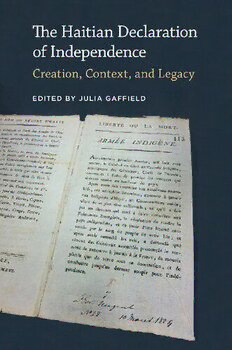
In February 2010, I discovered one of the original government-printed
versions of the declaration in the Jamaican records at The National Archives
of the United Kingdom in London. At the time, I thought this to be the only
extant copy. Just over a year later, however, I discovered another printed copy
in the Admiralty records of the same archives. This time the declaration was
printed as a broadside. These documents are the only known remaining offi -
cial copies of the Haitian Declaration of Independence. The text of the docu-
viii(cid:2)PREFACE
ment was well known, but a signed manuscript original or an offi cial printed
copy did not exist in Haiti or elsewhere, historians believed.
The presence of the documents in London tells a story of international
communication in the early months of Haiti’s independence. The procla-
mation announced to the nations and empires of the Atlantic World that the
territory was no longer under French authority; instead, the new “Haytian”
government ruled it. Haitians leaders knew that independence from France
could only be complete if foreign governments recognized and supported
the new nation.
The document circulated around the Atlantic, and portions of it were re-
printed in newspapers in cities like Philadelphia and London, and even as
far away as Bombay. The international reception of this document, however,
was mixed. Some readers were sympathetic and saw Haitian independence
as the justifi able reaction to French cruelties. Others, however, were terrifi ed
by the implications that this success might mean for their own nation’s col-
onies and personal property. Would the Revolution spread? was the question
on everyone’s mind.
Several weeks before I discovered the document, a magnitude 7.0 earth-
quake devastated Port-au-Prince and the surrounding area. The world’s at-
tention was on Haiti, as it often is when that nation is in crisis. Media outlets
around the world, like the Rachel Maddow Show, published digital copies of
the Haitian Declaration of Independence, marking the fi rst time many peo-
ple read or saw the document. They responded with interest and intrigue—
and sometimes with hostility. Much of the hostility came from readers who
compared the Haitian document against its American equivalent; the Hai-
tian Declaration of Independence is a call to arms that expresses hatred and
eternal vengeance toward the French. Many commenters also wanted to see
the roots of Haiti’s contemporary problems in its founding document, par-
ticularly in the context of American televangelist Pat Robertson’s claim that
Haitians had “sworn a pact with the devil.”²
Haiti was one of the fi rst countries in the world to issue a declaration of
independence after the United States. The American Declaration of Indepen-
dence, David Armitage writes, “provided the model for similar documents
around the world that asserted the independence of other new states.”³ In-
deed, when the revolutionary forces in the French colony of Saint-Domingue
defeated Napoléon’s troops, they followed the United States’ lead in proclaim-
ing their determination to “live free or die”—choosing the words “liberté ou
la mort” for the state letterhead and the title of their Acte de l’Indépendance.
However, while the Haitian leaders drew distantly on Jeff erson’s document
for inspiration—an earlier draft of the declaration based on his original had
PREFACE(cid:2)ix
been rejected as too tame for the task—they tailored their own words to the
circumstances at hand. Thus, the two documents are distinctly diff erent yet
clearly connected in motivation, meaning, and genre.
As part of its Revolution! exhibit, the New-York Historical Society put the
Haitian Declaration of Independence on display along with the Stamp Act
(1765), John Greenwood’s Sea Captains Carousing in Surinam (1752–1758),
Thomas Clarkson’s “African Box,” and other documents, paintings, and ob-
jects that symbolized the interconnected Age of Revolution. In conjunction
with the exhibit, the society hosted a symposium entitled, “The Age of Rev-
olution: A Whole History,” on January 21, 2012. The goal of this symposium
was to better understand the unique characteristics of each revolution as well
as the common threads that wove them together. During this conference, I
had the good fortune of meeting historian David Armitage, and during our
conversation he inspired and encouraged me to pursue a collaborative study
of the Haitian Declaration of Independence.
With this in mind, on March 7–8, 2013, the Robert H. Smith Interna-
tional Center for Jeff erson Studies (ICJS), under the direction of Andrew
O’Shaughnessy, sponsored and hosted the conference “The Haitian Decla-
ration of Independence in an Atlantic Context.” The ICJS seeks to support
the study of Thomas Jeff erson and his legacy through interdisciplinary and
innovative research. While the US Declaration of Independence was the fi rst
of its kind, the Haitian document helped to confi rm it as a genre; the Hai-
tian Declaration of Independence, therefore, is a crucial part of the legacy of
the American document. The eff orts of the ICJS to expand the scope of its
research beyond continental early America refl ects a series of historiograph-
ical interventions that highlight the interconnectedness of the early modern
Atlantic World, particularly during the Age of Revolution. Scholars have also
begun to situate Haiti at the center of the Age of Revolution and to look
beyond its revolution in order to appreciate the context, character, and devel-
opment of Haiti as an independent nation.
The essays in this volume are by leading scholars in the fi eld and aim to
provide a better understanding of the internal and external infl uences that
shaped the world’s second successful declaration of independence. How
tightly and in what ways was the Haitian Declaration of Independence in-
tertwined with its American predecessor? What shared aspects of the Age
of Revolution were articulated in the Haitian document? What distinctive
features were added and what elements were omitted? And how can a focus
on these documents provide a point of entry for a discussion about the larger
questions of meaning and signifi cance in the Atlantic revolutions? As the
product of the only successful slave revolution in the world, the Haitian Dec-