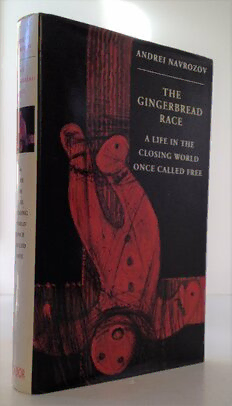
Table Of ContentANDREI NAVROZOY
TFIE,
GINGERBRE,AD
RACE
A LIFE IN THE
CLOSING WORLD
ONCE CALLED FREE
PICADOR ORIGINAL
A Picador original
First published 1993 by Pan Books Limited
a division of Pan Macmillan Publishcrs Limited
Cavaye Place hndon SWIO 9PG
and Basingstoke
Associated companies throughout the world
ISBN 0 330 376368
Cnpyright @ Andrei Nawozov 1993
Thc right of Andrei Nalrozov to be identifed as the
author of this work has been asscrtcd by him in accordance
with the C-opy.tght, Designs and Patents Acr 1988.
AII righa reserved. No reproducrion, copy or transmission
of this publication may bc made without writtcn pcrmission.
No pragraph of this publicadon may be reproduced, copied or
nansmined save wirh wrinen permission or in accordancc with
the provisions of the C,opltight Act 1956 (as amendcd). Any
pcrson who does any unauthorized act in relation to
this publication may be liablc to criminal prosccution
and civil daims for damagcs.
L35798642
A CIP catdogue record for this book is available from
the British Library
Desigred by Hayley Cove
Typeset by Cambridgc Composing (UK) Limitcd, Cambridge
Printed by Mackays of Chatham plc, Kent
I do not say to people yw an to be forgioen or confumncd,
I say to themyu,t are dying.
- Arthur de Gobineau to Alexis de Tocqueville, 1856.
PART ONE
OUT
OF PARADISE
t
The sun sets and lengthens the shadow on the dial. I understand what
this means because time is so easily read. It is a culture. In the
language to which I was born, it is the Sanskrit word for the track of
the wheel, left in the dust of the ritual chariot races, aartanna, a
millennium before the birth of Plato. The atavistic spokes on the face
of a clock are remnants of its revolutionary past. It passes, and an
artist composes a still life of ripe fruit on the wooden planks of a rustic
table. Now it is early morning. As he begins painting, his light changes
and declines. His hand, even if it is a hand of genius, is no match for
his honesty. Hence his yearning for the ideal, which alone captures
time, for in order to depict subjects in their true light he must know
their ultimate destiny. Let us rejoice. This yearning runs from our
purest Indo-European wellsprings, and it alone makes the present
worth living. But now the chariot wheel is in its last revolution. Then
let us mourn, because the aartanna of Western civilization is not
eternal. Another culture is on the move, and with our own dying eyes
we may yet see what sort of imprint it leaves on the asphalt. From
where I write, it looks like the caterpillar track of an armoured
personnel carrier. The artist may protest, as the still life before me
could not have seemed more picturesque. Yet I now commend it into
his hands, for he alone exhibits a vital interest in the ultimate destiny
of such subjects as ripe fruit, Iiarthingales and individual liberty.
2
If power is a culture, then Vnukovo was the Pieria of its muses. But
this hardly captures the glamour. [f Moscow is the Hollywood of
power, Vnukovo was Beverly Hills. But this empties it of the mystery.
IHE GTNGERBREAD RACE
Moscow was Versailles and Vnukovo was one of its finest grottoes,
though the whereabouts of several other retreats that fitted this
description was better known to the general public. Peredelkino, just
two bucolic whistlestops away on our railway line, had recently buried
Boris Pasternak. We still used his septic tank man. He arrived every
spring to pump our sewage into his cistern, his literary loyalties evenly
divided among his customers. He admired our late neighbour, the
poet with the pen name meaning Crimson who once wrote a song
called 'Broad is My Native Land'. It was the logical equivalent of
'America the Beautiful', but much more famous:
Broad is my native land,
With forests, rivcrs, fields aplcnry.
Crimson himself was roughly as famous as Walt Disney, and the
architectural follies of his house, whose peaked orange roof would be
visible from our terrace after the leaves fell in autumn, reflected
something of his analogue's distant world. Each house stood on its
own land, usually ten or fifteen acres, surrounded by a picket fence
that was painted green if the original owner was still alive, or weather-
beaten and with long splinters if he was dead. Crimson's, where it
connected with ours forming a kind of narrow wedge, had crumbled
out altogether, and there you could crawl through to his thicket of
raspberry bushes, peacefully going wild in the totalitarian gloom. To
get to the opening you passed under the apple trees of our orchard,
sixty-five in all. We also had three pear trees, and a thicket of
gooseberries and currants to rival his raspberries. But it was what lay
to the side that made our house the grandest in Vnukovo. To the side
lay a birch grove, vestals in white improbably edged in black Catalan
lace, running away from the eye every time it blinked to stop them.
At the end of the grove was another fence and another dead owner, a
novelist by the name of Cymbal. That is what the name meant,
anyway. Cymbal's famous novel was called The White Birch, and sharp
tongues would recite a limerick whose hero progressed from the white
birch of Vnukovo to the white silverfoil top of the vodka bottle to the
white heat of delirium tremens and finally to White Posts, a mental
hospital of distinction not far from Moscow. Be that as it may,
Cymbal's neglected property had nothing to olfer. The birch grove
receded just before it reached his fence, and even the mushrooms
seemed to disappear as you approached the fence from our side. The
best places to find them in the grove were along the fence which
OUT OF PARADISE
separated us from the composer who bore the name of the River
Danube, or else near the front fence, beyond which ran the road called
Mayakovsky Street. Ours was No. 4, Cymbal's was No. 6. Across the
road, at No. 3, was the house of another writer, also very famous,
although nobody remembered why. No. 5, down the street, was owned
by a poet whose name would be Marmot in English translation- His
wartime lyric, about fire beating in the stove, was not quite as famous
as 'Broad is My Native Land', but songs, after all, are supposed to be
more popular than poems:
Fire beats in the narrow stove,
And the resin is likc a tcar.
Perhaps I simplify. Still, Marmot's poems were not meant to be
di{Ecult. Further down at No. 7, on the assumption of relative equality
among the muses, lived the founder of the puppet theatre, a Diaghilev
of the inanimate. It was said that he kept pet alligators, but to what
extent this was true is now hard to say since we never visited our
neighbours. Except our immediate neighbours, both women. One
lived at No. 2 with her husband, a film director. She was Vnukovo's
movie star, and as the country's film industry was never very prolific
even in the good old days, it followed that she had to combine the
beauty of Marilyn Monroe and the intellect of Katharine Hepburn
with all the permutations of charm and sophistication imaginable in
between. Her Christian name was Love, of course, and the surname
can be rendered as Eagle. Together with Danube, Crimson and the
original owner of our own No. 4, a Frank Sinatra figure who may be
recalled as Cliff, Miss Eagle and her husband had made the film
industry what it was. Their happiest collaboration, indeed a master-
piece of optimism, was called Joll2 Fcllows. It accounted for roughly
one-third of all famous comedies ever produced, the other two also
starring Miss Eagle and directed by her husband, who started his
career with Eisenstein on the Battlcship Potemkin and was later
entrusted with such sensitive subjects as Encountcr on tlu Elbc. The
other woman we visited lived at No. l. She was a distant relation of
the original owner, a scientist who discovered the secret of immortal-
ity. This secret was of great interest to the ruler of a vast and powerful
country like ours, and he showered her with honours until his death
from cerebral haemorrhage. Sharp tongues later explained that,
simply put, the scientist's secret was a highly diluted solution of
caustic soda in which you bathed regularly. But as she too had now
THE GINGERBREAD RACE
died, of old age or a broken heart or some other cause embarrassingly
unbecoming a person of such uncompromisingly scientific outlook,
only the rumours of people with severe burns caused by their pursuit
of immortality still circulated, while the older rumours, the glorious
old rumours of her incontrovertible successes, had apparently died
with her. Zina, who inherited the villa that was once a personal gift
from the ruler, must have thought the whole thing terribly unfair
because she was kind and kind people think most things terribly
unfair. In a way it was, but we never discussed the matter. Zina had
sixteen cats and, bless her kind heart, looked like one, although it was
difficult to decide which one. It varied from day to day. The animals,
as she called them, were all deformed and quiet, and since I already
knew Dostoevsky's novel it was impossible not to think of them as the
insulted and injured of the title. Zina was the only truly obscure
inhabitant of Vnukovo, and the only one who was poor. For the
animals she cooked a kind of nightmare stew, although at times it
resembled plain gruel, perhaps simply oatmeal porridge with lots of
innocent water, which was sticky and therefore frightening to a child
who had never been exposed to life in the raw. She served the gruel at
dusk, on the front porch of the crumbling house , with a heart-rending
cry of 'Animals!' And, from the four corners of the garden, the animals
would leap, hobble, or crawl, depending on the nature and extent of
the injuries they had sustained in their formative years, meekly and
noiselessly. In the evenings she watched television with her husband,
a tired older man who, like her, never did or said a cruel thing in his
life. What bile Kolya had in him he reserved for the television. If a
singer sang, he would laugh demonically and exclaim: 'Is this singing?'
If the news came on, he would snort: 'Is this news?' The only
exception was what he called modern art, which he loathed despite
the fact that it never appeared on the screen. To compensate, he had
a reproduction of the Picasso etching of Don Quixote tacked, upside-
down, to the wall above the television set, presumably in order to say
'Is this art?', or even 'Is this Don Quixote?', and to enjoy its
humiliation when nothing on the screen diverted his selectively
jaundiced eye. Their garden had very late apples, which lasted even
longer into the winter than our own Antonov variety, and as we
munched them Kolya would occasionally hurl a core at the etching,
making even more of a mess of Don Quixote, he explained, than the
artist had. From their gate to ours was a few hundred yards, but at
midnight in winter it seemed much farther. During the day, in