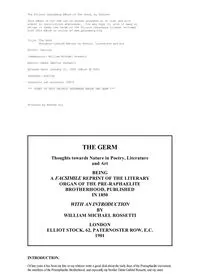
Table Of ContentThe Project Gutenberg EBook of The Germ, by Various
This eBook is for the use of anyone anywhere at no cost and with
almost no restrictions whatsoever. You may copy it, give it away or
re-use it under the terms of the Project Gutenberg License included
with this eBook or online at www.gutenberg.org
Title: The Germ
Thoughts towards Nature in Poetry, Literature and Art
Author: Various
Commentator: William Michael Rossetti
Editor: Dante Gabriel Rossetti
Release Date: January 31, 2006 [EBook #17649]
Language: English
Character set encoding: UTF-8
*** START OF THIS PROJECT GUTENBERG EBOOK THE GERM ***
Produced by Andrew Sly
THE GERM
Thoughts towards Nature in Poetry, Literature
and Art
BEING
A FACSIMILE REPRINT OF THE LITERARY
ORGAN OF THE PRE-RAPHAELITE
BROTHERHOOD, PUBLISHED
IN 1850
WITH AN INTRODUCTION
BY
WILLIAM MICHAEL ROSSETTI
LONDON
ELLIOT STOCK, 62, PATERNOSTER ROW, E.C.
1901
INTRODUCTION.
Of late years it has been my fate or my whim to write a good deal about the early days of the Præraphaelite movement,
the members of the Præraphaelite Brotherhood, and especially my brother Dante Gabriel Rossetti, and my sister
Christina Georgina Rossetti. I am now invited to write something further on the subject, with immediate reference to the
Præraphaelite magazine “The Germ,” republished in this volume. I know of no particular reason why I should not do
this, for certain it is that few people living know, or ever knew, so much as I do about “The Germ,”; and if some press-
critics who regarded previous writings of mine as superfluous or ill-judged should entertain a like opinion now, in equal
or increased measure, I willingly leave them to say so, while I pursue my own course none the less.
“The Germ” is here my direct theme, not the Præraphaelite Brotherhood; but it seems requisite to say in the first
instance something about the Brotherhood—its members, allies, and ideas—so as to exhibit a raison d'être for the
magazine. In doing this I must necessarily repeat some things which I have set forth before, and which, from the writings
of others as well as myself, are well enough known to many. I can vary my form of expression, but cannot introduce
much novelty into my statements of fact.
In 1848 the British School of Painting was in anything but a vital or a lively condition. One very great and incomparable
genius, Turner, belonged to it. He was old and past his executive prime. There were some other highly able men—Etty
and David Scott, then both very near their death; Maclise, Dyce, Cope, Mulready, Linnell, Poole, William Henry Hunt,
Landseer, Leslie, Watts, Cox, J.F. Lewis, and some others. There were also some distinctly clever men, such as Ward,
Frith, and Egg. Paton, Gilbert, Ford Madox Brown, Mark Anthony, had given sufficient indication of their powers, but
were all in an early stage. On the whole the school had sunk very far below what it had been in the days of Hogarth,
Reynolds, Gainsborough, and Blake, and its ordinary average had come to be something for which commonplace is a
laudatory term, and imbecility a not excessive one.
There were in the late summer of 1848, in the Schools of the Royal Academy or barely emergent from them, four young
men to whom this condition of the art seemed offensive, contemptible, and even scandalous. Their names were William
Holman-Hunt, John Everett Millais, and Dante Gabriel Rossetti, painters, and Thomas Woolner, sculptor. Their ages
varied from twenty-two to nineteen—Woolner being the eldest, and Millais the youngest. Being little more than lads,
these young men were naturally not very deep in either the theory or the practice of art: but they had open eyes and
minds, and could discern that some things were good and other bad—that some things they liked, and others they
hated. They hated the lack of ideas in art, and the lack of character; the silliness and vacuity which belong to the one,
the flimsiness and make-believe which result from the other. They hated those forms of execution which are merely
smooth and prettyish, and those which, pretending to mastery, are nothing better than slovenly and slapdash, or what
the P.R.B.'s called “sloshy.” Still more did they hate the notion that each artist should not obey his own individual
impulse, act upon his own perception and study of Nature, and scrutinize and work at his objective material with
assiduity before he could attempt to display and interpret it; but that, instead of all this, he should try to be “like
somebody else,” imitating some extant style and manner, and applying the cut-and-dry rules enunciated by A from the
practice of B or C. They determined to do the exact contrary. The temper of these striplings, after some years of the
current academic training, was the temper of rebels: they meant revolt, and produced revolution. It would be a mistake
to suppose, because the called themselves Præraphaelites, that they seriously disliked the works produced by Raphael;
but they disliked the works produced by Raphael's uninspired satellites, and were resolved to find out, by personal
study and practice, what their own several faculties and adaptabilities might be, without being bound by rules and big-
wiggeries founded upon the performance of Raphael or of any one. They were to have no master except their own
powers of mind and hand, and their own first-hand study of Nature. Their minds were to furnish them with subjects for
works of art, and with the general scheme of treatment; Nature was to be their one or their paramount storehouse of
materials for objects to be represented; the study of her was to be deep, and the representation (at any rate in the
earlier stages of self-discipline and work) in the highest degree exact; executive methods were to be learned partly from
precept and example, but most essentially from practice and experiment. As their minds were very different in range and
direction, their products also, from the first, differed greatly; and these soon ceased to have any link of resemblance.
The Præraphaelite Brothers entertained a deep respect and a sincere affection for the works of some of the artists who
had preceded Raphael; and they thought that they should more or less be following the lead of those artists if they
themselves were to develop their own individuality, disregarding school-rules. This was really the sum and substance of
their “Præraphaelitism.” It may freely be allowed that, as they were very young, and fired by certain ideas impressive to
their own spirits, they unduly ignored some other ideas and theories which have none the less a deal to say for
themselves. They contemned some things and some practitioners of art not at all contemptible, and, in speech still more
than in thought, they at times wilfully heaped up the scorn. You cannot have a youthful rebel with a faculty who is also a
model head-boy in a school.
The P.R.B. was completed by the accession of three members to the four already mentioned. These were James
Collinson, a domestic painter; Frederic George Stephens, an Academy-student of painting; and myself, a Government-
clerk. These again, when the P.R.B. was formed towards September 1848, were all young, aged respectively about
twenty-three, twenty-one, and nineteen.
This Præraphaelite Brotherhood was the independent creation of Holman-Hunt, Millais, Rossetti, and (in perhaps a
somewhat minor degree) Woolner: it cannot be said that they were prompted or abetted by any one. Ruskin, whose
name has been sometimes inaccurately mixed up in the matter, and who had as yet published only the first two volumes
of “Modern Painters,” was wholly unknown to them personally, and in his writings was probably known only to
Holman-Hunt. Ford Madox Brown had been an intimate of Rossetti since March 1848, and he sympathized, fully as
6
7
much as any of these younger men, with some old-world developments of art preceding its ripeness or over-ripeness:
but he had no inclination to join any organization for protest and reform, and he followed his own course—more
influenced, for four or five years ensuing, by what the P.R.B.'s were doing than influencing them. Among the persons
who were most intimate with the members of the Brotherhood towards the date of its formation, and onwards till the
inception of “The Germ,” I may mention the following. For Holman-Hunt, the sculptor John Lucas Tupper, who had
been a fellow Academy-student, and was now an anatomical designer at Guy's Hospital: he and his family were equally
well acquainted with Mr. Stephens. For Millais, the painter Charles Allston Collins, son of the well-known painter of
domestic life and coast-scenes William Collins; the painter Arthur Hughes; also his own brother, William Henry Millais,
who had musical aptitudes and became a landscape-painter. For Rossetti, William Bell Scott (brother of David Scott),
painter, poet, and Master of the Government School of Design in Newcastle-on-Tyne; Major Calder Campbell, a
retired Officer of the Indian army, and a somewhat popular writer of tales, verses, etc.; Alexander Munro the sculptor;
Walter Howell Deverell, a young painter, son of the Secretary to the Government Schools of Design; James Hannay,
the novelist, satirical writer, and journalist; and (known through Madox Brown) William Cave Thomas, a painter who
had studied in the severe classical school of Germany, and had earned a name in the Westminster Hall competitions for
frescoes in Parliament. For Woolner, John Hancock and Bernhard Smith, sculptors; Coventry Patmore the poet, with
his connections the Orme family and Professor Masson; also William North, an eccentric young literary man, of much
effervescence and some talent, author of “Anti-Coningsby” and other novels. For Collinson, the prominent painter of
romantic and biblical subjects John Rogers Herbert, who was, like Collinson himself, a Roman Catholic convert.
The Præraphaelite Brotherhood having been founded in September 1848, the members exhibited in 1849 works
conceived in the new spirit. These were received by critics and by the public with more than moderate though certainly
not unmixed favour: it had not as yet transpired that there was a league of unquiet and ambitious young spirits, bent
upon making a fresh start of their own, and a clean sweep of some effete respectabilities. It was not until after the
exhibitions were near closing in 1849 that any idea of bringing out a magazine came to be discussed. The author of the
project was Dante Gabriel Rossetti. He alone among the P.R.B.'s had already cultivated the art of writing in verse and
in prose to some noticeable extent (“The Blessed Damozel” had been produced before May 1847), and he was better
acquainted than any other member with British and foreign literature. There need be no self-conceit in saying that in
these respects I came next to him. Holman-Hunt, Woolner, and Stephens, were all reading men (in British literature
only) within straiter bounds than Rossetti: not any one of them, I think, had as yet done in writing anything worth
mentioning. Millais and Collinson, more especially the former, were men of the brush, not the pen, yet both of them
capable of writing with point, and even in verse. By July 13 and 14, 1849, some steps were taken towards discussing
the project of a magazine. The price, as at first proposed, was to be sixpence; the title, “Monthly Thoughts in Literature,
Poetry, and Art”; each number was to have an etching. Soon afterwards a price of one shilling was decided upon, and
two etchings per number: but this latter intention was not carried out.{1} All the P.R.B.'s were to be proprietors of the
magazine: I question however whether Collinson was ever persuaded to assume this responsibility, entailing payment of
an eventual deficit. We were quite ready also to have some other proprietors. Mr. Herbert was addressed by
Collinson, and at one time was regarded as pretty safe. Mr. Hancock the sculptor did not resist the pressure put upon
him; but after all he contributed nothing to “The Germ,” either in work or in money. Walter Deverell assented, and paid
when the time came. Thus there seem to have been eight, or else seven, proprietors—not one of them having any spare
cash, and not all of them much steadiness of interest in the scheme set going by Dante Rossetti.
{1} Many of the particulars here given regarding “The Germ” appear in the so-called “P.R.B. Journal,”
which was published towards December 1899, in the volume named “Preraphaelite Diaries and Letters,
edited by W.M. Rossetti.” At the date when I wrote the present introduction, that volume had not been
offered for publication.
With so many persons having a kind of co-equal right to decide what should be done with the magazine, it soon became
apparent that somebody ought to be appointed Editor, and assume the control. I, during an absence from London, was
fixed upon for this purpose by Woolner and my brother—with the express or tacit assent, so far as I know, of all the
others, I received notice of my new dignity on September 23, 1849, being just under twenty years of age, and I
forthwith applied myself to the task. It had at first been proposed to print upon the prospectus and wrappers of the
magazine the words “Conducted by Artists,” and also (just about this time) to entitle it “The P.R.B. Journal.” I called
attention to the first of these points as running counter to my assuming the editorship, and to the second as in itself
inappropriate: both had in fact been already set aside. My brother had ere this been introduced to Messrs. Aylott and
Jones, publishers in Paternoster Row (principally concerned, I believe, with books of evangelical religion), and had
entered into terms with them, and got them to print a prospectus. “P.R.B.” was at first printed on the latter, but to this
Mr. Holman-Hunt objected in November, and it was omitted. The printers were to be Messrs. Tupper and Sons, a firm
of lithographic and general printers in the City, the same family to which John Lucas Tupper belonged. The then title,
invented by my brother, was “Thoughts towards Nature,” a phrase which, though somewhat extra-peculiar, indicated
accurately enough the predominant conception of the Præraphaelite Brotherhood, that an artist, whether painter or
writer, ought to be bent upon defining and expressing his own personal thoughts, and that these ought to be based upon
a direct study of Nature, and harmonized with her manifestations. It was not until December 19, when the issue of our
No. 1 was closely impending, that a different title, “The Germ,” was proposed. On that evening there was a rather large
gathering at Dante Rossetti's studio, 72 Newman Street; the seven P.R.B.'s, Madox Brown, Cave Thomas, Deverell,
Hancock, and John and George Tupper. Mr. Thomas had drawn up a list of no less than sixty-five possible titles (a
facsimile of his MS. of some of them appears in the “Letters of Dante Gabriel Rossetti to William Allingham,” edited by
8
9
10
George Birkbeck Hill—Unwin, 1897). Only a few of them met with favour; and one of them, “The Germ,” going to the
vote along with “The Seed” and “The Scroll,” was approved by a vote of six to four. The next best were, I think, “The
Harbinger,” “First Thoughts,” “The Sower,” “The Truth-Seeker,” and “The Acorn.” Appended to the new title we
retained, as a sub-title, something of what had been previously proposed; and the serial appeared as “The Germ.
Thoughts towards Nature in Poetry, Literature, and Art.” At this same meeting Mr. Woolner suggested that authors'
names should not be published in the magazine. I alone opposed him, and his motion was carried. I cannot at this
distance of time remember with any precision what his reasons were; but I think that he, and all the other artists
concerned, entertained a general feeling that to appear publicly as writers, and especially as writers opposing the
ordinary current of opinions on fine art, would damage their professional position, which already involved uphill work
more than enough.
“The Germ,” No. 1, came out on or about January 1, 1850. The number of copies printed was 700. Something like
200 were sold, in about equal proportions by the publishers, and by ourselves among acquaintances and well-wishers.
This was not encouraging, so we reduced the issue of No. 2 to 500 copies. It sold less well than No. 1. With this
number was introduced the change of printing on the wrapper the names of most of the contributors: not of all, for some
still preferred to remain unnamed, or to figure under a fancy designation. Had we been left to our own resources, we
must now have dropped the magazine. But the printing-firm—or Mr. George I.F. Tupper as representing it—came
forward, and undertook to try the chance of two numbers more. The title was altered (at Mr. Alexander Tupper's
suggestion) to “Art and Poetry, being Thoughts towards Nature, conducted principally by Artists”; and Messrs.
Dickinson and Co., of New Bond Street, the printsellers, consented to join their name as publishers to that of Messrs.
Aylott and Jones. Mr. Robert Dickinson, the head of this firm, and more especially his brother, the able portrait-painter
Mr. Lowes Dickinson, were well known to Madox Brown, and through him to members of the P.R.B. I continued to
be editor; but, as the money stake of myself and my colleagues in the publication had now ceased, I naturally
accommodated myself more than before to any wish evinced by the Tupper family. No. 3, which ought to have
appeared March 1, was delayed by these uncertainties and changes till March 31. No. 4 came out on April 30. Some
small amount of advertising was done, more particularly by posters carried about in front of the Royal Academy (then in
Trafalgar Square), which opened at the beginning of May. All efforts proved useless. People would not buy “The
Germ,” and would scarcely consent to know of its existence. So the magazine breathed its last, and its obsequies were
conducted in the strictest privacy. Its debts exceeded its assets, and a sum of £33 odd, due on Nos. 1 and 2, had to be
cleared off by the seven (or eight) proprietors, conscientious against the grain. What may have been the loss of Messrs.
Tupper on Nos. 3 and 4 I am unable to say. It is hardly worth specifying that neither the editor, nor any of the
contributors whether literary or artistic, received any sort of payment. This was foreseen from the first as being “in the
bond,” and was no grievance to anybody.
“The Germ,” as we have seen, was a most decided failure, yet it would be a mistake to suppose that it excited no
amount of literary attention whatsoever. There were laudatory notices in “The Dispatch,” “The Guardian,” “Howitt's
Standard of Freedom,” “John Bull,” “The Critic,” “Bell's Weekly Messenger,” “The Morning Chronicle,” and I dare say
some other papers. A pat on the back, with a very lukewarm hand, was bestowed by “The Art Journal.” There were
notices also—not eulogistic—in “The Spectator” and elsewhere. The editor of “The Critic,” Mr. (afterwards Serjeant)
Cox, on the faith of doings in “The Germ,” invited me, or some other of the art-writers there, to undertake the fine-art
department—picture-exhibitions, etc.—of his weekly review. This I did for a short time, and, on getting transferred to
“The Spectator,” I was succeeded on “The Critic” by Mr. F.G. Stephens. I also received some letters consequent upon
“The Germ,” and made some acquaintances among authors; Horne, Clough, Heraud, Westland Marston, also Miss
Glyn the actress. I as editor came in for this; but of course the attractiveness of “The Germ” depended upon the writings
of others, chiefly Messrs. Woolner, Patmore, and Orchard, my sister, and above all my brother, and, among the artist-
etchers, Mr. Holman-Hunt.
I happen to be still in possession of the notices which appeared in “The Critic,” “Bell's Weekly Messenger,” and “The
Guardian,” and of extracts (as given in our present facsimile) from those in “John Bull,” “The Morning Chronicle,” and
“The Standard of Freedom”: I here reproduce the first three for the curious reader's perusal. First comes the review
which appeared in “The Critic” on February 15, 1850, followed by a second review on June 1. The former was (as
shown by the initials) written by Mr. Cox, and I presume the latter also. Major Calder Campbell must have called the
particular attention of Mr. Cox to “The Germ.” My own first personal acquaintance with this gentleman may have been
intermediate between 15 February and 1 June.
The Germ. Thoughts towards Nature in Poetry, Literature, and Art. Nos. I. and II. London: Aylott and Jones.
We depart from our usual plan of noticing the periodicals under one heading, for the purpose of introducing to our
readers a new aspirant for public favour, which has peculiar and uncommon claims to attention, for in design and
execution it differs from all other periodicals. The Germ is the somewhat affected and unpromising title give to a small
monthly journal, which is devoted almost entirely to poetry and art, and is the production of a party of young persons.
This statement is of itself, as we are well aware, enough to cause it to be looked upon with shyness. A periodical largely
occupied with poetry wears an unpromising aspect to readers who have learned from experience what nonsensical stuff
most fugitive magazine-poetry is; nor is this natural prejudice diminished by the knowledge that it is the production of
young gentlemen and ladies. But, when they have read a few extracts which we propose to make, we think they will
own that for once appearances are deceitful, and that an affected title and an unpromising theme really hides a great
11
12
deal of genius; mingled however, we must also admit, with many conceits which youth is prone to, but which time and
experience will assuredly tame.
That the contents of The Germ are the production of no common minds the following extracts will sufficiently prove,
and we may add that these are but a small portion of the contents which might prefer equal claims to applause.
“My Beautiful Lady,” and “Of my Lady in Death,” are two poems in a quaint metre, full of true poetry, marred by not a
few affectations—the genuine metal, but wanting to be purified from its dross. Nevertheless, it is pleasant to find the
precious ore anywhere in these unpoetical times.
To our taste the following is replete with poetry. What a picture it is! A poet's tongue has told what an artist's eye has
seen. It is the first of a series to be entitled “Songs of One Household.” [Here comes Dante Rossetti's poem, “My
Sister's Sleep,” followed by Patmore's “Seasons,” and Christina Rossetti's “Testimony.”] We have not space to take
any specimens of the prose, but the essays on art are conceived with an equal appreciation of its meaning and
requirements. Being such, The Germ has our heartiest wishes for its success; but we scarcely dare to hope that it may
win the popularity it deserves. The truth is that it is too good for the time. It is not material enough for the age.
Art and Poetry: being Thoughts towards Nature. Conducted principally by Artists. Nos. 3 and 4. London:
Dickinson and Co.
Some time since we had occasion to direct the attention of our readers to a periodical then just issued under the modest
title of The Germ. The surprise and pleasure with which we read it was, as we are informed, very generally shared by
our readers upon perusing the poems we extracted from it; and it was manifest to every person of the slightest taste that
the contributors were possessed of genius of a very high order, and that The Germ was not wantonly so entitled, for it
abounded with the promise of a rich harvest to be anticipated from the maturity of those whose youth could accomplish
so much.
But we expressed also our fear lest the very excellence of this magazine should be fatal to its success. It was too good
—that is to say, too refined and of too lofty a class, both in its art and in its poetry—to be sufficiently popular to pay
even the printer's bill. The name, too, was against it, being somewhat unintelligible to the thoughtless, and conveying to
the considerate a notion of something very juvenile. Those fears were not unfounded, for it was suspended for a short
time; but other journals after a while discovered and proclaimed the merit that was scattered profusely over the pages of
The Germ, and, thus encouraged, the enterprise has been resumed, with a change of name which we must regard as an
improvement. Art and Poetry precisely describes its character. It is wholly devoted to them, and it aims at originality in
both. It is seeking out for itself new paths, in a spirit of earnestness, and with an undoubted ability which must lead to a
new era. The writers may err somewhat at first, show themselves too defiant of prescriptive rules, and mistake
extravagance for originality; but this fault (inherent in youth when, conscious of its powers, it first sets up for itself) will
after a while work its own cure, and with experience will come soberer action. But we cannot contemplate this young
and rising school in art and literature without the most ardent anticipations of something great to grow from it, something
new and worthy of our age, and we bid them God speed upon the path they have adventured.
But our more immediate purpose here is with the poetry, of which about one-half of each number is composed. It is all
beautiful, must of it of extraordinary merit, and equal to anything that any of our known poets could write, save
Tennyson, of whom the strains sometimes remind us, although they are not imitations in any sense of the word. [The
Reviewer next proceeds to quote, with a few words of comment, Christina Rossetti's “Sweet Death,” John Tupper's
“Viola and Olivia,” Orchard's “Whit-Sunday Morn,” and (later on) Dante Rossetti's “Pax Vobis.”]
Almost one half of the April number is occupied with a “Dialogue on Art,” the composition of an Artist whose works
are well known to the public. It was written during a period of ill health, which forbad the use of the brush, and, taking
his pen, he has given to the world his thoughts upon art in a paper which the Edinburgh Review in its best days might
have been proud to possess.
Sure we are that not one of our readers will regret the length at which we have noticed this work.
The short and unpretending critique which I add from “Bell's Weekly Messenger” was written, I believe, either by or at
the instance of Mr. Bellamy, a gentleman who acted as secretary to the National Club. His son addressed me as editor
of “The Germ,” in terms of great ardour, and through the son I on one occasion saw the father as well.
Art and Poetry. Nos. I., II., and III. London, Dickinson and Co.
The present numbers are the commencement of a very useful publication, conducted principally by artists, the design of
which is to “express thoughts towards Nature.” We see much to commend in its pages, which are also nicely illustrated
in the mediæval style of art and in outline. The paper upon Shakespeare's tragedy of “Macbeth,” in the third number,
abounds with striking passages, and will be found to be well worthy of consideration.
I now proceed to “The Guardian.” The notice came out on August 20, 1850, some months after “The Germ” had
13
expired. I do not now know who wrote it, and (so far as memory serves me) I never did know. The writer truly said
that Millais “contributes nothing” to the magazine. This however was not Millais's fault, for he made an etching for a
prose story by my brother (named “An Autopsychology,” or now “St. Agnes of Intercession”); and this etching, along
with the story, had been expected to appear in a No. 5 of “The Germ” which never came out. The “very curious but
very striking picture” by Rossetti was the “Annunciation,” now in the National British Gallery.
Art and Poetry. Being Thoughts towards Nature. Conducted principally by Artists. Dickinson and Co., and Aylott and
Jones.
We are very sorry to find that, after a short life of four monthly numbers, this magazine is not likely to be continued.
Independently of the great ability displayed by some of its contributors, we have been anxious to see the rising school of
young and clever artists find a voice, and tell us what they are aiming at, and how they propose to reach their aim. This
magazine was to a great extent connected with the Pre-Raffaelle Brethren, whose paintings have attracted this year a
more than ordinary quantity of attention, and an amount of praise and blame perhaps equally extravagant. As might have
been expected, the school has been identified with its cleverest manipulator, Mr. Millais, and his merits or defects have
been made the measure of the admiration or contempt bestowed by the public upon those whom it chooses to class
with him. This is not matter of complaint, but it is a mistake. As far as these papers enable us to judge, Mr. Millais is by
no means the leading mind among his fraternity; and judged by the principles of some clever and beautiful papers upon
art in the magazine before us, his pictures would be described by them as wanting in some of the very highest artistic
qualities, although possessing many which entitle them to attention and respect. The chief contributors to this magazine
(to which Mr. Millais contributes nothing) are other artists, as yet not greatly known, but with feeling and purpose about
them such as must make them remarkable in time. Some of the best papers are by two brothers named Rossetti, one of
whom, Mr. D. G. Rossetti, has a very curious but very striking picture now exhibiting in the Portland Gallery. Mr.
Deverell, who has also a very clever picture in the same gallery, contributes some beautiful poetry. It is perhaps chiefly
in the poetry that the abilities of these writers are displayed; for, with somewhat absurd and much that is affected, there
is yet in the poetical pieces of these four numbers a beauty and grace of language and sentiment, and not seldom a
vigour of conception, altogether above the common run. Want of purpose may be easily charged against them as a fault,
and with some justice, but it is a very common defect of youthful poetry, which is sure to disappear with time if there be
anything real and manly in the poet. The best pieces are too long to extracted in entire, and are not to be judged of fairly
except as wholes. There is a very fine poem called “Repining” of which this is particularly true. [Next comes a quotation
of Christina Rossetti's “Dream Land,” and of a portion of Dante Rossetti's “Blessed Damozel.”] The last number
contains a remarkable dialogue on Art, written by a young man, John Orchard, who has since died. It is well worth
study. Kalon, Kosmon, Sophon, and Christian, whose names, of course, represent the opinions they defend, discuss a
number of subjects connected with the arts. Each character is well supported, and the wisdom and candour of the
whole piece is very striking, especially when we consider the youth and inexperience of the writer. Art lost a true and
high-minded votary in Mr. Orchard. [A rather long extract from the “Dialogue” follows here.]
It is a pity that the publication is to stop. English artists have hitherto worked each one by himself, with too little of
common purpose, too little of mutual support, too little of distinct and steadily pursued intellectual object. We do not
believe that they are one whit more jealous than the followers of other professions. But they are less forced to be
together, and the little jealousies which deform the natures of us all have in their case, for this reason, freer scope, and
tend more to isolation. Here, at last, we have a school, ignorant it may be, conceited possibly, as yet with but vague
and unrealised objects, but working together with a common purpose, according to certain admitted principles, and
looking to one another for help and sympathy. This is new in England, and we are very anxious it should have a fair trial.
Its aim, moreover, however imperfectly attained as yet, is high and pure. No one can walk along our streets and not see
how debased and sensual our tastes have become. The saying of Burke (so unworthy of a great man), that vice loses
half its evil by losing all its grossness, is practically acted upon, and voluptuous and seductive figures, recommended
only by a soft effeminacy, swarm our shop-windows and defile our drawing-rooms. It is impossible to over-state the
extent to which they minister to, and increase the foul sins of, a corrupt and luxurious age. A school of artists who
attempt to bring back the popular taste to the severe draperies and pure forms of early art are at least deserving of
encouragement. Success in their attempt would be a national blessing.
Shrivelling in the Spring of 1850, “The Germ” showed no further sign of sprouting for many years, though I suppose it
may have been known to the promoters of “The Oxford and Cambridge Magazine,” produced in 1856, and may have
furnished some incitement towards that enterprise—again an unsuccessful one commercially. Gradually some people
began to take a little interest in the knowledge that such a publication had existed, and to inquire after stray copies here
and there. This may perhaps have commenced before 1870, or at any rate shortly afterwards, as in that year the
“Poems” of Dante Rossetti were brought out, exciting a great amount of attention and admiration, and curiosity attached
to anything that he might have published before. One heard of such prices as ten shillings for a set of the “The Germ,”
then £2, £10, £30, etc., and in 1899 a copy handsomely bound by Cobden-Saunderson was sold in America for about
£104. Will that high-water mark ever be exceeded? For the sake of common-sense, let us hope not.
I will now go through the articles in “The Germ” one by one. Wherever any of them may seem to invite a few words of
explanation I offer such to the reader; and I give the names of the authors, when not named in the magazine itself. Those
articles which do not call for any particular comment receive none here.
14
15
On the wrapper of each number is to be found a sonnet, printed in a rather aggressively Gothic type, beginning, “When
whoso merely hath a little thought.” This sonnet is my performance; it had been suggested that one or other of the
proprietors of the magazine should write a sonnet to express the spirit in which the publication was undertaken. I wrote
the one here in question, which met with general acceptance; and I do not remember that any one else competed. This
sonnet may not be a good one, but I do not see why it should be considered unintelligible. Mr. Bell Scott, in his
“Autobiographical Notes,” expressed the opinion that to master the production would almost need a Browning
Society's united intellects. And he then gave his interpretation, differing not essentially from my own. What I meant is
this: A writer ought to think out his subject honestly and personally, not imitatively, and ought to express it with
directness and precision; if he does this, we should respect his performance as truthful, even though it may not be
important. This indicated, for writers, much the same principle which the P.R.B. professed for painters,—individual
genuineness in the thought, reproductive genuineness in the presentment.
By Thomas Woolner: “My Beautiful Lady,” and “Of My Lady in Death.” These compositions were, I think, nearly the
first attempts which Mr. Woolner made in verse; any earlier endeavours must have been few and slight. The author's
long poem “My Beautiful Lady,” published in 1863, started from these beginnings. Coventry Patmore, on hearing the
poems in September 1849, was considerably impressed by them: “the only defect he found” (as notified in a letter from
Dante Rossetti) “being that they were a trifle too much in earnest in the passionate parts, and too sculpturesque
generally. He means by this that each stanza stands too much alone, and has its own ideas too much to itself.”
By Ford Madox Brown: “The Love of Beauty: Sonnet.”
By John L. Tupper: “The Subject in Art.” Two papers, which do not complete the important thesis here undertaken.
Mr. Tupper was, for an artist, a man of unusually scientific mind; yet he was not, I think, distinguished by that power of
orderly and progressive exposition which befits an argumentation. These papers exhibit a good deal of thought, and
state several truths which, even if partial truths, are not the less deserving of attention; but the dissertation does not
produce a very clear impression, inasmuch as there is too great a readiness to plunge, in medias res, checked by too
great a tendency to harking back, and re-stating some conclusion in modified terms and with insecure corollaries. Two
points which Mr. Tupper chiefly insists upon are: (1) that the subject in a work of art affects the beholder in the same
sort of way as the same subject, occurring as a fact or aspect of Nature, affects him; and thus whatever in Nature
excites the mental and moral emotion of man is a right subject for fine art; and (2), that subjects of our own day should
not be discarded in favour of those of a past time. These principles, along with others bearing in the same direction,
underlie the propositions lately advanced by Count Leo Tolstoy in his most interesting and valuable (though I think one-
sided) book entitled “What is Art?”—and the like may be said of the principles announced in the “Hand and Soul” of
Dante Rossetti, and in the “Dialogue on Art” by John Orchard, through the mouths of two of the speakers, Christian
and Sophon. I have once or twice seen these papers by Mr. Tupper commented upon to the effect that he wholly
ignores the question of art-merit in a work of art, the question whether it is good or bad in form, colour, etc. But this is a
mistake, for in fact he allows that this is a relevant consideration, but declines to bring it within his own lines of
discussion. There is also a curious passage which has been remarked upon as next door to absurd; that where, in
treating of various forms of still life as inferior subjects for art, he says that “the dead pheasant in a picture will always be
as ‘food,’ while the same at the poulterer's will be but a dead pheasant.” I do not perceive that this is really absurd. At
the poulterer's (and Mr. Tupper has proceeded to say as much in his article) all the items are in fact food, and therefore
the spectator attends to the differences between them; one being a pheasant, one a fowl, one a rabbit, etc. But, in a
varied collection of pictures, most of the works representing some subject quite unconnected with food; and, if you see
among them one, such as a dead pheasant, representing an article of food, that is the point which primarily occurs to
your mind as distinguishing this particular picture from the others. The views expressed by Mr. Tupper in these two
papers should be regarded as his own, and not by any means necessarily those upheld by the Præraphaelite
Brotherhood. The members of this body must however have agreed with several of his utterances, and sympathized
with others, apart from strict agreement.
By Patmore: “The Seasons.” This choice little poem was volunteered to “The Germ” in September, after the author had
read our prospectus, which impressed him favourably. He withheld his name, much to our disappointment, having
resolved to do so in all instances where something of his might be published pending the issue of a new volume.
By Christina Rossetti: “Dream Land.” Though my sister was only just nineteen when this remarkable lyric was printed,
she had already made some slight appearance in published type (not to speak of the privately printed “Verses” of
1847), as two small poems of hers had been inserted in “The Athenæum” in October 1848. “Dream Land” was written
in April 1849, before “The Germ” was thought of; and it may be as well to say that all my sister's contributions to this
magazine were produced without any reference to publication in that or in any particular form.
By Dante G. Rossetti: “My Sister's Sleep.” This purports to be No. 1 of “Songs of One Household.” I do not much
think that Dante Rossetti ever wrote any other poem which would have been proper to such a series. “My Sister's
Sleep” was composed very soon after he emerged from a merely juvenile stage of work. I believe that it dates before
“The Blessed Damozel,” and therefore before May 1847. It is not founded upon any actual event affecting the Rossetti
family, nor any family of our acquaintance. As I have said in my Memoir of my brother (1895), the poem was shown,
perhaps early in 1848, by Major Calder Campbell to the editress of the “Belle Assemblée,” who heartily admired it,
but, for one reason or another, did not publish it. This composition is somewhat noticeable on more grounds than one;
16
17
18
not least as being in a metre which was not much in use until it became famous in Tennyson's “In Memoriam,” published
in 1850, and of course totally unknown to Rossetti when he wrote “My Sister's Sleep.” In later years my brother
viewed this early work with some distaste, and he only reluctantly reprinted it in his “Poems,” 1870. He then wholly
omitted the four stanzas 7, 8, 12, 13, beginning: “Silence was speaking,” “I said, full knowledge,” “She stood a
moment,” “Almost unwittingly”; and he made some other verbal alterations.{2} It will be observed that this poem was
written long before the Præraphaelite movement began. None the less it shows in an eminent degree one of the
influences which guided that movement: the intimate intertexture of a spiritual sense with a material form; small actualities
made vocal of lofty meanings.
{2} I may call attention to Stanza 16, “She stooped an instant.” The word is “stooped” in “The Germ,” and
in the “Poems” of 1870. This is undoubtedly correct; but in my brother's re-issue of the “Poems,” 1881, the
word got mis-printed “stopped”; and I find the same mis-print in subsequent editions.
By Dante G. Rossetti: “Hand and Soul.” This tale was, I think, written with an express view to its appearing in No. 1 of
our magazine, and Rossetti began making for it an etching, which, though not ready for No. 1, was intended to appear
in some number later than the second. He drew it in March 1850; but, being disgusted with the performance, he
scratched the plate over, and tore up the prints. The design showed Chiaro dell' Erma in the act of painting his
embodied Soul. Though the form of this tale is that of romantic metaphor, its substance is a very serious manifesto of
art-dogma. It amounts to saying, The only satisfactory works of art are those which exhibit the very soul of the artist. To
work for fame or self-display is a failure, and to work for direct moral proselytizing is a failure; but to paint that which
your own perceptions and emotions urge you to paint promises to be a success for yourself, and hence a benefit to the
mass of beholders. This was the core of the “Præraphaelite” creed; with the adjunct (which hardly came within the
scope of Rossetti's tale, and yet may be partly traced there) that the artist cannot attain to adequate self-expression save
through a stern study and realization of natural appearances. And it may be said that to this core of the Præraphaelite
creed Rossetti always adhered throughout his life, greatly different though his later works are from his earlier ones in the
externals of artistic style. Most of “Hand and Soul” was written on December 21, 1849, day and night, chiefly in some
five hours beginning after midnight. Three currents of thought may be traced in this story: (1) A certain amount of
knowledge regarding the beginnings of Italian art, mingled with some ignorance, voluntary or involuntary, of what was
possible to be done in the middle of the thirteenth century; (2) a highly ideal, yet individual, general treatment of the
narrative; and (3) a curious aptitude at detailing figments as if they were facts. All about Chiaro dell' Erma himself,
Dresden and Dr. Aemmster, D'Agincourt, pictures at the Pitti Gallery, the author's visit to Florence in 1847, etc., are
pure inventions or “mystifications”; but so realistically put that they have in various instances been relied upon and cited
as truths. I gave some details as to this in my Memoir of Dante Rossetti. The style of writing in “Hand and Soul” is of a
very exceptional kind. My brother had at that time a great affection for “Stories after Nature,” written by Charles Wells
(author of “Joseph and his Brethren”), and these he kept in view to some extent as a model, though the direct
resemblance is faint indeed. In the conversation of foreign art-students, forming the epilogue, he may have been not
wholly oblivious of the scene in Browning's “Pippa Passes” (a prime favourite of his), where some “foreign students of
painting and sculpture” are preparing a disagreeable surprise for the French sculptor Jules. There is, however, no sort of
imitation; and Rossetti's dialogue is the more markedly natural of the two. In re-reading “Hand and Soul,” I am struck
by two passages which came true of Rossetti himself in after-life: (1) “Sometimes after nightfall he would walk abroad in
the most solitary places he could find—hardly feeling the ground under him because of the thoughts of the day which
held him in fever.” (2) “Often he would remain at work through the whole of a day, not resting once so long as the light
lasted.” When Rossetti, in 1869, was collecting his poems, and getting them privately printed with a view to after-
publication, he thought of including “Hand and Soul” in the same volume, but did not eventually do so. The privately-
printed copy forms a small pamphlet, which has sometimes been sold at high prices—I believe £10 and upwards. At
this time I pointed out to him that the church at Pisa which he named San Rocco could not possibly have borne that
name—San Rocco being a historical character who lived at a later date: the Church was then re-named “San Petronio,”
and this I believe is the only change of the least importance introduced into the reprint. In December 1870 the tale was
published in “The Fortnightly Review.” The Rev. Alfred Gurney (deceased not long ago) was a great admirer of Dante
Rossetti's works. He published in 1883 a brochure named “A Dream of Fair Women, a Study of some Pictures by
Dante Gabriel Rossetti”; he also published an essay on “Hand and Soul,” giving a more directly religious interpretation
to the story than its author had at all intended. It is entitled “A Painter's Day-dream.”
By W. M. Rossetti: “Review of Clough's Bothie of Toper-na-fuosich.” The only remark which I need to make on this
somewhat ponderous article is that I, as Editor of “The Germ,” was more or less expected to do the sort of work for
which other “proprietors” had little inclination—such especially as the regular reviewing of new poems.
By W. M. Rossetti: “Her First Season: Sonnet.” As I have said elsewhere, my brother and I were at one time greatly
addicted to writing sonnets together to bouts-rimés: the date may have been chiefly 1848, and the practice had, I think,
quite ceased for some little while before “The Germ” commenced in 1850. This sonnet was one of my bouts-rimés
performances. I ought to have been more chary than I was of introducing into our seriously-intended magazine such
hap-hazard things as bouts-rimés poems: one reason for doing so was that we were often at a loss for something to fill
a spare page.
By John L. Tupper: “A Sketch from Nature.” The locality indicated in these very spirited descriptive lines is given as
“Sydenham Wood.” When I was compiling the posthumous volume of John Tupper's “Poems” which came out in
19
20
1897, I should, so far as merit is concerned, have wished to include this little piece: it was omitted solely on the ground
of its being already published.
By Christina Rossetti: “An End.” Written in March 1849.
By Collinson: “The Child Jesus, a Record Typical of the Five Sorrowful Mysteries.” Collinson, as I have already said,
was hardly a writing man, and I question whether he had produced a line of verse prior to undertaking this by no means
trivial task. The poem, like the etching which he did for it, is deficient in native strength, nor is there much invention in the
symbolical incidents which make it up: but its general level, and several of its lines and passages, always appeared to
me, and still appear, highly laudable, and far better than could have been reckoned for. Here and there a telling line was
supplied by Dante Rossetti. Millais, when shortly afterwards in Oxford, found that the poem had made some sensation
there. It is singular that Collinson should, throughout his composition, speak of Nazareth as being on the sea-shore—
which is the reverse of the fact. The Præraphaelites, with all their love of exact truth to nature, were a little arbitrary in
applying the principle; and Collinson seems to have regarded it as quite superfluous to look into a map, and see whether
Nazareth was near the sea or not. Or possibly he trusted to Dante Rossetti's poem “Ave,” in which likewise Nazareth is
a marine town. My brother advisedly stuck to this in 1869, when I pointed out the error to him: he replied, “I fear the
sea must remain at Nazareth: you know an old painter would have made no bones if he wanted it for his background.” I
cannot say whether Collinson, if put to it, would have pleaded the like arbitrary and almost burlesque excuse: at any rate
he made the blunder, and in a much more detailed shape than in Rossetti's lyric. “The Child Jesus” is, I think, the poem
of any importance that he ever wrote.
By Christina Rossetti: “A Pause of Thought.” On the wrapper of “The Germ” the writer's name is given as “Ellen
Alleyn”: this was my...