Table Of ContentSILVERTON, OREGON
HISTORIC CONTEXT STATEMENT
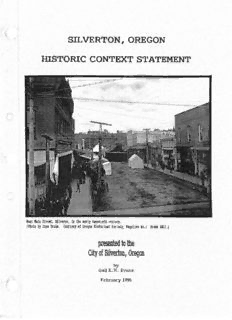
West Main Street, Silveron, in the early twentieth century.
(Photo by June Drake. Courtesy of Oregon Historical Society, Negative lo.: Drake 1821.)
presented to the
City of Silverton, Oregon
by
Gail E. H. Evans
February 1996
TABLE OF CONTENTS
ACKNOWLEDGEMENTS iii
INTRODUCTION 1
Temporal Boundaries 2
Spatial Boundaries 2
Geographic Description 2
Methodology 5
Document Format 6
Endnotes 7
PART I: HISTORICAL OVERVIEW 8
Themes 8
Historical Background 8
Native Americans, Exploration & Fur Trade,
and Initial Settlement (1650s-1850s) 8
Settlement and Early Transportation (1840s-1880) 13
Railroads and Industrial Growth (1880-1905) 20
Industrial Expansion in the Motor Age &
Great War Years (1906-1929) 29
Decline, Depression, and World War II (1928-1945) 40
Notable People Associated with Silverton History 43
Endnotes 51
Related Study Units 61
Bibliography 62
PART II: IDENTIFICATION 71
Previous Surveys 71
Resource Types & Distribution Patterns 72
PART m: EVALUATION fn
Evaluation Methodology 87
Evaluation Criteria 87
Historic Property Registration . 89
Evaluation Criteria Rating System 91
PART IV: TREATMENT 94
Survey and Research Needs 95
Treatment Strategies 97
ii
ACKNOWLEDGEMENTS
The completion of this Historic Context Statement owes to the efforts
m~ch
of others many of whom are past or present Silverton residents who have written
1
about the different aspects of the town's history. Several of thei.r names appear
in the endnotes and bibliography which follow the "Historical Overview" section
1
of this document. This study also benefitted greatly from the information and
general helpfulness given freely by several individuals including Jeff Brekas
1 I
Mildred Thayer Betty and Al Hollin Robert Edgerton and Jim Engeman. The
1 1 1
project as a whole has received the overall support of Historic Silverton, Inc.
Any errors of historical fact or interpretation are those of the author's alone.
ill
INTRODUCTION
This "Historic Context Statement" has been prepared for the City of
Silverton in partial fulfillment of Oregon's Land Use and Development Commis
sion's (LCDC) Goal 5 requirements for assessing the presence and value of
historic resources in the City. In its "Comprehensive Plan" (adopted in 1979 and
most recently revised in 1989) the City indicated its intention to complete an
inventory of all historic resources in the City located outside the commercial
district, which was formally listed in the National Register of Historic Places in
1987. This document also complies with the Oregon State Historic Preservation
Office's (SHPO) requirements for historic context statements, which are designed
to serve as the basis for a detailed inventory and evaluation of historic features.
The information contained in this context statement, together with the future
inventory of specific historic features in certain neighborhoods, will aid the City
in making decisions about goals and strategies to protect valuable historic
resources as the City grows. This context statement will also provide an
overview of Silverton history that can be used for a variety of purposes by
Silverton residents and the visiting public.
In general, a historic context statement describes general patterns of
historical development in a community and its region during a specified time
period. It identifies important trends that are represented by existing historic
features, often referred to as cultural resources. This identification process
helps form the foundation for planning decisions aimed at protecting and
preserving valued cultural resources. The Silverton Historic Context Statement
describes several broad patterns of history that relate to particular themes.
Together the thematic categories and chronological periods developed by the
Oregon State Historic Preservation Office and the National Park Service provide
the organizational structure for this context statement.
A knowledge of Silverton's past is immensely important in planning the
community's future. This context statement is a vital tool for effectively target
ing areas in the City and outlining tasks to be undertaken in the future in a more
.. detailed site-by-site inventory of historic features. Information contained in this
cdntext statement and the future inventory of important historic sites and
buildings will help determine planning priorities and provide greater incentive for
historical designation and protection~ This study also suggests methods for
resolving conflicts over historic preservation issues. Finally, both the context
statement and the future inventory of historic features, will encourage further
research on Silverton's history and its cultural resources.
In 1986 an overview history of Silverton and inventory of forty-four
buildings within approximately seven acres of the downtown core area was
completed for the nomination of the City's historic commercial district to the
National Register of Historic Places, the official list of historic properties recog
nized by the federal government as worthy of preservation. This historic context
statement and the future detailed inventory will expand on and extend beyond the
information contained in that National Register nomination form.
1
TEMPORAL BOUNDARIES
The Silverton Historic Context Statement briefly chronicles the history of
the City during the period of Native American occupation, European and American
exploration, and initial settlement in the Silver Creek country. It describes in
greater detail the City's history from the time of settlement through 1945.
SPATIAL BOUNDARIES
The spatial boundaries include the area within Silverton's urban growth
boundary (UGB), which embraces several acres outside the City limits,
particularly around Pine Street in the northwest, Hobart Road in the north, and
Water Street in the southeast. (Please see accompanying map.)
GEOGRAPHIC DESCRIPTION
Topography
Silverton is located at the eastem edge of the broad alluvial plain of the
Willamette Valley, just north of an area known as the Waldo Hills, near the base of
the Cascade's westem foothills. Ancient lake sediments, fluvio-glacial deposits,
and volcanic pumice underlay much of the more recent river alluvium in the
relatively flat northeastem and northwestem sections of Silverton. Volcanic
basalt, interspersed with sedimentary stratum, characteristic of the Columbia
River geologic group, are found in a large area of southwestem and southeastem
Silverton. Marine sediments exist in the southeast, within the urban growth
boundary.
The commercial center of town is around 250 feet above sea level. Steep-
.. wooded hills rise abruptly 200 feet or more above the narrow Silver Creek
~ided,
flcod plain, which extends to and pinches off southeast of the center of town.
North of the town center, the land levels off at about 200 feet and flattens into
broad, open fields dotted with scattered individual or small clusters of trees. 1
Silver Creek, a tributary of the Pudding River, which flows into the
Willamette River, is a historically important natural feature inside the Silverton
UGB. After leaving the human-made Silverton Reservoir south of town, Silver
Creek flows in a northerly direction through the town center, then westerly
toward the Pudding River. Silver Creek and, to a lesser extent, Abiqua Creek,
which flows generally from east to west just north of the UGB, drain the town.
Climate & Soil
The climate throughout the Willamette Valley, and in Silverton, is relatively
mild. Considering its northerly latitude, Silverton's annual temperature fluctua
tions are small, ranging from only 59 to 64 degrees Fahrenheit. July tempera
tures average from 52 to 76 degrees Fahrenheit, while January's average
2
~ lrH~'tN1II ..J ~lfI~JI/RJUINIC'IUf
s~.IJAJ/'1/1/'C
.tHJ:::/1/-tJ::r
//
t/
temperatures range from 34 to 42 degrees Fahrenheit. Precipitation, primarily in
the form of rain falling in the fall and winter, ranges between 40 and 50 inches
annually. 2
Two basic soil types exist within Silverton's urban growth boundary. In
the nearly level, lower-lying northern and northwestern sections of town, which
lie at the edge of the Willamette Valley floodplain, soils are characteristically
deep, silty, moderately dark, and somewhat acid. Poor drainage in this area is
common. Soils in the southern and eastern sections of Silverton, where the land
is hilly and begins to rise toward the western uplands of the Cascade Range, are
derived from igneous, volcanic, and sedimentary rock. They are typically dark,
clayey, and moderately acid. The soil and climate around Silverton have made
this area well suited for growing a variety of crops, for orc hard ing, and for
livestock grazing. 3
Native Vegetation
Since the arrival of Euro-Americans, many of the earlier open prairies have
been replaced with closed-canopy oak forests. Settlers and later farmers
perpetuated existing grasslands and created new ones by burning grass and
clearing trees for diversified farming. The large old oak tree that once stood in
the intersection of Silverton's main commercial streets (Main and First streets)
serve as a reminder of the prominent existence of oaks in the town's pioneering
years. Some Silverton street names, like Oak, Pine, Ash, Willow, and Alder
streets, also suggest the presence of these tree species at the time that those
particular streets were surveyed and named.
Many of the native plant and tree species that existed on the Willamette
Valley floor and foothills in the past are still present within the Silverton UGB.
Narrow gallery forests of deciduous and scattered coniferous trees and their
understory line the moist riparian stretches of Silver Creek. Tree species in this
vegetative creek corridor include Oregon white oak, red alder, big leaf maple,
" and black cottonwood. On the flatter eastern margin of the Willamette Valley
floodplain, which lies inside the northwestern portions of Silverton, the thick
trunked, heavy-limbed Oregon white oak often stands as a conspicuous landscape
feature along the edges of agricultural fields. Solitary or small open groves of
old oaks are scattered throughout this section, and found at places like the
Silverton Pioneer Cemetery, the intersection of Hobart and Monitor roads, and
between Mark Twain School on Church Street and Mill Street. A small stand of
large oaks is near the intersection of West Main and Welch streets.
Older stands of Oregon white oak are often found mixed with Douglas fir
and, sometimes, western red cedar in several areas of the hilly central and
southern sections of Silverton. Coolidge McClaine Park, on the west side of
Silver Creek near the downtown commercial district, is heavily shaded by an
aging, stately stand of oak and Douglas fir that dates from the park's founding in
the early 1900s. Open stands of mixed oak and Douglas fir cover several sections
of the western slopes and ridges above Silver Creek. White oaks mixed with a few
Douglas fir are also scattered along the ridge tops east of the town center. East
of these ridges, a distinctive grouping of oaks are scattered throughout a meadow
south of Reserve Street between East Park and East View Lane.
4
METHODOLOGY
Preparation of the Silverton Historic Context Statement involved four often
overlapping activities: review of existing historical studies, reconnaissance field
survey, archival research, and information compilation
Review of Existing Studies
All existing studies, known as secondary sources, written about the
history of Silverton and western Oregon were thoroughly reviewed at the outset
of the project. Materials reviewed included books, published articles disserta
1
tions and theses booklets, pamphlets and brochures found in or obtainable
1 1
through the Chemeketa Regional Library Service and the Oregon State Library.
Information gathered during the literature review helped determine an organiza
tional framework based on historical themes and time periods, for the historical
1
overview section of this context statement. In addition, by indicating the types
and distribution patterns of historical features that might be likely to exist in
Silverton today, this material also suggested what buildings, structures, and
landscape features to look for in the field. Finally the review of secondary
1
sources indicated areas of missing information that would require more intensive
research in other libraries and in archives.
Reconnaissance Field Survey
The purpose of the reconnaissance field, often called windshield, survey
was not to gather detailed data about particular structures or sites but, instead,
to get a general picture of the distribution of historic features and the overall
character of streetsc apes, commercial buildings, residential neighborhoods, and
cultural landscapes. During the field survey which involved driving and some
1
times walking throughout Silverton, cultural resource types and their patterns of
distribution throughout the city were recorded. Also noted were the environ-
.. mental and social effects of past growth on historic features. An assessment was
ma.de of resource types that were missing from those places they were expected to
be found and of the reasons for their absence. The windshield survey helped
identify geographically definable concentrations of historic buildings and major
cultural landscape features such as parks, cemeteries, and roadways with
distinctive land-use patterns. It suggested areas that warranted a more detailed
intensive survey in the future. Lastly, this visual reconnaissance raised ques
tions that required further in-depth historical investigation in archives.
Archival Research
Although much of the information required to complete this historic context
statement came from existing historical studies, some additional historical re
search was required when certain information was missing or the accuracy of
existing material proved questionable. In such cases, historical records and
documents produced and preserved from the time period of interest, known as
primary sources, were consulted. Primary sources that provided valuable
information for this context statement included scattered back issues of Silverton
5
Appeal Tribune, census records, city and county commercial directories, ceme
tery records, maps, and photographs. This material is housed at various
repositories such as the Silver Falls Public Library (in Silverton), the Oregon
State Library, the Oregon State Archives, and the Marion County Historical
Society (all in Salem), the Oregon Historical Society Library (in Portland), the
Kerr Library at Oregon State University (in Corvallis), and University of Oregon
libraries (in Eugene).
Information Compilation
After gathering and organizing the historical information, compilation and
summarization began. The Historical Overview and Identification sections of the
context statement were written first. They formed the basis for the last two
parts, the Evaluation and Treatment sections, which were developed in close
consultation with the City of Silverton staff.
DOCUMENT FORMAT
The Silverton Historic Context Statement consists of four basic parts:
11Historical Overview,., 11Identification," 11Evaluation,., and 11Treatment . .,
Historical Overview
The overview chronicles important events, trends, influences, and cultural
values that have contributed to and help define the history of Silverton. The
overview is not intended to be a definitive history of Silverton but, rather, a
summary of broad patterns of change and continuity over time. The overview is
organized according to historical themes and chronological periods suggested by
the Oregon State Historic Preservation Office and the National Park Service. The
- broad themes characterizing the historical development and cultural resources of
Sllverton include: settlement, agriculture, transportation, commerce,
manufacturing and industry, government, and culture (such as architecture,
education, fraternal movements, religion, medicine, and recreation) .
Identification
Based on information presented in the Historical Overview and previous
inventories of historic sites in Silverton, this section identifies the types and
distribution of cultural resources that are known or likely to exist in the city.
Historic photographs, maps, and other records, as well as a visual inspection of
all areas in town, provided information that helped approximate the date of roads,
neighborhoods, and landscape features.
Evaluation
Following the completion of the first two parts, the Evaluation section
6
presents a method for evaluating the types and condition of extant cultural
resources in Silverton. It suggests a criteria for evaluating the significance of
historic architectural and cultural landscape features by defining those
1 1
characteristics of good and best existing examples of each resource type.
Treatment
The Treatment section focuses on the future research and inventory needs
that have been identified in the other three sections of the context statement. In
this section specific recommendations for protecting Silverton's cultural resources
are outlined. Recommended strategies for treating the City's cultural resources
were devised in consultation with the City planner and are directly linked to the
City's planning goals and priorities as articulated in its Comprehensive Plan.
Endnotes
1. William G. Loy, Atlas of Oregon (Eugene: University of Oregon, 1976), 108-109, 116-17; Ewart M. Baldwin,
Geology of Oregon (Dubuque, Iowa: Kendall/Hunt Publishing Company, 1976, 39-47; nsilverton Quadrangle, Oregonn
map and nstayton NE Quadrangle, Oregonn map (Denver, Col.: U.S. Geological Survey, 1956, photorevised 1985
[Silverton! and 1969 [Stayton NEJ).
2. Loy, Atlas of Oregon, 130-39; Richard M. Highsmith, Jr., Atlas of Oregon Agriculture (Corvallis: Oregon State
University Press, 1962), 6-11.
3. Loy, Atlas of Oregon, 124-25; Jerry F. Franklin and C. T. Dyrness, Natural Vegetation of Oregon and Washington,
U.S. Forest Service General Technical Report, PNW-8 (Portland, Oreg.: U.S. Department of Agriculture, 1973), 15-
16.
Description:Silverton in partial fulfillment of Oregon's Land Use and Development Commis- commercial buildings lined the creek side of Water Street and stood along both .. lamette Valley to Coburg and had a total trackage of 183 miles.