Table Of Content8.
om
0 1 8
•
I n6
~~ by~·"
Botty .
Frio dan
"THE BOOK WE WERE WAITING FOR . . . THE
WISEST, SANEST, SOUNDEST, MOST UNDERSTAND·
ING AND COMPASSIONATE TREATMENT OF AMERI·
CAN WOMAN'S GREATEST PROBLEM."
-Ashley Montagu
"This is one of those rare books we are
endowed with only once in several decades;
a volume which launches a major social
movement, toward a more humane and
just society. Betty Friedan is a liberator of
women and men."
-Amitai Etzioni,
Chairman, Department of Sociology,
Columbia University
"The most important book of the twentieth
century . . . Betty Friedan is to women
what Martin Luther King was to blacks."
-Barbara Seaman, author of Free and Female
"It states the trouble with women so clearly
that every woman can recognize herself.
. . . Things are different between men and
women because we now have words for the
trouble. Betty gave them to us."
-Caroline Bird, author of
Everything a Woman Needs to Know
to Get Paid What She's Worth
o .
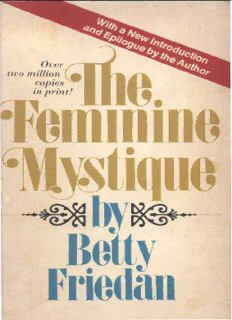
'Fomlnino ,
~tiquo
.. ..
~· ~~by~~·
Botty
~
Friodan
With aNew Introduction and Epilogue
by the Author
A DELL BOOK
I:
1'
Published by
~. DELL PUBLISHING CO., INC.
1 Dag Hammarskjold Plaza
New York, New York 10017
t
Copyright © 1974, 1963 by Betty Friedan
Selections from this book have appeared in
Mademoiselle © 1962 by the Conde Nast Publications, Inc.,
Ladies' Home Journal © 1963 by Betty Friedan and
McCall's © 1963 by Betty Friedan.
Introduction and Epilogue first published in the
New York Times Magazine. Copyright © 1973 by
Betty Friedan.
All rights reserved. For information contact
W. W. Norton & Company, Inc.
New York, New York 10003
Dell ® TM 681510, Dell Publishing Co., Inc.
IBSN: 0-440-12498-0
Reprinted by arrangement with
W. W. Norton & Company, Inc.
Printed in the United States of America
Previous Dell Edition #2498
New Dell Edition
First printing-September 1977
Second printing-June 1979
I
I
For all the new women,
and the new men
CONTENTS
INTRODUCTION 1
PREFACE AND ACKNOWLEDGMENTS 7
ONE
THE PROBLEM THAT HAS NO NAME 11
TWO
THE HAPPY HOUSEWIFE HEROINE 28
THREE
THE CRISIS IN WOMAN'S IDENTITY 62
FOUR
THE PASSIONATE JOURNEY 73
F I V E
THE SEXUAL SOLIPSISM
OF SIGMUND FREUD 95
SIX
THE FUNCTIONAL FREEZE,
THE FEMININE PROTEST,
AND MARGARET MEAD 117
SEVEN
THE SEX-DIRECTED EDUCATORS 142"
I,
,
EI GHT
THE MISTAKEN CHOICE 174
N I N E
THE SEXUAL SELL 191
f TEN
HOUSEWIFERY EXPANDS TO
!
FILL THE TIME AVAILABLE 224
ELEVEN
THE SEX-SEEKERS 241
TWELVE
PROGRESSIVE DEHUMANIZATION:
THE COMFORTABLE CONCENTRATION CAMP 271
THIRTEEN
THE FORFEITED SELF 299
FOURTEEN
A NEW LIFE PLAN FOR WOMEN 326
EPILOGUE 365
NOTES 381
INDEX 409
INTRODUCTION
JO THE TENTH ANNIVERSARY EDITION
IT IS A DECADE NOW SINCE THE PUBLICATION OF
The Feminine Mystique, and until I started writing the
book, I wasn't even conscious of the woman problem.
Locked as we all were then in that mystique, which kept
us passive and apart, and kept us from seeing our real
problems and possibilities, I, like other women, thought
there was something wrong with me because I didn't have
an orgasm waxing the kitchen floor. I was a freak, writing
that book-not that I waxed any floor, I must admit, in
the throes of finishing it in 1963.
Each of us thou ht she was a freak ten ears a 0 if she
didn't expenence~~~ ~~ious or~ashc ment the
Commercials prom;;;ed 3i/h;;; waxing the kitchen floor.
""HOWever much we enjoyed being Junior's and Janey"S or~
Emily's mother, or B.J.'s wife, if we still had amibitions,
ideas about ourselves as people in our own right-well,
we were simply freaks, neurotics, and we confessed our
sin or neurosis to priest or psychoanalyst, and tried hard
to adjust. We didn't admit it to each other if we felt there
should be more In hfe {han eanut-butter sandWIches WIth
e kids, throwing power In 0 was ng mac ine
didn't make us relive our wedding night, if getting the
socks or shirts pure white was not exactly a peak experi
ence, even if we did feel guilty about the tattletale gray.
Some of us (in 1963, nearly half of all women in the
me
United States) Were already commIftmg UnpardObable
SIn of working outside the home to belp pay the mortgage
"or W'0cery tid!. Those who did felt guilty, too-about be
~mg their femimmty, yndermining their husbands' mas
culImty, and neglecting their children by daring to work
for money at all, no matter how much it was needed.
They couldn't admit, even to themselves; that the:ll-resent
t:..d being paid half what a man would have been paid for
2 THE FEMININE MYSTIQUE
the job, or always being passed over for promotion, or
writing the paper for which he got the degree and the
raise.
A suburban neighbor of mine named Gertie was having
coffee with me when the census taker came as I was writ
ing The Feminine Mystique. "Occupation?" the census
taker asked, "Housewife," I said. Gertie, who had cheered
me on in my efforts at writing and seIling magazine arti
cles, shook her head sadly. "You should take yourself
more seriously," she said. I hesitated, and then said to the
census taker, "Actually, I'm a writer." But, of course, I
then was, and still am, like all married women in Amer
ica, no matter what else we do between 9 and 5, a house
wife. Of co se single women di 't "house-
. ". the cens e came around ut even ere,
society was less interested in what these women were
~persons in the world than in askmg, "WhY lsn~
'IiiCegiIi like you married.:E And so they: too, were~
~ged to take themselves seriously.
It seems such a precarious accident that I ever wrote
the book at all-but, in another way, my whole life had
prepared me to write that book. All the pieces finally
came together. In 1957, getting strangely bored with writ
ing articles about breast feeding and the like for Redbook
and the Ladies' Home Journal, I put an unconscionable
amount of time into a questionnaire for my fellow Smith
graduates of the class of 1942, thinking I was going
. ove the current notion that education had fitted us ill
for our ro e as women. But t e questionnaire raised more
questions than it answered for me-education had not ex
actly geared us to the role women he~ng tQ..PW. it
seemed. The suspicion arose as to weer it was the edu
cation or the role 'that was wrong. McCall's commissioned
an article based on my Smith alumnae questionnaire, but
the then male publisher of McCall's, during that great era
of togetherness, turned the piece down in horror, despite
underground efforts of female editors. The male McCall's
editors said it couldn't be true.
I was next commissioned to do the article for Ladies'
Home Journal. That time I took it back, because they
rewrote it to say just the opposite of what, in fact, I was
trying to say. I tried it again for Redbook. Each time I
was interviewing more women, psychologists, sociologists,
INTRODUCTION 3
marriage counselors, and the like and getting more and
-more sure I was on the track of something. But what? I
needed a name for whatever it was that kept us from
using our rights, that made us feel guilty about anything
we did not as our husbands' wives, our children's mothers,
but as people ourselves. I needed a name to describe that
guilt. uolike tbe guilt women used to feel about sexual
needs, the guilt they felt now was about needs . ,
t e sexua e 1 on 0 women, the mystique of femi
nine fulfillment-the femmme mystique.
"The editor of Redbook told my agent, "Betty has gone
off her rocker. She has always done a good job for us, but
this time only the most neurotic housewife could
identify." I opened my agent's letter on the subway as I
was taking the kids to the pediatrician. I got off the sub
way to call my agent and told her, "I'll have to write a
book to get this into print." What I Was writing threat
ened the very foundations of the women's magazIne
World-the feminine mystique.
When Norton contracted for the book, I thought it
would take a year to finish it; it took five. I wouldn't have
even started it if the New York Public Library had not, at
just the right time, opened the Frederick Lewis Allen
Room, where writers working on a book could get a desk,
six months at a time, rent free. I got a baby-sitter three
days a week and took the bus from Rockland County to
the city and somehow managed to prolong the six months
to two years in the Allen Room, enduring much joking
from other writers at lunch when it came out that I was
writing a book about women. Then, somehow, the book
took me over, obsessed me, wanted to write itself, and I
took my papers home and wrote on the dining-room table,
the living-room couch, on a neighbor's dock on the river,
and kept on writing it in my mind when I stopped to take
the kids somewhere or make dinner, and went back to it
after they were in bed.
I have never experienced anything as powerful, truly
mystical, as the forces that seemed to take me over when
I was writing The Feminine Mystique. The book came
from somewhere deep within me and all my experience
came together in it: my mother's discontent, my own
training in Gestalt and Freudian psychology, the fellow
ship I felt guilty about giving up, the stint as a reporter
Description:Landmark, groundbreaking, classic — these adjectives barely describe the earthshaking and long-lasting effects of Betty Friedan's The Feminine Mystique. This is the book that defined "the problem that has no name," that launched the Second Wave of the feminist movement, and has been awakening wome