Table Of Content0) s —I
=J ~ zr
David D.
CL 5- CD
(/)_(£!
T> ^
Q O O
cr ® 5
*< =^0=
</> E_ °
_® 3 g
Burns. M D
^ ® 7T
5 £ =r
S
Q. O-D
5 ^ 0
Q(/) o_. CO-I
- c 9j
O cfDn 3
o o
CD <
"O CD
-5 —I
CD Q
to O
- • 3
§ 0
> O
? 0
X Z>
© -Q
r+ C
CD
5" m
Hh . 13
q* o*
QJ ^
-5
(D
CD
Hh
cd
-1
“Carries the very useful procedures of Feeling Good into many other
important areas of life. Clear, systematic, and forceful.”
—Albert Ellis, Ph.D., President, Institute for Rational-Emotional
Therapy, and author of A New Guide to Rational Living
“This book makes a difference. Anyone who experiences
emotional distress (that is, everyone) will find this book invaluable.
Dr. Burns presents dozens of helpful exercises in his inimitable,
lively, and self-revealing style.”
—Jackie Persons, Ph.D., Associate Clinical Professor,
Department of Psychiatry, University of California at
San Francisco, and Director, San Francisco Bay Area
Center for Cognitive Therapy
(for more extraordinary praise, from professionals and readers,
please turn the page. . .)
David D. Burns, M.D. graduated magna cum laude from Amherst
College, received his M.D. degree from Stanford University School
of Medicine, and completed his psychiatry residency at the
University of Pennsylvania School of Medicine. He has served as
Acting Chief of Psychiatry at the Presbyterian-University of
Pennsylvania Medical Center and Visiting Scholar at the Harvard
Medical School. He is currently Clinical Associate Professor of
Psychiatry and Behavioral Sciences at the Stanford University School
of Medicine, where he is actively involved in research and teaching.
Dr. Burns has received numerous awards, including the A. E.
Bennett Award from the Society for Biological Psychiatry and the
Distinguished Contribution to Psychology through the Media
Award from the Association of Applied and Preventive Psychology.
In 1998 and in 2000 he received the Teacher of the Year award from
the graduating psychiatric residents at Stanford.
The Feeling Good Handbook teaches an extraordinarily helpful set of
techniques for turning depression into joy, anger into intimacy.”
—S. M., Philadelphia
“Dr. Burns seemed to be talking directly to me ... he took me by
the hand and led me step by step to an understanding of why I feel
the way I do and how I can feel better about myself.”
—N.C.S., Caldwell, New Jersey
“This is my Bible! It’s amazing! It’s wonderful!
—EG., San Diego, California
“These techniques are for anyone who doubts his own self-worth,
falls prey to anxieties, desperately strives to be perfect, or just feels
bad but can’t figure out why. This book can truly change
your life and give you back the ability to enjoy it.”
—J.K.S., Chadds Ford, Pennsylvania
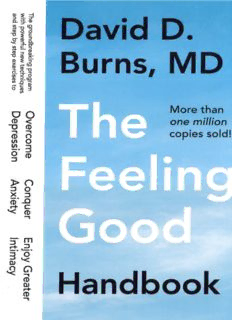
The
Feeling Good
Handbook
David D. Burns, M.D.
REVISED EDITION
A PLUME BOOK
This book is dedicated to my colleagues
Tony Bates and Sheila Flynn,
who are very dear to me.
Acknowledgments
I owe a debt of gratitude to many people who have contributed to this
book in so many ways. First, I want to thank my colleagues, Dr. Tony
Bates and Sister Sheila Flynn. Their vision and creativity were crucial
to the birth of this book and have been a constant source of joy to me.
I would also like to thank several Stanford colleagues who helped me
with the revised chapters on antidepressant and anti-anxiety medica
tions for the 1999 revision of the Handbook. They included Alan
Schatzberg, M.D., our department chairman, Joe Bellenoff, M.D., a
psychopharmacology fellow, and Greg Tarasoff, M.D., a senior psychi
atric resident. In addition, many of my patients, who wish to remain
anonymous, read and critiqued various chapters of the Handbook while
it was being written and edited. This feedback was essential in show
ing me what was genuinely helpful and what was not. The result was
the development of a much stronger manuscript. Thank you!
I would like to thank Mary Lovell, Wendy Brusick, and Sharon
Barksdale for the huge volume of meticulous word processing that was
necessary in the creation of this book. I am indebted to many individ
uals who have provided help with the editing. I want to thank my two
editors, Arnold Dolin and Maria Guarnaschelli, for their generous sup
port and technical expertise when the Handbook was first published. I
Contents
Preface to Revised Edition xiii
Introduction xxxi
Part I. Understanding Your Moods
1. You Can Change the Way You Feel 3
2. How to Measure Your Moods 32
3. How to Diagnose Your Moods 49
4. Should You Change the Way You Feel? 61
Part II. Feeling Good About Yourself: How to Conquer
Depression and Build Self-Esteem
5. How to Change the Way You Feel: The Four Steps
to Happiness 73
6. Ten Ways to Untwist Your Thinking 97
7. How to pevelop a Healthy Personal Value System 120
8. Cognitive Therapy in Action: How to Break Out
of a Bad Mood 137
9. Why People Procrastinate 169
10. A Prescription for Procrastinators 183
Preface to Revised Edition
This book is about a relatively new type of treatment for depression,
anxiety, and other disorders called cognitive behavioral therapy (CBT).
Although CBT may seem like a complicated name, it has a simple
meaning. A “cognition” is just a fancy name for a thought. If you have
ever been very depressed or anxious, you are probably aware that you
think about things very negatively when you are down in the dumps.
Depressed people also have a tendency to behave in self-defeating
ways—you may avoid work, pleasurable activities, and other people,
for example. CBT can help you change these negative thinking and be^-
havior patterns so you can experience greater happiness, productivity,
and intimacy.
I have been very gratified by the overwhelming positive response to
the Feeling Good Handbook. In 1994 the results of a nationwide survey
about the use of self-help books by mental health professionals were
published in the Authoritative Guide to Self-Help Books. In this study the
researchers surveyed 500 American mental health professionals and
asked if they “prescribed” books for patients to read between sessions to
speed recovery. Seventy percent of the therapists polled indicated that
they did use “bibliotherapy” with their patients, and 86 percent re
ported that the books were helpful to their patients. The therapists
PREFACE TO REVISED EDITION xv
scientific evidence shows that psychological interventions, particularly
cognitive-behavioral therapies (CBTs), are generally as effective or
more effective than medications in the treatment of depression, even if
severe.”*
CBT is gaining popularity in the treatment of many other disorders
as well. For example, at a recent conference, I was intrigued by the pres
entation by a colleague of mine from Stanford, Dr. Stuart Agras. Dr.
Agras is a professor of psychiatry and a world-renowned eating-disor
ders expert. He presented the results of numerous recent studies on the
treatment of eating disorders with medications, such as the new SSRI
antidepressants like Prozac, and different types of psychotherapy. These
studies indicated that CBT is the most effective treatment for eating
disorders—far better than any known drug or any other form of
psychotherapy.
The first controlled-outcome study of cognitive behavioral therapy
for depression was conducted when I was doing my postdoctoral fel
lowship in depression research at the University of Pennsylvania in the
mid-19708.* In that study depressed patients were randomly assigned
to one of two treatment groups. Patients in the first group were treated
with imipramine, one of the most widely used antidepressants at the
time. These patients received medication alone without any psy
chotherapy. Patients in the second group received cognitive therapy
alone without any antidepressant medications. At the end of the 12-
week treatment period, tfre patients in the cognitive therapy group had
improved as much as, if not more than, the patients in the antidepres
sant drug group. This was the first time that any form of psychother
apy had been shown to be as effective as medications. The study caused
considerable controversy and led to a tremendous increase in interest in
cognitive therapy and in psychotherapy research.
During the two decades since that study was published, dozens of
similar studies comparing CBT with antidepressant medications as
well as other forms of short-term psychotherapy have been published in
psychology and psychiatry journals throughout the world. Drs. An-
tonuccio and William Danton, from the University of Nevada, and
♦Antonuccio, D. O., Danton, W. G., & DeNelsky, G. Y. 1995. Psychotherapy versus medication for
depression: Challenging the conventional wisdom with data. Professional Psychology, 26, 574-85.
fRush, A. J., Beck, A. T., Kovacs, M., & Hoi Ion, S. 1977. Comparative efficacy of cognitive therapy and
pharmacotherapy in the treatment of depressed outpatients. Cognitive Therapy and Research, 1(1): 17-38.
PREFACE TO REVISED EDITION xvii
genetic disorder and that antidepressant drugs represent the most pow
erful form of treatment—beliefs that are not solidly grounded in the
facts.
You might question these conclusions and wonder if Dr. Antonuccio
and his co-authors interpreted the literature in a fair and unbiased man
ner. Certainly, their conclusions are controversial. Yet there have been
several other scholarly review articles summarizing research studies on
antidepressant drugs versus psychotherapy in the treatment of depres
sion,* and their conclusions are consistent with those of Dr. Antonuc
cio and his colleagues. There is strong evidence from many
independent studies that CBT is at least as good as antidepressant med
ications. For many patients CBT actually seems to work better.
Is there any evidence that a cognitive therapy self-help book such as
this one can have antidepressant effects? If you are feeling down in the
dumps and you diligently study this book and complete the exercises
in it,, what is the chance that your mood will improve?
Self-help books are quite controversial. Many people are skeptical
about the motives of the individuals who write them. They believe that
self-help authors are primarily out to help themselves make money. In
addition, self-help authors are often criticized for offering overly sim
plistic formulas for the complex problems of daily living. I think these
impressions are justified. When I look through the self-help sections of
popular bookstores, the superficial jargon and quick fixes that are
promised in many books turn me off as well.
However, there are two sides to every coin, and academic researchers
have begun to take a serious look at self-help books as a new form of
therapy. This type of treatment is called bibliotherapy, or reading ther
apy. It can be administered in one of two ways. First, therapists can
“prescribe” a self-help book for their patients to read between therapy
sessions to increase the speed of learning and recovery. Second, individ
uals suffering from depression or anxiety can be given a self-help book
to read as a self-administered treatment without any other drug ther
apy or psychotherapy.
The second approach—bibliotherapy without other therapy—has
been recently evaluated in five published studies over the past decade
♦Dobson, K. S. 1989. A meta-analysis of the efficacy of cognitive therapy for depression. Journal of
Consulting and Clinical Psychology, 57(3), 414-19.
Hollon, S. D., & Beck, A. T. 1994. Cognitive and cognitive behavioral therapies, in A. E. Bergin
& S. L. Garfield (eds.), Handbook of Psychotherapy and Behavioral Change. New York: John Wiley.
Robinson, L. A.,.Berman, J. S., & Neimeyer, R. A. 1990. Psychotherapy for the treatment of de
pression: A comprehensive review of controlled outcome research. Psychological Bulletin, 108, 30-49.
Description:Make life an exhilarating experience!With his phenomenally successfulFeeling Good: The New Mood Therapy, Dr. David Burns introduced a groundbreaking, drug-free treatment for depression. Now in this long-awaited sequel, he reveals powerful new techniques and provides step-by-step exercises that help