Table Of ContentAbout the Author Rabbi Geoffrey Dennis is adjunct instructor of
Rabbinics in the Jewish Studies Program at the University of North
Texas and rabbi of Congregation Kol Ami in Flower Mound, TX.
His articles have appeared in Journal of Ritual Studies, Parabola: the
Magazine of Myth and Tradition, Journal of the Central Conference of American
Rabbis, American Journal and The Journal of the Anthropology of
Consciousness. He co-authored the recent article, Vampires and Witches and
Commandos: Oy Vey! Comic Book Appropriations of Lilith, with his son, Avi.
He has also authored over 20 encyclopedia entries for The Encyclopedia of the
Bible and Its Reception; The Encyclopedia of Possession and Exorcism; and The
Encyclopedia of Miracles.
Llewellyn Publications
Woodbury, Minnesota
Concerning everything that cannot be grasped, its question is its
answer.
—Ketem Paz
To my sons, Avi and Micah, who love secrets.
To Robin, the greatest angel I know.
Contents
Acknowledgments
Introduction
Introduction To The Second Edition
How to Use This Book
The Encyclopedia A–Z
A / B / C / D / E / F / G / H / I / J / K / L
M / N / O / P / Q / R / S / T / U / V / W / X / Y / Z
Abbreviations Of Citations
From Traditional Texts
Quick Reference Glossary
Of Frequently Used Terms
Bibliography
List of Art Credits
Acknowledgments
My deep appreciation to my classmates and friends Rabbi Martha
Bergadine, Rabbi George Gittleman, Dr. Dana Kaplan, Rabbi Max
Weiss, and Rabbi Stan Zamek for taking the time from their busy
lives to read the manuscript and offer insights and suggestions. Their
contributions greatly improved the final product.
Thanks too to my brother John, to Charles Gregory, to Terry
Hansen, and to Scott and Kelley Snowden. Though nonexperts in
matters Jewish, they also read the book and helped me see it through
the eyes of a general reader.
My gratitude also goes to Dr. Richard Golden. He unwittingly
triggered the creation of the EJMMM and then graciously offered me
encouragement once I finally owned up to what I was doing.
I want to acknowledge my teachers at Hebrew Union College-
Jewish Institute of Religion, for teaching me the tools I needed to
research this book: Rabbi Steven Balaban, Dr. Marc Bregman, Rabbi
Chanan Brichto z”l, Dr. Alan Cooper, Dr. Susan Einbinder, Rabbi
Ben Hollander, Dr. Adam Kamasar, Dr. Robert Katz z”l, Dr. Steve
Kaufmann, Masha Klein, Dr. Michael Klein z”l, Dr. Barry Kogan, Dr.
Paul Liptz, Dr. Michael Meyer, Dr. Eugene Mihaly z”l, Dr. Alvin
Reines z”l, Hannah Saggi, Dr. Richard Sarason, Rabbi Julie Schwartz,
Ezri Uval z”l, Dr. Ben Zion Wacholder z”l, Dr. Mark Washofsky, Dr.
David Weisberg z”l, and Dr. Isaac Yerushalmi.
I want to thank Natalie Harter, Karl Anderson, and all the editors at
Llewellyn, both for taking an interest in an unsolicited proposal from
an unknown author, and also for being the nicest and most pleasant
people I’ve yet encountered in the publishing world.
My greatest and eternal thanks must go to my wife and soulmate,
Robin, who encouraged my vision and gave me the confidence to
write this book. Not only did she read and help revise countless
manuscripts, but she has been more patient and forgiving of me during
the years of writing this book than I deserve or merit. May her reward
be waiting in the World to Come, because she’s stuck with me until
then.
Introduction
Judaism is one of the oldest living esoteric traditions in the world.
Virtually every form of Western mysticism and spiritualism known
today draws upon Jewish mythic and occult teachings—magic, prayer,
angelology, alchemy, numerology, astral projection, dream
interpretation, astrology, amulets, divination, altered states of
consciousness, alternative, and rituals of power—all have roots in the
Jewish occult.
But for millennia, many of these core teachings have been
unavailable to the general public, concealed by barriers of language
and by the protective principles governing the teaching of Kabbalah,
which has both nurtured and guarded such knowledge. Now, however,
many more traditional texts of Jewish mysticism and magic are being
translated into English and many more almost-forgotten manuscripts
of Jewish esoteric teachings have been recovered and identified. At
the same time, people of all backgrounds are thirsty for the kind of
wisdom that can only be drawn from ancient wells. This confluence of
factors inspired me to write a book like The Encyclopedia of Jewish
Myth, Magic, and Mysticism.
When Adam HaRishon, the First Man, sinned, he blemished all the
nitzotzot (Holy Sparks) … causing them to become immersed in
the kelipot … The kelipot are the husks or shells [of impurity, evil,
and entropy] that imprison the fallen Holy Sparks.1
This is a book full of husks and sparks: of things concealed and
revealed, lost and then recovered. This encyclopedia focuses
exclusively on the esoteric in Judaism—the fabulous, the miraculous,
and the mysterious. In this book the reader will find many kelipot,
husks from the ancient and shattered world of Jewish occult teachings:
the seemingly eccentric, the offbeat, the peripheral, and the
outlandish. Much of it will strike a modern reader as dark, strange,
and alien stuff indeed—husks.
Because so much has been lost over the past two centuries of what
we term “modernization,” even many Jews will be puzzled by the
contents of this book. And to be frank, most Jews can live very
satisfactory spiritual lives never having known, or never knowing,
much of what can be found in these pages. So be forewarned: this is
not a primer on Judaism, providing a conventional perspective on
those beliefs and practices most people associate with Torah and
Jewish faith. On the other hand …
Concealed within these many husks there are nitzotzot, or “holy
sparks.” Since Jewish esotericism is the oldest and most influential
continuous occult tradition in the West, shaping everything from
angelology to the zodiac, this book contains lore that can spiritually
enrich the lives of anyone, Jewish or not, who wishes to understand
the mysteries that underlie our universe. The reader who looks
carefully into this book will glimpse flashes of insight, glimmers of
inspiration, and sparks of wit and wisdom. For Jews, this book
uncovers aspects of Judaism that have been lost to most of us until
recently. For every reader, this book is meant to be a portal into an
exotic alternate spiritual world, for this is a book about three things
that have profoundly shaped human experience: myth, magic, and
mysticism.
Already, with the word “myth,” the puzzlement begins and our
modern prejudices take over our thinking. For is not a myth a kind of
fairy tale, a fantastic account about something that never really was?
Modern Jews are constantly taught that Judaism is a religion without
mythology, a faith unburdened by fanciful and grotesque “adventures
of the gods.” To that claim I answer, “Well, yes and no.”
First of all, let us clear something up: a myth, a really good myth, is
not a story about something that never happened. It’s a story about
something that happens all the time. Myths are archetypal tales,
fabulous stories told to help us fathom important truths—truths about
ourselves, our universe, and how things really are. And while it is true
that Judaism (mostly) lacks stories about “God as action-hero,” it
nevertheless revels in mythological tales about those things which are,
to paraphrase the Psalms, “little less than God”; angels and demons,
primeval monsters, magicians and miracle-workers, agents of good
and evil. After all, what are the first eleven chapters of Genesis if not
a carefully crafted mythic account of exactly what human beings are
and how our world came to look the way it does? The simple fact is
that Jewish tradition overflows with myths of deep complexity and
singular wisdom.
It is much the same with regard to the magical. Modern Jews like to
imagine that magic has been swept into the dustbin of history by the
long, inexorable progress of rationalism. More than that, Jews have
been taught from our youth that Judaism has always possessed an
essentially naturalistic worldview and that magic, merely a marginal
Jewish preoccupation at most, was just an anomaly resulting from our
being situated (and corrupted) by the superstitions of our neighbors.
But that’s not entirely accurate. It is only in the last two centuries that
Jews have fully embraced science, but we have always been looking
for ways to change the world for the better, whether it be through
science, medicine, or “practical Kabbalah.”
Even today, rationalism has not completely displaced our sense that
there is a mystical potential at work in the world; Occam’s razor has
never been able to fully overpower the Sixteen-Sided Sword of the
Almighty.2 Millions of people, both Jews and gentiles, continue to
believe that the stars influence our lives. Most Americans believe in
the reality of angels. Jewish techniques of dream interpretation and for
combating the evil eye are still widely practiced today. When you read
the entries of this book on topics such as these, you will realize that
magical thinking and enchanting deeds have always had a place in
Judaism and, however much some might want to dismiss Judaism’s
miraculous and wondrous traditions, the presence of Jewish magic in
Jewish life has merely been eclipsed, never uprooted; it still has the
potential to empower us.
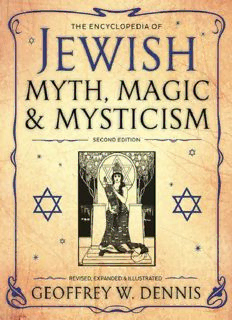
Description:Llewellyn Publications, 2016. — 816 p. — ISBN: 073874591X. — Second EditionJewish esotericism is the oldest and most influential continuous occult tradition in the West. Presenting lore that can spiritually enrich your life, this one-of-a-kind encyclopedia is devoted to the esoteric in Judaism