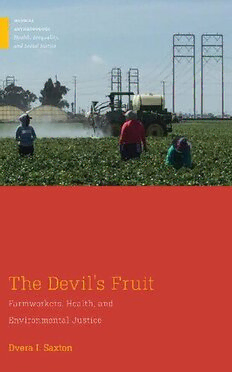
Table Of ContentTHE DEV IL’S FRUIT
MEDICAL ANTHROPOLOGY: HEALTH, IN EQUALITY,
AND SOCIAL JUSTICE
Series editor: Lenore Manderson
Books in the Medical Anthropology series are concerned with social patterns of and
social responses to ill health, disease, and suffering, and how social exclusion and
social justice shape health and healing outcomes. The series is designed to reflect the
diversity of con temporary medical anthropological research and writing, and will
offer scholars a forum to publish work that showcases the theoretical sophistication,
methodological soundness, and ethnographic richness of the field.
Books in the series may include studies on the organ ization and movement of
peoples, technologies, and treatments, how inequalities pattern access to these, and
how individuals, communities and states respond to vari ous assaults on wellbeing,
including from illness, disaster, and vio lence.
Carina Heckert, Fault Lines of Care: Gender, HIV, and Global Health in Bolivia
Joel Christian Reed, Landscapes of Activism: Civil Society and HIV and AIDS Care in
Northern Mozambique
Alison Heller, Fistula Politics: Birthing Injuries and the Quest for Continence in Niger
Jessica Hardin, Faith and the Pursuit of Health: Cardiometabolic Disorders in Samoa
Beatriz M. Reyes-F oster, Psychiatric Encounters: Madness and Modernity in
Yucatan, Mexico
Sonja van Wichelen, Legitimating Life: Adoption in the Age of Globalization and
Biotechnology
Andrea Whittaker, International Surrogacy as Disruptive Industry in Southeast Asia
Lesley Jo Weaver, Sugar and Tension: Diabetes and Gender in Modern India
Ellen Block and Will McGrath, Infected Kin: Orphan Care and AIDS in Lesotho
Nolan Kline, Pathogenic Policing: Immigration Enforcement and Health in the U.S. South
Ciara Kierans, Chronic Failures: Kidneys, Regimes of Care, and the Mexican State
Stéphanie Larchanché, Cultural Anx i eties: Managing Mi grant Suffering in France
Dvera I. Saxton, The Dev il’s Fruit: Farmworkers, Health, and Environmental Justice
TH E D E V I L’S FRU IT
Farmworkers, Health, and
Environmental Justice
dvera i. saxton
rutgers university press
New Brunswick, Camden, and Newark, New Jersey, and London
Library of Congress Cataloging-in-Publication Data
Names: Saxton, Dvera I., author.
Title: The devil’s fruit : farmworkers, health and environmental
justice / Dvera I. Saxton.
Other titles: Medical anthropology (New Brunswick, N.J.)
Description: New Brunswick, NJ : Rutgers University Press, [2021] |
Series: Medical anthropology | Includes bibliographical references and index.
Identifiers: LCCN 2020020470 | ISBN 9780813598611 (paperback) |
ISBN 9780813598628 (hardcover) | ISBN 9780813598635 (epub) |
ISBN 9780813598642 (mobi) | ISBN 9780813598659 (pdf)
Subjects: LCSH: Migrant agricultural laborers—Health and Hygiene—
California. | Pesticides—Health aspects—California. | Pesticides—
Environmental aspects—California.
Classification: LCC HD1527.C2 S32 2021 | DDC 363.17/9209794—dc23
LC record available at https://lccn.loc.gov/2020020470
A British Cataloging- in- Publication rec ord for this book is available from the
British Library.
Copyright © 2021 by Dvera I. Saxton
All rights reserved
No part of this book may be reproduced or utilized in any form or by any means,
electronic or mechanical, or by any information storage and retrieval system, without
written permission from the publisher. Please contact Rutgers University Press,
106 Somerset Street, New Brunswick, NJ 08901. The only exception to this prohibition
is “fair use” as defined by U.S. copyright law.
The paper used in this publication meets the requirements of the American
National Standard for Information Sciences— Permanence of Paper for Printed
Library Materials, ANSI Z39.48-1992.
www . rutgersuniversitypress . org
Manufactured in the United States of Amer i ca
In memory of my dad, Ronald L. Saxton.
And dedicated to the people of the Pájaro and
Salinas Valleys.
CONTENTS
Series Foreword by Lenore Manderson ix
Abbreviations xiii
Introduction: Becoming an Engaged Activist
Ethnographer 1
1 Engaged Anthropology with Farmworkers:
Building Rapport, Busting Myths 28
2 Strawberries: An (Un)natur al History 55
3 Pesticides and Farmworker Health: Toxic Layers,
Invisible Harm 86
4 Accompanying Farmworkers 115
5 Ecosocial Solidarities: Teachers, Students, and
Farmworker Families 140
Conclusion: Activist Anthropology as Triage 168
Acknowl edgments 179
Notes 183
References 189
Index 223
vii
SERIES FOREWORD
LENORE MANDERSON
Medical Anthropology: Health, Ine quality, and Social Justice aims to capture
the diversity of con temporary medical anthropological research and writing.
The beauty of ethnography is its capacity, through storytelling, to make sense of
suffering as a social experience, and to set it in context. Central to our focus in
this series, therefore, is the way in which social structures, po liti cal and economic
systems and ideologies shape the likelihood and impact of infections, injuries,
bodily ruptures and disease, chronic conditions and disability, treatment and
care, social repair, and death.
Health and illness are social facts; the circumstances of the maintenance and
loss of health are always and everywhere s haped by structural, local, and global
relations. Social formations and relations, culture, economy, and po liti cal organ-
ization, as much as ecolo gy, shape the variance of illness, disability, and disad-
vantage. The authors of the monographs in this series are concerned centrally
with health and illness, healing practices, and access to care, but in each case they
highlight the importance of such differences in context as expressed and experi-
enced at individual, h ouse hold, and wider levels: health risks and outcomes of
social structure and house hold economy, health systems factors, and national
and global politics and economics all shape p eople’s lives. In their accounts of
health, in equality, and social justice, the authors move across social circum-
stances, health conditions, and geography, and their intersections and interac-
tions, to demonstrate how individuals, communities, and states manage assaults
on people’s health and well- being.
As medical anthropologists have long illustrated, the relationships of social
context and health status are complex. In addressing these questions, the authors
in this series showcase the theoretical sophistication, methodological rigor, and
empirical richness of the field while expanding a map of illness, social interac-
tion, and institutional life to illustrate the effects of material conditions and social
meanings in troubling and surprising ways. The books reflect medical anthropol-
ogy as a constantly changing field of scholarship, drawing on diverse research in
residential and virtual communities, clinics and laboratories, emergency care,
and public health settings; with ser vice providers, individual healers, and
house holds; and with social bodies, h uman bodies, and biologies. While medi-
cal anthropology once concentrated on systems of healing, par tic u lar diseases,
and embodied experiences, t oday the field has expanded to include environmen-
tal disaster, war, science, technology, faith, gender- based vio lence, and forced
ix