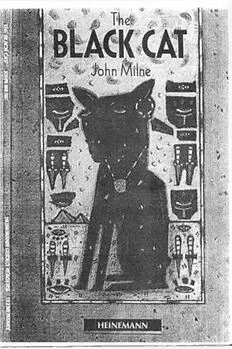
Table Of ContentHEINEMANN GUIDED READERS
ELEMENTARY LEVEL
Series Editor: John Milne
The Heinemann Guided Readers provide a choice of enjoyable
reading material for learners of English. The series is published at five
levels - Starter, Beginner, Elementary, Intermediate and Upper. At
Elementary Level, the control of content and language has the
following main featilres:
Information Control
Stories have straightforward plots and a restricted number of main
characters. Information which is vital to the understanding of the
story is clearly presented and repeated when necessary. Difficult
allusion and metaphor are avoided and cultural backgrounds are
made explicit.
Structure Control
Students will meet those grammatical features which they have
already been taught in their elementary course of studies. Other
grammatical features occasionally occur with which the students may
not be so familiar, hut their use is made clear through context and
reinforcement. This ensures that the reading as well as being enjoy-
able provides a continual learning situation for the students.
Sentences are kept short — a maximum of two clauses in nearly all
cases — and within sentences there is a balanced use of simple
adverbial and adjectival phrases. Great care is taken with pronoun
reference.
Vocabulary Control
At Elementary Level there is a limited use of a carefully controlled
vocabulary of approximately 1,100 basic words. At the same time,
students are given some opportunity to meet new or unfamiliar
words in contexts where their meaning is obvious. The meaning of
words introduced in this way is reinforced by repetition. Help is also
given to the students in the form of vivid illustrations which are
closely related to the text.
Contents
Introductory Note 6
The People in This Story 7
1 Salahadin is Worried 10
2 The Missing Box 12
3 The Taxi Driver 16
4 Boat to Beirut 20
5 The Black Cat 22
6 hi Beirut 25
7 The Road to Ba’albek 28
8 Burkinan's Story 31
9 Beirut to Athens 34
10 Salahadin finds Peterson 37
11 Salahadin finds the Black Cat 39
12 Death on The Syria 42
13 Do Not Disturb 45
14 Return to Cairo 48
15 The End 51
Points for Understanding 55
List of titles at Elementary Level 63
Introductory Note
The main character in this story is called Salahadin. He is
an inspector in the Egyptian police. His job is to protect
Egyptian antiquities. An antiquity is something which is
very old.
There are many antiquities in Egypt. Most of them are
valuable. Many of them are in museums in Cairo or in
Europe. But there are many others which have not yet been
found. These antiquities are buried under the sands, in
tombs or in pyramids.
There are many archeologists working in Egypt. Archeo-
logists study ancient cities and tombs. Sometimes they find
antiquities. They must give all these antiquities to the
Egyptian Government. But some archeologists try to keep
them. Salahadin’s job is to stop this happening.
Salahadin has studied history at Cairo University and at
the University of London. He has visited many museums in
Cairo and in Europe.
6
The People in This Story
7
ARCHEOLOGIST
MURDERED
Yesterday morning, an
archeologist was found
dead in a Cairo hotel.
The archeologist was
called Pearson.
The police are making
enquiries.
9
1
Salahadin is Worried
Salahadin was sitting in his office with his coat off. It was
the month of May in Cairo and it was very hot. Salahadin
stood up and turned on the fan. He was a young man, only
twenty-eight yeahs old. He was not very tall and quite thin.
His black hair was cut very short.
Salahadin’s office was in the centre ol Cairo. It was in a
large building behind the Nile Hotel. It was a small office
and Salahadin’s name was not on the door. Not many
people knew that he was a detective. But he was not an
ordinary detective. Inspector Salahadin protected all the
antiquities of Egypt.
10
Salahadin was waiting for an archeologist called Mr
Pearson. Pearson had been in Egypt for six months. He had
been working in a valley in the south of Egypt. Pearson had
been looking for antiquities. He had come hack to Cairo a
few days ago and was leaving Egypt soon.
But Mr Pearson had not come to Salahadin’s office.
Every archeologist had to see Salahadin before they left
Egypt. Salahadin was worried. Pearson had not come yet.
Salahadin picked up the telephone and rang the number
of Pearson’s hotel.
‘Nile Hotel,’ said a voice. ‘Can 1 help you?’
‘Can I speak to the manager, please,’ said Salahadin.
Salahadin waited for a few moments. Then he heard the
manager’s voice.
‘Can 1 help you?’ said the manager.
‘Yes,’ replied Salahadin. ‘My name’s Salahadin El Nur.
I’m a police inspector. 1 want to speak to Mr Pearson.’
‘Do you mean Mr Pearson, the archeologist?’ asked the
manager.
‘Yes,’ replied Salahadin.
‘I’m sorry. You can’t speak to Mr Pearson, sir,’ said the
manager.
‘Oh,’ said Salahadin in surprise. ‘Why not?’
‘Mr Pearson is dead,’ replied the manager. ‘He was found
dead in his room this morning. Mr Pearson was murdered.’
11
2_
The Missing Box
Salahadin put on his coat and quickly left his office. It was
much hotter outside in the street. A hot, dusty wind was
blowing between the tall buildings. Salahadin jumped into a
taxi. The streets \vere full of cars and the taxi moved slowly.
It took a long time to get to the Nile Motel.
A policeman was standing at the door of the hotel.
Tm sorry,’ said the policeman. ‘No one is allowed into
the hotel.’
Salahadin showed the policeman his identity card.
OF ANTIQUITIES
The policeman took Salahadin to his chief. Luckily,
Salahadin knew this officer. It was Inspector Ahmed, a
school friend of Salahadin’s.
12