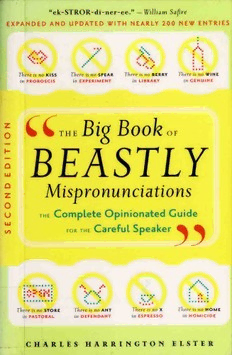
Table Of Content““eekk--SSTTRROORR--ddii--nneerr--eeee..”” —William Safire
EXPANDED AND UPDATED WITH NEARLY 200 NEW ENTRIES
O' ■ ■ .■■■■
■ B
6-
There is no KISS Th ere is no SPEAR I here is no BERRY There is no WINE
in PROBOSCIS in EXPERIMENT in LIBRARY in GENUINE
i-
cc
z Big Book
THE OF
O
BEASTLY
D
LU
Mispronunciations
o
Complete Opinionated Guide
E
TH
u
Careful Speaker 33
FOR. THE
i/>
H m
■ MOB m m m m m y \
a a
V V
l l
■ a mm®
"
a B ■ ■ ■ I 01 B
Th ere is no STORE Th ere is no ANT There is no X There is no HOME
in PASTORAL in DEFENDANT in ESPRESSO in HOMICIDE
C H A R L E S HARRINGTON E L S T E R
Digitized by the Internet Archive
in 2017 with funding from
Kahle/Austin Foundation
https://archive.org/details/isbn_9780618423156
The Big Book of
Beastly Mispronunciations
Books by Charles Harrington Elster
WHAT IN THE WORD?
Wordplay, Word Lore, and Answers to
Your Peskiest Questions About Language
THERE’S A WORD FOR IT
A Grandiloquent Guide to Life
VERBAL ADVANTAGE®
10 Easy Steps to a Powerful Vocabulary
(also available as an audio program)
TOOTH AND NAIL
A Novel Approach to the SAT
TEST OF TIME
A Novel Approach to the SAT and ACT
THE BIG BOOK OF
BEASTLY MISPRONUNCIATIONS
The Complete Opinionated Guide for the
Careful Speaker, Second Edition
The Big Book of
Beastly Mispronunciations
Charles Harrington Elster
SECOND EDITION
HOUGHTON MIFFLIN COMPANY
BOSTON • NEW YORK
FOR JUDITH AND CARMEN
cultivated speakers of the 21st century
Copyright © 1999, 2005 by Charles Harrington Elster
ALL RIGHTS RESERVED
For information about permission to reproduce selections from
this book, write to Permissions, Houghton Mifflin Company,
215 Park Avenue South, New York, New York 10003.
Visit our Web site: www.houghtonmifflinbooks.com.
Library of Congress Cataloging-in-Publication Data
Elster, Charles Harrington.
The big book of beastly mispronunciations : the complete
opinionated guide for the careful speaker / Charles
Harrington Elster. — [2nd ed.].
p. cm.
Includes bibliographical references.
ISBN-13: 978-0-618-42315-6 isBN-10: 0-618-42315-x
1. English language — Pronunciation — Dictionaries.
1 . Title.
PE1137.E56 2005 423'.1 — dc22 2005020060
PRINTED IN THE UNITED STATES OF AMERICA
Book design by Robert Overholtzer
MP 10 9876543
THE AUTHOR GRATEFULLY ACKNOWLEDGES permission to quote from the following: Say It My Why by Willard
R. Espy. Copyright © 1980 by Willard R. Espy. Used by permission of Doubleday, a division of Bantam Doubleday
Dell Publishing Group, Inc. Watching My Language: Adventures in the Word Trade by William Satire. Copyright ©
1997 by The Cobbett Corporation. Reprinted by permission of The New York Times Company. The New Fowler’s
Modern English Usage, 3rd ed., edited by R. W. Burchfield. Copyright © 1965,1996 by Oxford University Press. A Dic-
tionary of Modern English Usage by H. W. Fowler. Copyright © 1926 by Oxford University Press. Garner’s Modern
American Usage by Bryan A. Garner. Copyright © 2003 by Bryan A. Garner. Reprinted by permission of Oxford Uni-
versity Press. The Random House Dictionary of the English Language, 2nd ed., unabridged, copyright © 1987 by Ran-
dom House, Inc. Used by permission of Random House, Inc. Comfortable Words by Bergen Evans. Copyright © 1962
by Bergen Evans. Used by permission of Random House, Inc. The Harper Dictionary of Contemporary Usage, 2nd
ed., by William Morris and Mary Morris. Copyright © 1976,1985 by William Morris and Mary Morris. Don’t Say It!
by John B. Opdycke. Copyright © 1939 by Funk & Wagnalls Company. A Desk-Book of 25,000 Words Frequently Mis-
pronounced, 4th ed., by Frank H. Vizetelly. Copyright © 1917,1919, and 1929 by Funk & Wagnalls Company. You Don’t
Say! by Alfred H. Holt. Copyright © 1937 by Thomas Y. Crowell Company. We Who Speak English, and Our Igno-
rance of Our Mother Tongue by Charles Allen Lloyd. Copyright © 1938 by Thomas Y. Crowell Company. Reprinted
by permission of HarperCollins Publishers. By permission: Webster’s New International® Dictionary of the English
Language, 2nd ed., unabridged. Copyright © 1934 by Merriam-Webster, Inc. (www.Merriam-Webster.com), for-
merly G. 8c C. Merriam Co. “The Unpronounceables: Difficult Literary Names 1500-1940” in the December 1996
issue of English Language Notes. Reprinted by permission of J. Wallace Donald of the University of Colorado, Boul-
der. Letter from Brian M. Sietsema, Ph.D., reprinted by permission. Comments and letters of Ralph H. Emerson,
reprinted by permission. “The Word” in the Boston Sunday Globe, reprinted by permission of Jan Freeman.
Contents
Introduction to the Second Edition vi
Introduction to the First Edition vii
The Key to Pronunciation xii
Some Terms Often Used in This Book xv
1
Authorities Consulted 515
Other Sources Cited or Consulted 520
Acknowledgments 523
*- 43007608585
"-
J*.1 El st er
D
Lster, Charles
Arrington.
ie big book of beastly [v]
Lspromunciations s the
smplete opinionated
Introduction to the Second Edition
that have passed since the first edition of this guide appeared,
IN THE YEARS
I have had the benefit — or the distinct displeasure, depending on how you
look at it — of hearing a heck of a lot more words mispronounced. I have
also heard from readers upset about some earsore* or eager to have me opine
about something. And, like an orthoepic Santa Claus — who knows whether
you’ve “talked bad or good” — I’ve been making my list and checking it
twice.
Herein you will find discussions of almost two hundred more words and
names whose pronunciation is mangled or muddled, disputed or in doubt.
You will learn about some relatively new inductees into English like bru-
schetta, gigabyte, and pedophile; you will lay to rest your anxiety over daunt-
ing French loanwords and phrases like coup de grace, piece de resistance, and
sobriquet; and you will get authoritative advice on proper names like Al
Qaeda, Muslim, Niger, Pinochet, and Qatar that have been in and on the air
in recent years.
You will emerge from these augmented pages knowing how and how not
to pronounce the twenty-third letter of the English alphabet (W) and why
you should be wary of how the dictionaries of Merriam-Webster treat pro-
nunciation. (Start at archipelago and follow the cross-references.) You will
emerge confidently pronouncing tricky words like devotee, dieresis, gewgaw,
seneschal, and tinnitus. You will emerge having learned the right way, once
and for all, to pronounce fiance(e), hara-kiri, Halloween, machismo, magnate,
Pulitzer, and sheik. I suspect that you will also emerge surprised by my rul-
ings on how best to pronounce curriculum vitae, saith, and sorbet.
As usual, you will get a healthy dose of my opinion — which I give liber-
ally and passionately but which you are free to take in moderation or eschew.
Though I exercise my right to pontificate, I don’t presume to dictate. As
always, I encourage you to use my informed opinion to formulate your own.
Finally, all the entries in the first edition have been revised and updated
so that they report how the current dictionaries weigh in. If anything has
changed — especially my opinion — I promise that you will hear about it
here.
Charles Harrington Elster
San Diego, California
July 2005
* Earsore: an annoyance to the ear — a rare but useful companion to eyesore.
[vi]
Introduction to the First Edition
WHEN IT COMES to pronunciation, there are two types of people: those who
don’t give the subject a second thought and those who do. This book is for
those who do.
When I was growing up, one of the surest ways to raise the decibel*level
of the already stentorian conversation at dinnertime was to raise the sub-
ject of pronunciation, or worse, to question how another family member pro-
nounced a certain word. What would begin as an animated discussion of-
ten would degenerate into a shouting match and end with the contestants
hunched and panting over an unabridged dictionary. If a clear victor emerged,
the vanquished party was often sullen for weeks.
Were we fanatics, members of some fringe element of verbally obsessed
freaks? Not at all. I have heard scores of testimonials about this sort of famil-
ial sparring from people all over the country. Were we nitpickers, smitten by
the bug of phonetic correctness? You bet — and proud of it. In our home,
words were nothing to trifle with. Language was the great, mysterious gift
that distinguished the human being from the beast, and how you used
words — and pronounced them — was a mark of character, intelligence, and
refinement. It was an important lesson for a young person to learn, especially
for one who would grow up to make pronouncements about pronunciation.
There are those, however, who would teach a much different lesson —
that simply because we are human our speech can never be beastly:
Few people nowadays botch pronunciation. Americans are perfectly sensible
in not caring a hoot about it. Inarticulateness, not mispronunciation, is what
sends people to defeat in the Game. It used to be thought that a distinct and
careful pronunciation was most desirable, but no one believes that anymore
except a few speech teachers. ... Most people are well advised not to worry
about a particular pronunciation. Say it the way you want and be proud of it.
No party or parties decide the meaning of a word, and no one decides the pro-
nunciation. ... You needn’t worry about pronunciation, since no one cares
about that anymore.
— Robert C. Pinckert, Pinckert’s Practical Grammar (1986)
It’s hard to imagine any self-respecting person swallowing this nonsense.
Telling us to pronounce words however we please and claiming that no one
cares about how they are pronounced is an insult to our intelligence — and
* See the Guide for the proper pronunciation of this word.
[ vii ]
an invitation to disaster. Would you trust a driving instructor who told you
not to worry about the rules of the road? Pinckert is like the writing teacher
who, faced with a roomful of students eager to sharpen their skills, says,
“Don’t worry about grammar, spelling, punctuation, diction, syntax, and all
that useless, boring stuff. There’s no such thing as a mistake. Whatever you
feel like writing is good.” Those who take that counsel to heart no doubt will
learn to write good and get a more better job.
The sad truth is that lots of people mispronounce words every day and
plenty of other people notice. (Just listen to all the folks around you who say
pro-noim-ciation instead of pro-nim-ciation!) And because we know that
other people take note of how we speak, most of us do care about pronunci-
ation, as this passage illustrates:
If you are like most of us, you are embarrassed when you mispronounce a
word. You feel that mispronouncing common, or even uncommon, words
marks you as not quite educated. And you are right. ... Of course, you can
still make a million, have friends, influence people, be admired for your good
sense, be loved for your good heart, send your children to the best colleges,
become President of the United States even if your pronunciation is not what
it should be. But you will still be judged by the words you mispronounce. And
you may not be judged kindly.
— Abraham and Betty Lass, Dictionary of Pronunciation (1976)
As the author of several books about language, I have had the opportunity
to be a guest on several hundred radio shows throughout the United States
and in Canada, and the experience has been ear-opening, to say the least. As
I fielded questions, noted gripes, and listened to the lamentations of hun-
dreds of listeners, one thing became persistently and incontestably clear: Peo-
ple do care about how the English language is spoken, and they care about it
with a passion — sometimes a ferocious one.
The Big Book of Beastly Mispronunciations is the product of my lifelong in-
terest in the spoken word. Specifically, it is the culmination of over a dozen
years of observing the pronunciation of educated Americans, studying the
pronunciations recorded in dictionaries from the 18th century to the present,
and weighing the opinions of pronunciation experts on hundreds of dis-
puted words (and various troublesome names as well). My focus naturally is
on the present, but my analysis always takes in the past. What emerges from
these pages is a snapshot of cultivated American speech at the end of the mil-
lennium with the entire 20th century in the background.
Although this volume incorporates my two earlier books on pronuncia-
tion, There Is No Zoo in Zoology, and Other Beastly Mispronunciations (1988)
and Is There a Cow in Moscow? More Beastly Mispronunciations and Sound
Advice (1990), it is by no means merely a reprint or rehash of their contents.
[ viii ]