
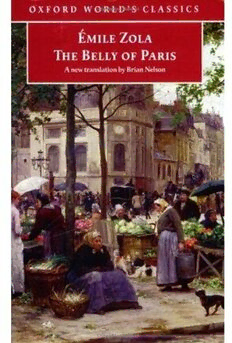
Download The Belly of Paris (Oxford World's Classics) PDF Free - Full Version
Download The Belly of Paris (Oxford World's Classics) by Émile Zola, Brian Nelson in PDF format completely FREE. No registration required, no payment needed. Get instant access to this valuable resource on PDFdrive.to!
About The Belly of Paris (Oxford World's Classics)
You will always find someone who buys you a drink, but no one will ever buy you food! It is dishonest to be hungry! Zola's volume 3 in the Rougon Maquart series is at its core about the disgusting bourgeoisie, who will love government as long as business is profitable. The food market "Les Halles" has recently been built, in the course of Haussmann's redesign of Paris, and it is a wonder of modern society. A side character, the painter Claude (later the hero of the sequel The Masterpiece), says: what a shame that the bourgeois scoundrels get to eat all this food! Our hero Florent is a man who was unjustly banned to Devil's Island during the Coup d'Etat of Napoleon III. He escapes and finds his way back to Paris, where he tries to live in the Halles world, under a fake identity. Problem: too many people know him from old times! And he can't stay away from political circles, though he is harmlessness personified. Clandestine life might still work, but he is a danger to his brother's wellbeing. The brother is not the main problem, but his wife is. The couple runs a successful butchery in the area and can't risk being identified with a runaway convict, a political prisoner! On top of that, Florent might eventually want his rightful share in the successful business, or at least of the inheritance that bought it. He must go back to the devil! One of the key scenes in the book is set in the butchery during an evening. Florent, who lives with this brother's family, is telling a `story' about how he was transported to Devil's Island, how he escaped with 2 companions, how they both died, how he walked alone through the jungles of Dutch Guyana, how he found a settlement, and slowly managed to earn and save some money for his return to France. During his tale we watch the butcher and his staff do a batch of boudin, the blood sausage from pig's blood. Florent is a weak character. He obtains a job as inspector of the fish market in the Halles, but he can not be assertive to use his authority. He is a well-intentioned push-over. Lisa, the charcutiere, is the negative central heroine. She is a proper daughter to patriarch Maquart, one of the two evil half-brothers who started the `dynasty' in volume 1. She is also a cousin of speculator Saccard from La Curee, the second volume. Claude, the painter, is a nephew of the evil Lisa. He dislikes her thoroughly. But she wins. She is not actually evil, just a proper person who likes her comfort and supports the emperor and disapproves of political activists. Napoleon III took power in 1851. The novel is set in 1858, nearly through half time of the shameful 2nd Empire. Zola despised the epoch. He wrote the novel in 1872, after the downfall of the usurper. Florent can not settle down to accept the second empire and remains in opposition. Is he a danger? Well, tyrannies have never been very slow in declaring any opposition a danger, up to now. Zola's political outspokenness brought him trouble even when the regime had already fallen. I like him for it, and for his encyclopedic forays into the real world. 'Naturalism' had its own poetic values. I admit that I post the review after reading only half of the book; what prompted me to post it prematurely is this: after I read the tale of the escape from Devil's Island (see the Papillon movie with D.Hoffman and Steve McQueen if you want a visual idea), I watched the movie To Have and Have Not (already reviewed). That ends on the exodus of Bogart plus an assembly of odd people from Vichy Martinique (another shameful period of French history) by boat with the lunatic intention to liberate a prisoner from Devil's Island. (Which mainly shows how far away from the world's realities William Faulkner lived and wrote!) Does this happen to you too, that things come in pairs? To me, all the time.
Detailed Information
| Author: | Émile Zola, Brian Nelson |
|---|---|
| Publication Year: | 2008 |
| ISBN: | 9781435638761 |
| Pages: | 320 |
| Language: | English |
| File Size: | 0.893 |
| Format: | |
| Price: | FREE |
Safe & Secure Download - No registration required
Why Choose PDFdrive for Your Free The Belly of Paris (Oxford World's Classics) Download?
- 100% Free: No hidden fees or subscriptions required for one book every day.
- No Registration: Immediate access is available without creating accounts for one book every day.
- Safe and Secure: Clean downloads without malware or viruses
- Multiple Formats: PDF, MOBI, Mpub,... optimized for all devices
- Educational Resource: Supporting knowledge sharing and learning
Frequently Asked Questions
Is it really free to download The Belly of Paris (Oxford World's Classics) PDF?
Yes, on https://PDFdrive.to you can download The Belly of Paris (Oxford World's Classics) by Émile Zola, Brian Nelson completely free. We don't require any payment, subscription, or registration to access this PDF file. For 3 books every day.
How can I read The Belly of Paris (Oxford World's Classics) on my mobile device?
After downloading The Belly of Paris (Oxford World's Classics) PDF, you can open it with any PDF reader app on your phone or tablet. We recommend using Adobe Acrobat Reader, Apple Books, or Google Play Books for the best reading experience.
Is this the full version of The Belly of Paris (Oxford World's Classics)?
Yes, this is the complete PDF version of The Belly of Paris (Oxford World's Classics) by Émile Zola, Brian Nelson. You will be able to read the entire content as in the printed version without missing any pages.
Is it legal to download The Belly of Paris (Oxford World's Classics) PDF for free?
https://PDFdrive.to provides links to free educational resources available online. We do not store any files on our servers. Please be aware of copyright laws in your country before downloading.
The materials shared are intended for research, educational, and personal use in accordance with fair use principles.

