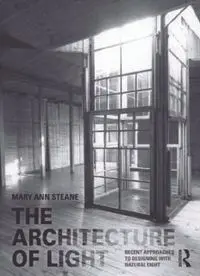
Table Of ContentThe Architecture of Light
How architects have spoken about and worked with natural light since electricity
has become an alternative light source in buildings is the subject of this book.
Not only does the book argue that natural light remains a fundamentally import-
ant source of orientation in architecture, but it underlines how and why the art
of daylighting imposes creative discipline on design.
Examining a series of twentieth-century projects whose architects
have a particular interest in light and window design, the book gives careful
attention to the way in which words and practice in natural light are intercon-
nected. In the process a number of key influences are revealed including the
significance of Le Corbusier’s written and built oeuvre for subsequent thinking.
The book underlines how ambitions for light have been arrived at not only through
reference to relevant precedents but an approach to context that sees light as
a critical aspect of place.
A willingness to treat natural light seriously has prompted imagin-
ative and resonant design approaches for a wide range of building types and
contexts. In demonstrating such thinking, this sourcebook looks at climates of
light as diverse as those of northern Europe and central Chile, eastern Australia
and northern Portugal. Its overall argument is that a sensitive approach to day-
lighting not only remains a complex yet ultimately rewarding endeavour but a
fundamental if under-appreciated aspect of the ‘practical art’ of architecture.
Mary Ann Steane is an architect and a lecturer at the University of Cambridge.
Her research on the use of natural light marries an understanding of light-
ing design principles with a broader cultural perspective. She examines how
architects handle the relationship between light, material and the occupation of
space, looking closely at the way in which these factors affect perception of and
attunement to the visual environment.
The Architecture of Light
Recent approaches to designing
with natural light
Mary Ann Steane
First published 2011
by Routledge
2 Park Square, Milton Park, Abingdon, Oxon, OX14 4RN
Simultaneously published in the USA and Canada
by Routledge
711 Third Avenue, New York, NY 10017
Routledge is an imprint of the Taylor & Francis Group, an informa business
© 2011 Mary Ann Steane
The right of Mary Ann Steane to be identified as author of this work has been
asserted by her in accordance with sections 77 and 78 of the Copyright,
Designs and Patents Act 1988.
Typeset in Univers by
All rights reserved. No part of this book may be reprinted or reproduced or
utilised in any form or by any electronic, mechanical, or other means, now
known or hereafter invented, including photocopying and recording, or in any
information storage or retrieval system, without permission in writing from
the publishers.
The publisher makes no representation, express or implied, with regard to
the accuracy of the information contained in this book and cannot accept any
legal responsibility or liability for any errors or omissions that may be made.
British Library Cataloguing in Publication Data
Steane, Mary Ann.
The architecture of light : recent approaches to designing with natural light /
Mary Ann Steane.
p. cm.
Includes bibliographical references and index.
1. Light in architecture. 2. Lighting, Architectural and decorative. I. Title.
II. Title: Recent approaches to designing with natural light.
NA2794.S74 2011
729’.28--dc22 2010041747
Library of Congress Cataloging- in-P ublication Data
A catalog record has been requested for this book
ISBN13: 978-0 -415-3 9478-9 (hbk)
ISBN13: 978- 0-415-3 9479- 6 (pbk)
Contents
Illustration credits vi
Acknowledgements vi
Introduction: Daylighting in the era of electricity 1
1 Speaking of light, speaking with light: Le Corbusier’s ‘carnets
de recherche patiente’, Une Petite Maison and La Chapelle
de Ronchamp 9
2 Desert tent: Light and geometry in the church of the Benedictine
Monastery of the Holy Trinity, Las Condes, Santiago de Chile 35
3 Deciding the colouring of things: Scarpa’s Fondazione Querini
Stampalia, Venice 57
4 Reading light at Seinajoki, Finland, and Viana do Castelo, Portugal:
Aalto’s and Siza’s conspicuous conservation of daylight 77
5 Enlightening conversation: The Music Room and the Open City,
Ritoque, Chile 105
6 Seeing the light: The Poole House, Lake Weyba, Queensland 131
James Bichard, ed. Mary Ann Steane
7 O’Donnell and Tuomey’s lessons in the history and geography of
light: The Ranelagh Multi- Denominational School, Dublin, 1998 151
8 Inverse light? The vulnerable openings of Libeskind’s Jewish
Museum, Berlin 171
9 New light for old across London: Recent interventions at the
Carmelite Priory, Kensington, by Niall McLaughlin, and at 1A John
Campbell Road, Hackney, by Lisa Shell 193
10 The electricity of daylight? Herzog and De Meuron’s excavation of
dusk at London’s Bankside Power Station, 1998–2000 221
Index 243
Illustration credits
The authors and publishers gratefully acknowledge the following for their permis-
sion to reproduce material in this book. Every effort has been made to contact
and acknowledge copyright owners. The publishers would be grateful to hear
from any copyright holder who is not acknowledged here and will undertake to
rectify any errors or omissions in future printings or editions of the book.
Archivo Histórico José Vial PUCV 2.7, 2.8, 5.1, 5.2, 5.3, 5.8, 5.9, 5.10, 5.11,
5.12, 5.14, 5.17, 5.18, 5.23
Archive of the Benedictine Monastery of Las Condes 2.5, 2.6
Kate Baker 5.13
Mike Baker/Anne Dye 4.1, 4.8, 4.9, 4.10, 4.11, 4.12, 4.13, 4.15
José Baltanas and FLC/ADAGP, Paris and DACS, London 1.2, 1.3
Max Beckenbauer 1.1, 1.8, 1.10, 1.12, 1.19, 3.6, 4.6, 4.7, 4.21, 4.22, 5.4, 6.9,
6.10. 6.11, 8.3, 10.1, 10.2
Noah Carl 10.6, 10.18
Bettmann/Corbis and FLC/ADAGP, Paris and DACS, London 1.14
James Bichard 6.6, 6.19
Reiner Blunck 6.7, 6.13, 6.14, 6.15, 6.16, 6.17, 6.18, 6.20
Simon Blunden 3.5
Bitter Bredt 8.5, 8.6, 8.15, 8.18, 8.20
Holger Ellgaard 4.5
FLC/ADAGP, Paris and DACS, London 1.4, 1.11, 1.13, 1.16, 1.18, 1.20,
1.21
National Gallery of Ireland 7.3
Dennis Gilbert 7.16, 7.17, 7.18, 7.19, 7.21
P. Gross and E. Vial 2.2, 2.3, 2.10
Max Gwiazda 8.4, 8.8, 8.10, 8.12
Wade Johanson 6.4
Hamburg Kunsthalle 4.4
Dean Hawkes 3.1
Sarah Honeyball 7.12, 7.13, 7.20, 7.22, 7.23
Soane Museum 9.2
Jeffery Howe 0.1
Niall MLaughlin Architects 9.5, 9.6, 9.7, 9.8, 9.9, 9.10, 9.11, 9.12, 9.13
George Middleton-Baker 8.17, 8.19, 8.21
Illustration credits
Tomas Mikulas, École Athenaeum, Lausanne and FLC/ADAGP, Paris and
DACS, London 1.5, 1.6
Michele Nastesi 8.11, 8.13,
Fernando Perez 2.18
O’Donnell and Tuomey Architects 7.5, 7.7, 7.8, 7.9, 7.10, 7.14
Gabriel Poole 6.12
Gunter Schneider 8.1
Patrick and Maura Shaffrey (Irish Countryside Buildings, O’Brien Press Ltd.,
Dublin) 7.9
Lisa Shell Architects 9.3, 9.17, 9.18, 9.16, 9.19, 9.20, 9.21, 9.22, 9.25
David Steane 7.11
Wren Strabuchi 2.4
Studio Daniel Libeskind and Udo Hesse 8.2, 8.9, 8.14
Tate, London, 2010 10.3, 10.5
Alan Worn 3.19
vii
Acknowledgements
I wish to acknowledge the help that a large number of people have given me
during the course of this project. First of all I would like to express my thanks
to the University of Cambridge Centre of Latin American Studies who awarded
me a grant to cover the costs of a study trip to Chile in 2006 to look at buildings
in and around Santiago and Valparaiso, and to the AHRC, who funded a research
project entitled ‘Designing with Light in Libraries’ that enabled trips to Finland
to carry out detailed photographic studies of the public library at Seinajoki. I am
also indebted to my publisher Georgina Johnson for her patience and guidance
in bringing this project to a conclusion.
Many individuals have also gone to great lengths to help me access
buildings and to contact architects, and sometimes even to translate the inter-
views I held to discuss the ideas about light represented by a particular project.
In this regard I am particularly grateful to Wren Strabuchi and Fernando Perez
of the School of Architecture at the Catholic University of Santiago and to David
Jolly, Miguel Eyquem and Alberto Cruz of the School of Art and Design at the
Catholic University of Valparaiso, both for their generous hospitality during my
time in Chile, and rapid response to subsequent queries. Luis Urbano who
organized the 2008 study trip to look at contemporary architecture near Porto
which introduced me to the work of Alvaro Siza, including his library at Viana do
Castelo, is another colleague whose thoughtful reactions to conversation about
light I have built on subsequently.
I would like to thank all the living architects whose work is discussed
here. Sadly, I have not had the opportunity to meet all of them in person, though
several have proved to be excellent email correspondents, Gabriel Poole in
particular. Among those I have met, I owe a particular debt to Sheila O’Donnell
and John Tuomey who not only showed me round their Multi- Denominational
School in Dublin but arranged for me to visit other projects of theirs further afield;
Brother Martin Correa who twice welcomed me to the Benedictine Monastery
at Las Condes, Santiago; Lisa Shell, who moved out so I could experience her
house by myself for a night; Niall McLaughlin, whose perceptive comments
at student reviews, and during an interview carried out by one of my students
stimulated my initial ideas for the book; and Tarla MacGabhann, whose enthusi-
astic response to the text of my chapter on the Jewish Museum in Berlin was a
welcome confirmation that others might be interested in the subject of the book.
A number of individuals have helped me with images. Sound
Acknowledgements
judgement and no little skill has been exercised by Max Beckenbauer in the
production of a number of the drawings; Max Gwiazda and Kate Baker took
photographs especially for the book, and I am also grateful to Reiner Blunck
for sending me some of his wonderful shots of Gabriel Poole’s work at very
short notice. Staff at Tate Images, The Soane Museum, The National Gallery of
Ireland, Hamburg Kunsthalle, DACS, the Fondation Le Corbusier, the Art Gallery
of Ballarat, Victoria, Australia and a number of the practices whose work I have
discussed have also helped ensure the book is suitably illustrated.
Educators are in a privileged position when it comes to finding people
with whom to discuss their ideas and I should like to express particular thanks to
a number of the students I have been fortunate to work with during the past dec-
ade. They may not have realized it, but it was the thoughtful exchanges in which
they participated that prompted either directly or indirectly several of the themes
presented here. Chief among this group are Oriel Prizeman, Maria Konstadoglou,
Ed Shinton, Philip Veall, Lynne Sandlands, Sarah Honeyball, Siobhan Kelly, Alan
Worn and Andy Mackintosh. My co-a uthor James Bichard has also proved a
willing correspondent and I am very grateful to him for the time he has put in to
review a text of which he was the original author, that has subsequently been
reworked for the book.
Finally, I would like to acknowledge all those colleagues among the
permanent and visiting teaching staff at Cambridge whose contributions have
proved invaluable to my ongoing engagement with the principles and aspirations
of environmental thinking in architecture, Dean Hawkes and Koen Steemers in
particular. Last but not least, I want to end this expression of thanks by saying
how fortunate I have been to enjoy stimulating conversation with Peter Carl for
thirty years concerning architecture – ephemeral or permanent, light- filled or
shadow-b ound – and its ordering principles. He has been a major influence on
all that I do and I dedicate this book to him.
ix
Introduction
Daylighting in the era of electricity
There is only one day left, always starting over: it is given to us at dawn
and taken away from us at dusk.1
A sensible man shows off his estate to his future mother-i n-l aw at twilight.2
Arguably ‘lighting’ as an architectural topic is now largely determined by the ter-
minology and assumptions of artificial lighting, and therefore by all the science
and technology that has built up around it that is decreeing the weight now given
to the predictability and control of light in buildings. On the one hand, electricity
has enabled the working day to be 24/7, and cities to be safe, to handle traffic,
as well as to be neon- fantasies of capitalist buying and selling; on the other hand,
we have grown accustomed to viewing the satellite night view of the planet as
marked with a luminous cancer of consumption that threatens human life itself.
Its introduction may have resulted in elevating task- lighting to the quantifiable
standards set out in current building codes,3 but too frequently it is only possible
to meet such standards with artificial sources and so lights are left on whether
needed or not, leading to spaces baked in uniform lux, or where task-l ighting is
unnecessary, their counterform, lighting- specialist effects of colour and intensity.
The latter date from the electricity pavilion of the 1893 Chicago World Fair, but
have subsequently led to Albert Speer’s 1935 encircling of the vast Nuremberg
parade grounds with 130 anti- aircraft searchlights to create his ‘cathedral of
light’,4 contemporary ‘light-s hows’, as well as unctuous corporate lobbies and
florid monument lighting. Most critically of all it is the advent of electric light
(with the support of air conditioning) that has enabled deep-p lan buildings and
the need for laws to decide what corner of sky office workers should be able to
glimpse from their desks.
It cannot be emphasized enough that artificial light is only appar-
ently effortless, its instant push-b utton availability coming to represent what
technological culture is expected to deliver more broadly: a milieu of ease and
efficiency in which all the effort is hidden and vitality is either downgraded as an
ambition, completely ironed out or planned ahead with meticulous precision. In
this regard the very term ‘daylighting’ used to describe the art of bringing natural
light into buildings is arguably a tautology derived from privileging quantifiable/
technological light.