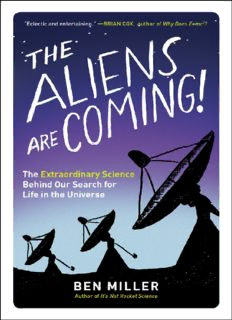
Table Of ContentTHE
ALIENS
ARE COMING!
The Extraordinary Science Behind Our Search for
Life in the Universe
BEN MILLER
For Sonny, Harrison, and Lana
CONTENTS
1 Extremophiles
2 SETI
3 Planets
4 Universes
5 Life
6 Humans
7 Aliens
8 Messages
Further Reading
Acknowledgments
About the Author
CHAPTER ONE
EXTREMOPHILES
In which the author gets his starships in a row, and discovers that the solar
system is an oasis, not a desert.
WE COME IN PEACE
On August 25, 2012, the first of our ships reached interstellar space. It was
unmanned. Launched three and a half decades earlier, it had skirted Jupiter and
Saturn, and was now heading out of the solar system toward Camelopardalis, a
little-known constellation close to the Big Dipper. Although clear of the solar
wind, it was not quite out of reach of the sun’s gravity, nor would it be for a
further thirty millennia. By then it would finally have traversed what is known as
the Oort Cloud, a thick outer shell of icy rubble that encases our home star and
its eight planets like the flesh around a peach stone. At that point it would be
nearly a light-year out. Forget the galaxy; even the solar system is unimaginably
large.
The ship’s name was Voyager 1, and on board was a message from the people
of Earth, encoded on what became known as the “Golden Record.” This gold-
plated phonographic disc, curated by the distinguished American cosmologist
Carl Sagan, spoke on behalf of all humanity. It began with a recorded message
from the Secretary-General of the United Nations, Kurt Waldheim. Reading
haltingly, with a strong Austrian accent, he made the following statement:
I send greetings on behalf of the people of our planet. We step out of our solar system into the
universe seeking only peace and friendship: to teach if we are called upon; to be taught if we are
fortunate. We know full well that our planet and all its inhabitants are but a small part of this
immense universe that surrounds us and it is with humility and hope that we take this step.
After this greeting came a choir of voices speaking in fifty-five languages:1
everything from Akkadian, the language of ancient Sumer, to Wu, the
contemporary Chinese dialect spoken around Shanghai. Some, such as the
Japanese, appeared shy: “Hello, how are you?” Others were more forthcoming,
such as the Amoy of southeastern China, who offered: “Friends of space, how
are you all? Have you eaten yet? Come visit us if you have time.” The speaker of
Ancient Greek, on the other hand, issued a barely concealed threat: “Greetings to
you all, whoever you are. We come in friendship . . . to those who are friends.”
These Greetings of Earth were accompanied by twenty-odd Sounds of Earth,
among them echoing footsteps, hard rain, and a handsaw cutting fresh wood.
Over one hundred Scenes of Earth showed images such as a hand being x-rayed,
the chemical structure of DNA, and a man and a pregnant woman in silhouette.
And, finally, there was the Music of Earth, with over twenty of humanity’s finest
recordings, including the first movement of Beethoven’s Fifth, Bach’s Well-
Tempered Clavier, and “Johnny B. Goode” performed by Chuck Berry.
EARTH LEFT YOU A MESSAGE
That might have the flavor of science fiction—at least, I hope it does as I was
trying my hardest—but it is all true. So far as we know, the Golden Record has
not yet been intercepted by spacefaring aliens. If it is, what they are to make of it
is anyone’s guess. For a start, we have to hope that they aren’t too big. An alien
the size of a blue whale might have a hard time getting a needle in the groove, let
alone building a hi-fi system for it to play on at the required speed of 16⅔
revolutions per minute. Equally, too small an alien—one the size of a microbe,
say—might never realize the Golden Record, or Voyager 1 itself, was even there
in the first place.
Next, of course, we have to hope that they share our perception of time. As we
shall see in a later chapter, not all animals on Earth do, let alone all aliens. To
crows, for example, whose brains have a faster clock, human communication
appears slow and deliberate. If “alien time” passes much faster than “human
time,” the aliens might not realize that human speech contains information; it
might simply sound like long, unintelligible groans. To understand human
speech, it helps to have a brain that chugs along at human speed.
And while we are on the subject of human speech, we had better hope that any
aliens that find the Golden Record have ears, that the frequency range of those
ears matches that of our own, and that they themselves communicate using
vocalizations. On a deeper level, we had better hope that the concepts expressed
in our messages—things like “peace” and “space” and “time”—have equivalents
within their own language, or languages. And on an even deeper level, we hope
they share the concept of a “message” within their culture, and don’t just fire it
straight back again.
It doesn’t end there. To be able to see the instructions on the case of the
Golden Record, detailing how the information inside is to be decoded, the aliens
had better be able to see, and their vision had better be attuned to the same range
of the electromagnetic spectrum as our own eyes. Again, we can see from life-
forms on Earth that this is not a given. A race of superintelligent bats, for
example, might see the Golden Record as nothing more than a metallic Frisbee.
A community of superintelligent bacteria might just see it as a snack.
And, most importantly of all, we had better hope that the aliens have a good
understanding of human culture. If they don’t, they are going to have a hard time
figuring out what we were up to. When storage capacity must have been so
precious, why include so many greetings? Why are genitals shown in some of
the drawings of humans, but not in others? What’s the music for? Who are these
people, and what the hell are they trying to tell us?
In short, we had better hope that the aliens are just like us.
LOVING THE ALIEN
Is there any question more fascinating than whether or not we are alone in the
universe? The faint, ghostly light of the Milky Way is the glow of billions of
stars. Is it really possible that Earth is the only habitable planet among them, and
that we are the only intelligent species? And if there is intelligent life out there,
might we be able to communicate with it?
The Ancient Greeks certainly thought we might. Epicurus, for example, one of
the founding fathers of modern science, stated around 300 BC that “other
worlds, with plants and other living things, some of them similar and some of
them different from ours, must exist.” Newton was also onside, as is plain from
an appendix he added to his famous treatise on mechanics and gravitation, the
Principia:
This most beautiful System of the Sun, Planets, and Comets, could only proceed from the counsel
This most beautiful System of the Sun, Planets, and Comets, could only proceed from the counsel
and dominion of an intelligent and powerful being. And if the fixed Stars are the centers of other
like systems, these, being form’d by the like wise counsel, must be all subject to the dominion of
One.
Aliens are everywhere. They can be angels come to warn us of the follies of
nuclear war or they can be demons that abduct us to carry out bizarre sexual
experiments. Their shape changes, from the angry Little Green Men of the first
half of the twentieth century to the placid Greys of the present day. They visit us
in flying saucers, speak to us telepathically, or appear as strange lights in the
sky. Yet so far as we can determine, all this is a product of our imaginations.
Much as we might wish it were otherwise, there is no compelling evidence that
intelligent, technologically advanced aliens have ever visited Earth.
But before you throw this book down in a pique of anti-scientific disgust and
head for the Mind, Body, and Spirit section, stop. Because as is so often the case,
the real science is so much more interesting than the non-scientific stuff. While
alien autopsies grab the headlines, thousands of scientists—real, hardworking,
peer-reviewed, genuinely qualified scientists—are slowly inching closer to the
real thing. And trust me: If we do manage to make contact with an alien
intelligence, those stories about flying saucers and pervy Little Green Men are
going to seem very man-made indeed.
The plain truth is that the last few years have seen something of a sea change
in the way we view life in the cosmos. Thanks to NASA’s recent Kepler
mission, we have discovered that planets like ours are common throughout the
galaxy. We also know that life got started on Earth very early in its history, and
that it thrives in some incredibly extreme environments. As our probes and
manned missions venture out into the solar system, and we image Earthlike
planets with ever-increasing accuracy, our first encounter with alien life is
rapidly approaching.
Most scientists expect that encounter will take place via a telescope, and that
the life in question will be in the form of single-celled organisms so small that
they would be invisible to the naked eye. A second, slightly more remote
possibility is that microscopic organisms will be found on an icy moon within
our own solar system, or even living cheek by jowl with us right here on Earth.
And if single-celled life is as widespread as we currently believe, complex
Description:Discover the fascinating and cutting-edge science behind the greatest question of all: is there life beyond Earth? For millennia, we have looked up at the stars and wondered whether we are alone in the universe. In the last few years, scientists have made huge strides towards answering that question