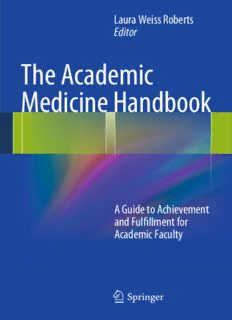
Table Of ContentLaura Weiss Roberts
Editor
The Academic
Medicine Handbook
A Guide to Achievement
and Fulfi llment for
Academic Faculty
123
The Academic Medicine Handbook
Laura Weiss Roberts
Editor
The Academic Medicine
Handbook
A Guide to Achievement and
Ful fi llment for Academic Faculty
Editor
Laura Weiss Roberts
Department of Psychiatry and Behavioral Sciences
Stanford University School of Medicine
Stanford , CA, USA
ISBN 978-1-4614-5692-6 ISBN 978-1-4614-5693-3 (eBook)
DOI 10.1007/978-1-4614-5693-3
Springer New York Heidelberg Dordrecht London
Library of Congress Control Number: 2012955677
© Springer Science+Business Media New York 2013
This work is subject to copyright. All rights are reserved by the Publisher, whether the whole or
part of the material is concerned, speci fi cally the rights of translation, reprinting, reuse of
illustrations, recitation, broadcasting, reproduction on micro fi lms or in any other physical way,
and transmission or information storage and retrieval, electronic adaptation, computer software,
or by similar or dissimilar methodology now known or hereafter developed. Exempted from this
legal reservation are brief excerpts in connection with reviews or scholarly analysis or material
supplied speci fi cally for the purpose of being entered and executed on a computer system, for
exclusive use by the purchaser of the work. Duplication of this publication or parts thereof is
permitted only under the provisions of the Copyright Law of the Publisher’s location, in its
current version, and permission for use must always be obtained from Springer. Permissions for
use may be obtained through RightsLink at the Copyright Clearance Center. Violations are liable
to prosecution under the respective Copyright Law.
The use of general descriptive names, registered names, trademarks, service marks, etc. in this
publication does not imply, even in the absence of a speci fi c statement, that such names are
exempt from the relevant protective laws and regulations and therefore free for general use.
While the advice and information in this book are believed to be true and accurate at the date of
publication, neither the authors nor the editors nor the publisher can accept any legal responsibility
for any errors or omissions that may be made. The publisher makes no warranty, express or
implied, with respect to the material contained herein.
Printed on acid-free paper
Springer is part of Springer Science+Business Media (www.springer.com)
For our sweet Tuli
Introductory Commentary
by Philip A. Pizzo, MD
While each of our life journeys is distinct and even unique, most of us who
chose a career in academic medicine share in common a deep personal
fulfi llment that comes from pursuing unchartered questions, making discov-
eries, educating students and trainees, learning constantly, and being able to
bring one’s individual and collective knowledge to improve the lives of oth-
ers, especially those suffering from illness or disease. I am not unique in
those goals and aspirations. However, as I re fl ect on the course of my own
career, I also recognize that during its various stages, including its ups and
downs, starts and restarts, it would have been impossible to predict the path
ultimately traveled. I didn’t plan most of what has transpired over the past
several decades. Looking backward, the seemingly distinct threads of my
own career, each a different journey, some of which I anticipated, but many
others of which were the result of unexpected forks in the road, now seem to
have woven together in a pattern that makes sense to me, at least in retrospect.
But that too is one of the great ful fi llments of a career in academic medi-
cine—one’s personal career portrait is really de fi ned by looking backward
rather than forward. This does not mean that one’s career is unplanned—but,
rather, that adventuring in the unknown can lead to the greatest ful fi llment—in
time, space, and personal growth.
The individual threads of one’s career are bound by common principles
that glue and connect them. At least for me, these have been the very deep
sense and resolve that one’s career is more of a “personal calling” than a job.
A career is something one relishes and is excited about—not just something
to fi ll time and space or to march in the path of proscribed expectations.
Linking the threads of one’s academic career is a sense of vision and
mission—often to tackle the big challenges that negatively affect the lives of
others or that threaten the integrity of institutions and individuals we value
and admire. To the contrary, it should not be about the gathering of titles or
super fi cial “metrics” of success—in academic medicine or beyond. In them-
selves, titles and positions are simply transition points to me, not stopping
places. When they become endpoints or goals in their own right, they can
blunt creativity and the sense of risk that makes science and medicine so
exciting. Although we all work at institutions and serve as its leaders, when
the need for a “position” and the trappings of power become goals in their
own right, the opportunities for bold leadership shrink exponentially. We
should aspire to positions of leadership because they are vehicles for bold
vii
viii Introductory Commentary by Philip A. Pizzo, MD
change, not because they bolster who we think we are—or should be. Success
comes from serving others and is re fl ected in the glow of spawned accom-
plishments, the light of which should be more transparent and dispersed,
rather than a search for a personal limelight.
If I were to narrate the beginning of my life journey, I might start with gradu-
ating from high school—now nearly 5 decades ago. In some ways with that
accomplishment I would have reached a pinnacle of success in the fi rst-generation
working-class family in which I was raised in the Bronx and Queens. I was the
fi rst to graduate high school and to go on to college. Some of the threads that had
begun earlier in my life began to interconnect at this phase. Without immediate
role models, my heroes were the discoverers, inventors— fi rst in physics and
science—about whom I read as a young child and adolescent. From Newton to
Pasteur, Fleming to Burnet—they were my guide through the Penguin “classics”
or the pages of S cienti fi c American . I am not sure now how I imagined them
other than with awe and vicarious admiration.
Although I was highly interested in science, my college years were more
marked by the works of Heidegger and existential philosophy—including the
social justice of Huxley and Pauling. In many ways I was coming of age dur-
ing the turbulent period now affectionately called “the 60s,” which has many
stereotypic portraits but one enduring value that has marked my own career—
and I am sure many of my generation. More speci fi cally, it was the sense that
one could “change the world,” that individuals could make a difference by
taking on big issues with big visions. That aspiration, with all of its youthful
naiveté, proved a galvanizing force and a lifelong guidepost.
The goal of becoming a doctor emerged from multiple beginnings: the hidden
and sometimes stated aspirations of parents hoping for a different life for their
children, the sense of pursuing a career path that seemed to have social value,
meaning, altruism, and professionalism (at least at that point), at a time in history
when social issues were dominant. There were no role models of academic medi-
cine in my personal orbit before I started medical school, other than the champi-
ons I had imagined or the stories told in Paul DeKruif’s “M icrobe Hunters .”
In fact, my original plan was rather circumscribed. Before going to medi-
cal school, I had envisioned a career that would likely mirror the family doc-
tor who had come to our house for interval illnesses when I was growing up.
That began to change dramatically when I entered medical school—as new
doors of inquiry opened and new possibilities seemed to abound. Yet, even
when I graduated medical school, my planned career pathway turned out to
be quite dramatically different than I had anticipated—even though the val-
ues, integrity, and sense of mission were still clearly manifested. My goal
when I left Rochester for Boston was to shape the future of pediatric health
care for the underserved. Although I had been quite involved in research at
the interface between stress and risk for infection during medical school,
social issues seemed more pressing—likely re fl ecting the in fl uence of incred-
ible leaders and mentors in my medical school but also the sense of social
inequity and racial injustice that was so apparent, especially as the 1970s
began in the wake of President Johnson’s “Great Society Program” and his
“War in Vietnam”—seemingly diametrically opposed forces that had a big
in fl uence on impressionable young people, including me.
Introductory Commentary by Philip A. Pizzo, MD ix
The threads that connected me to the research that has dominated the
largest part of my career occurred with my transition from Rochester to
Boston. It started immediately with a research project I conducted on the
sources and value of teaching and learning experiences during internship and
was soon accompanied by a study of “unexplained fever,” which I conducted
while a resident. It was a dramatically different time of expectations and
mores—of individuals and institutions. My “on-call schedule” in the hospital
was 132 hours/week—and during that time I used unscheduled night call
times to do research. In retrospect this seems pretty “pathological”—but at
the time it was exciting and ful fi lling. These intense days redirected my inter-
ests to two seemingly unlinked career paths—hematology-oncology and
infectious disease. At fi rst it was not clear how to choose between these dif-
ferent life journeys—but unexpected coincidences found a way to link them
and create other connections in the seemingly disparate threads of my then
nascent career.
It was an unexpected detour from Boston to Bethesda that occurred weeks
before I was about to begin my fellowship in hematology–oncology at the
Children’s Hospital and Dana Farber Cancer Institute that changed my life
and career journey. There was a need for a pediatrician to care for an 11-year-
old youngster who had developed aplastic anemia and who had been placed
in a special “protected environment” room in the Clinical Center at the NIH
that changed my life. I was literally “drafted” for this duty and found myself
immersed with the care of a young patient who would change my life person-
ally and professionally. While my time in Bethesda was supposed to be for
2 years, I wound up spending 23 years—the fi rst 7 of which were involved
with Ted, who grew from 11 to 18 years of age in a room the size of a modern
bathroom. Because of the nature of his illness and the uncertainties it posed,
my research moved quickly to efforts to understand bone marrow failure and
immunocompromised host defenses. Suddenly a link between infectious dis-
ease and hematology became apparent and extended to my decades’ long
work as a pediatric oncologist and infectious disease specialist.
In another unexpected turn of events, the links between my earlier work
and commitment to underserved communities intersected with a new disease
that emerged in the early 1980s and that arose at the intersection between
infectious disease and pediatric oncology—and earlier work that I had done in
virology. As HIV/AIDS became de fi ned and children became involved— fi rst
by transfusion, then coagulation factor replacement for hemophilia, and fi nally
by vertical transmission from mother to child—my research journey moved
quickly to de fi ne pathogenesis and treatment for this new and frightening dis-
ease. Indeed my previous work in childhood cancer and the use of clinical
trials and translational medicine had important rami fi cations for the early days
of pediatric AIDS research and again linked threads that seemed parallel rather
than interlocked. Soon these were coupled with advocacy positions for chil-
dren who were being excluded from school or who were unable to receive
experimental therapies—and which brought confrontations and struggles with
leaders in industry, the Food and Drug Administration, Congress, and the pub-
lic community. Science, social justice, medicine, advocacy, leadership—the
power of children and parents—all served as catalysts for unanticipated
changes in medicine, science, and my career development—at least looking
Description:Attaining professional success and finding personal happiness in academic medicine is not an easy path, yet both are critical if the future is to be brighter through better science, better clinical care, better training, better responsiveness to communities, and better stewardship and leadership in